
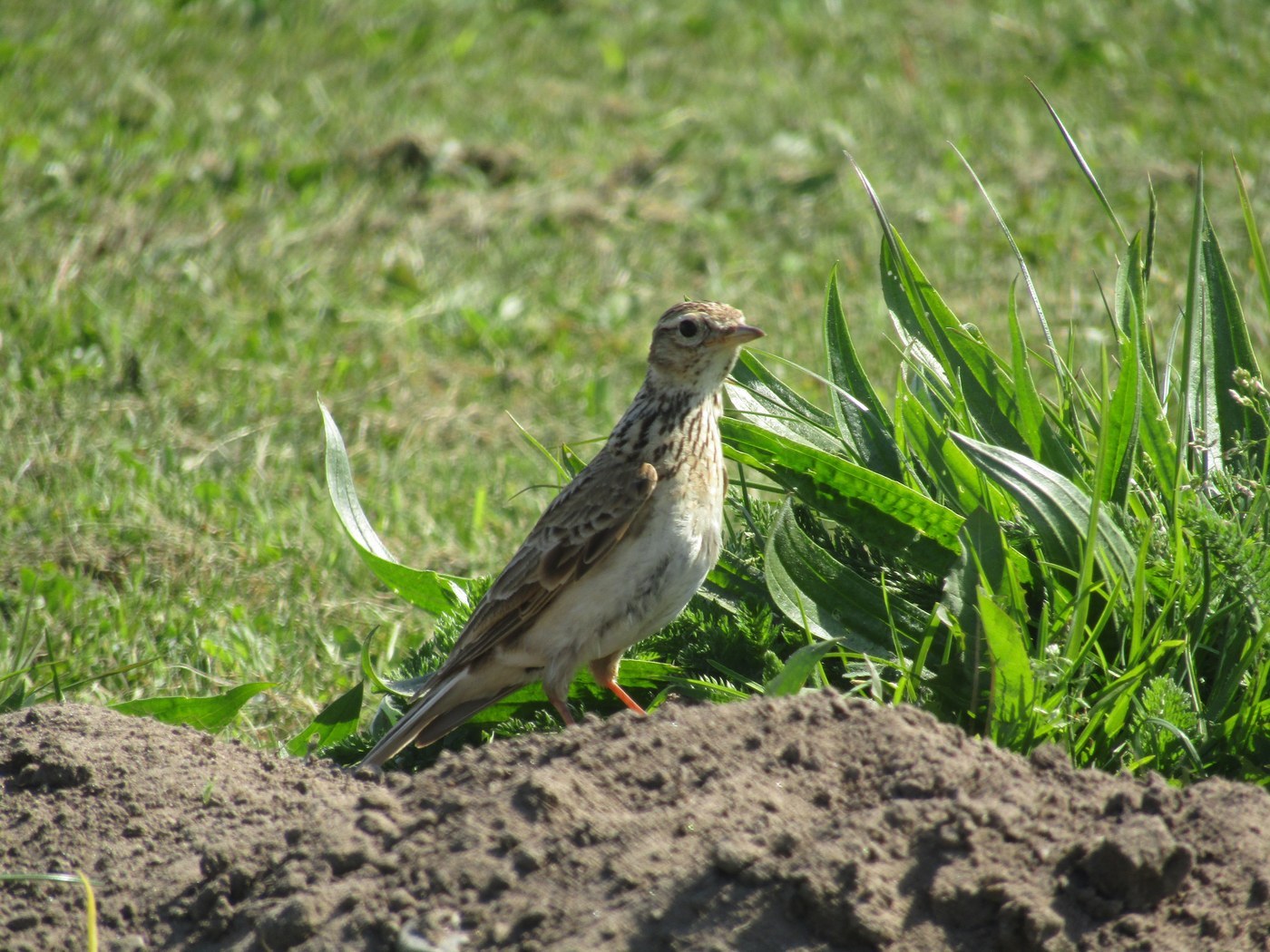
Eurasian Skylark
Alauda arvensis
A streaky brown ground bird famous for its prolonged, high-flying song delivered while hovering far overhead.
- Size
- 18-19 cm long; wingspan around 30-36 cm
- Habitat
- Open farmland, grassland, moorland, and coastal dunes
- Type
- songbird
Spotted a bird like this?
Identify any bird from a photo, free.
Overview
The Eurasian Skylark is a medium-sized lark of open country, renowned throughout literature and folklore for its extended, musical song delivered from high in the sky. Its plumage is streaky brown above and paler buff-white below, providing excellent camouflage against bare or sparsely vegetated ground.
The bird has a small, somewhat shaggy crest that it can raise when alert or excited, along with a moderately stout, conical bill suited to eating both seeds and insects. In flight, it shows a white trailing edge to the wings and white outer tail feathers.
Sexes look alike, and juveniles are similarly streaked but with more scaly-looking upperparts.
How to identify it
Key field marks
- Streaky brown upperparts, buffy-white streaked underparts
- Small, often raised crest on the crown
- White trailing edge on the wing, visible in flight
- White outer tail feathers
- Stocky build with a relatively short tail compared to pipits
Similar species
- Woodlark: smaller, shorter-tailed, with a more contrasting facial pattern (strong pale supercilium meeting over the nape) and a distinctive short, undulating song flight rather than a prolonged vertical hover.
- Crested Lark: has a taller, more pointed crest, warmer sandy-brown plumage, and lacks the white wing trailing edge.
- Pipits (e.g., Meadow Pipit): slimmer-billed and lack the crest, and have a different, more fluttery flight and call.
Habitat & range
Habitat
Eurasian Skylarks favor open, treeless habitats including arable farmland, hay meadows, grassland, heathland, moorland, and coastal dunes, needing low or sparse vegetation for nesting and foraging.
Range
The species breeds across most of Europe and temperate Asia, from Britain and Iberia eastward through Russia to Japan. It has also been introduced to parts of North America (Vancouver Island) and other regions.
Migration
Northern and eastern populations are migratory, moving south and west to winter in milder parts of Europe, North Africa, and southern Asia, while populations in more temperate western Europe are often resident or make only short movements.
Behavior & voice
Behavior
Skylarks spend most of their time on the ground, walking rather than hopping, and crouching low when disturbed rather than flushing immediately. Outside the breeding season they can gather in loose flocks in fields.
Voice
The song is the species' defining trait: a continuous, rapid stream of warbling, trilling notes delivered while the bird hovers and climbs, sometimes to great height, often sustained for several minutes at a time. The call is a liquid "chirrup" or "chirrrup" given in flight.
Feeding
Diet shifts seasonally, with more seeds and grain eaten in autumn and winter and more insects, larvae, and other invertebrates taken during the breeding season to feed growing chicks.
Nesting and breeding
The nest is a shallow cup built directly on the ground, hidden among grass or crops. Females typically lay 3-4 eggs and may raise two or three broods in a season, an adaptation that has historically made the species resilient despite heavy predation pressure.
Frequently asked questions
Why is the Skylark's song famous?
It sings a continuous, rapid, warbling song while hovering high in the sky, sometimes for several minutes without pause, a display that has inspired poets and composers for centuries.
How can you identify a Eurasian Skylark?
Look for a streaky brown, crested ground bird with white trailing edges on the wings and white outer tail feathers, most often seen or heard singing high overhead in open farmland.
What does a Skylark eat?
It eats seeds and grain for most of the year, switching to insects and other invertebrates during the breeding season to feed its chicks.
Where do Skylarks nest?
They nest on the ground in a shallow cup hidden among grass or low crops in open farmland and grassland.
Are Eurasian Skylark populations declining?
Yes, in many parts of western Europe skylark numbers have dropped significantly due to agricultural intensification, though the species overall remains widespread and is listed as Least Concern.
Eurasian Skylark guides
In-depth guides for identifying, finding, and understanding Eurasian Skylark.
Other birds you may enjoy

Black Redstart
13-14.5 cm (5.1-5.7 in) long, 23-26 cm wingspan

Black-throated Sparrow
12-14 cm (4.7-5.5 in) long, about 19-20 cm (7.5-8 in) wingspan

Greater Bird-of-paradise
Body about 43 cm; males with additional flank plumes up to 50 cm and long tail wires

Blue Tit
11-12 cm (4.3-4.7 in) long, 17-20 cm wingspan

Red-billed Quelea
11.5–13 cm long, wingspan about 20–22 cm
White-plumed Antbird
13-14 cm (5-5.5 in) long

Pyrrhuloxia
19-22 cm (7.5-8.7 in) long, 30 cm wingspan

Blue-gray Tanager
16-18 cm (6-7 in) long

Blackburnian Warbler
11-13 cm (4.3-5.1 in) long, 20-22 cm wingspan

Bluethroat
13-14 cm (5.1-5.5 in) long, 20-22 cm wingspan

Eurasian Nuthatch
12-14.5 cm (4.7-5.7 in) long, 22.5-27 cm wingspan

Wood Thrush
19-21 cm (7.5-8.3 in) long, about 33 cm (13 in) wingspan