
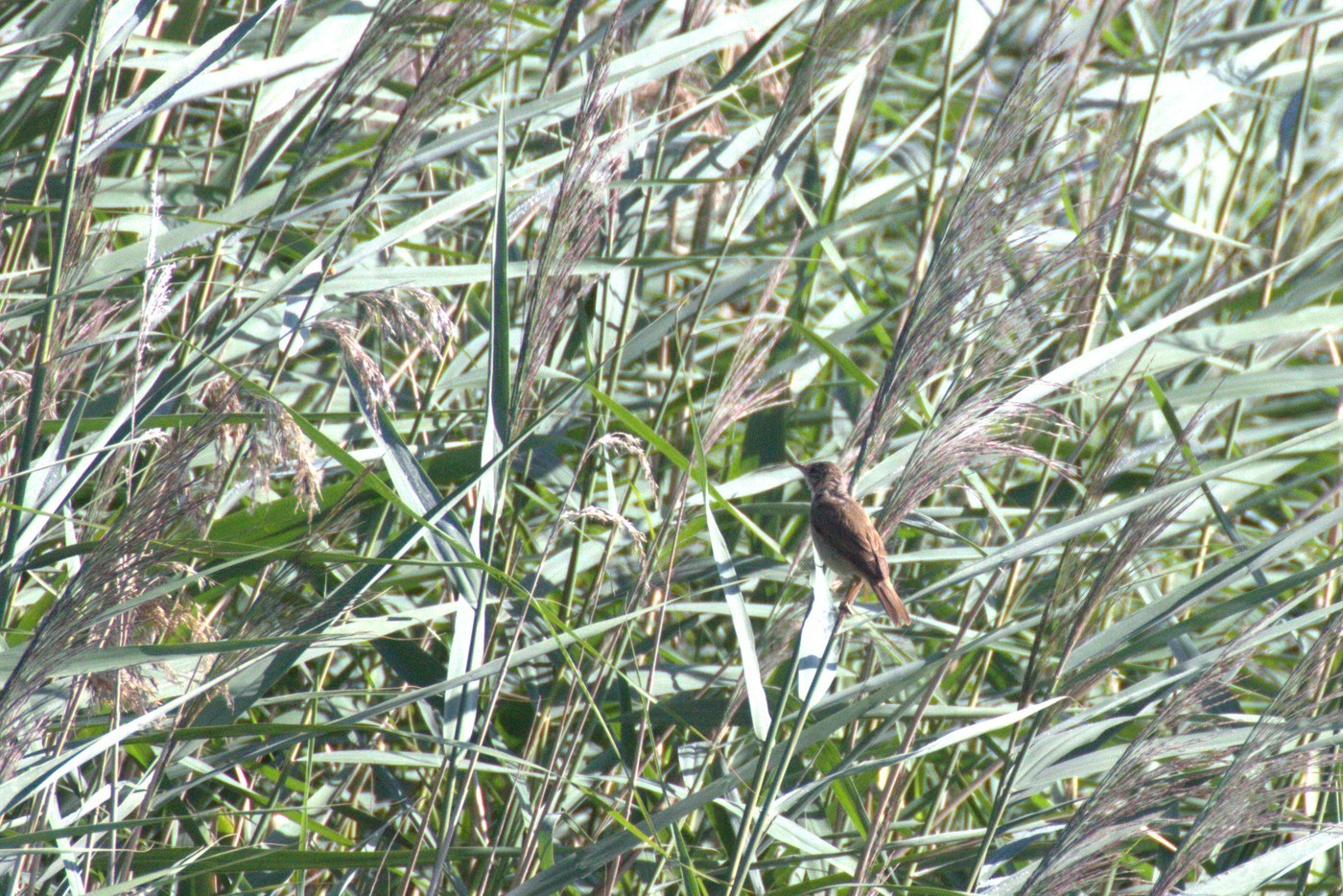
Eurasian Reed Warbler
Acrocephalus scirpaceus
A plain, unstreaked, warm brown warbler of dense reedbeds, best known for its steady, rhythmic, chattering song and as a frequent host of the Common Cuckoo.
- Size
- 12.5-14 cm (5-5.5 in) long, 17-21 cm wingspan
- Habitat
- reedbeds and tall reeds fringing lakes, rivers, and marshes
- Type
- songbird
Spotted a bird like this?
Identify any bird from a photo, free.
Overview
The Eurasian Reed Warbler is a slim, plain, warm brown warbler almost entirely lacking in bold markings, an adaptation that suits its life clambering through dense stands of reed. The upperparts are a uniform reddish-brown, the underparts pale buff, and the face shows only a faint, indistinct pale area around the eye rather than a true supercilium.
Its long, pointed bill and slightly rounded tail are adapted for gripping reed stems, and it moves with a distinctive clambering gait, using its feet and bill to grasp vertical stems as it forages.
The species is one of the most frequent hosts of the Common Cuckoo in much of Europe, with cuckoo chicks often raised in reed warbler nests at the expense of the host's own young.
How to identify it
Key field marks
- Plain, unstreaked, warm reddish-brown upperparts
- Pale buffy underparts with no streaking
- No obvious supercilium, only a faint pale area near the eye
- Long, pointed bill
- Rounded tail, often held slightly raised
Similar species
- Sedge Warbler: shows a bold, prominent pale supercilium and heavily streaked crown and back, unlike the plain Reed Warbler.
- Marsh Warbler: extremely similar in plumage, best separated by voice (more musical, mimicry-rich song) and slightly greener tone, olive rather than reddish-brown.
- Common Whitethroat: has a distinct white throat patch and chestnut wing panel, absent in Reed Warbler.
Habitat & range
Eurasian Reed Warblers breed across much of Europe and western Asia, almost entirely restricted to dense stands of common reed (Phragmites) fringing lakes, rivers, canals, and marshes, though they also use reed-fringed ditches and smaller wetland patches.
They are long-distance migrants, wintering in sub-Saharan Africa, and their close dependence on reedbed habitat makes them a useful indicator species for wetland health and reedbed management.
The species returns to breeding wetlands from April, with males establishing territories in the reed and singing to attract mates.
Behavior & voice
Voice
The song is a steady, rhythmic, chattering sequence of repeated churring phrases, often rendered as "jrr jrr jrr chirruc chirruc chirruc," continuing for long periods with relatively little variation compared to the Sedge Warbler's mimicry-rich song. The call is a low, guttural "churr."
Feeding
Reed Warblers glean insects and spiders from reed stems and leaves, clambering actively through dense reed growth and occasionally making short flights to catch flying insects.
Nesting and breeding
The nest is a deep, tightly woven cup suspended between several vertical reed stems, an adaptation that keeps eggs and chicks secure as the reeds sway in wind. Clutches typically contain three to five eggs. The species is a common host for the parasitic Common Cuckoo, which lays a single egg in the reed warbler's nest.
Frequently asked questions
How do you identify a Eurasian Reed Warbler?
Look for a plain, unstreaked, warm reddish-brown warbler with pale buff underparts, a long pointed bill, and no obvious eyebrow stripe, typically found clambering through dense reeds.
How is the Reed Warbler different from the Sedge Warbler?
Reed Warbler is plain and unstreaked with no eyebrow stripe, while Sedge Warbler has a heavily streaked back and a bold pale supercilium.
Why is the Reed Warbler linked to cuckoos?
It is one of the most common host species for the Common Cuckoo in Europe, frequently raising a cuckoo chick after the cuckoo lays an egg in its nest.
What does a Reed Warbler's song sound like?
It is a steady, rhythmic, chattering song made up of repeated churring phrases, less varied than the mimicry-filled song of the Sedge Warbler.
What habitat does the Reed Warbler require?
It is closely tied to dense stands of common reed fringing lakes, rivers, and marshes, rarely straying far from this specific wetland habitat.
Eurasian Reed Warbler guides
In-depth guides for identifying, finding, and understanding Eurasian Reed Warbler.
Other birds you may enjoy

Black Redstart
13-14.5 cm (5.1-5.7 in) long, 23-26 cm wingspan

Black-throated Sparrow
12-14 cm (4.7-5.5 in) long, about 19-20 cm (7.5-8 in) wingspan

Greater Bird-of-paradise
Body about 43 cm; males with additional flank plumes up to 50 cm and long tail wires

Blue Tit
11-12 cm (4.3-4.7 in) long, 17-20 cm wingspan

Red-billed Quelea
11.5–13 cm long, wingspan about 20–22 cm
White-plumed Antbird
13-14 cm (5-5.5 in) long

Pyrrhuloxia
19-22 cm (7.5-8.7 in) long, 30 cm wingspan

Blue-gray Tanager
16-18 cm (6-7 in) long

Blackburnian Warbler
11-13 cm (4.3-5.1 in) long, 20-22 cm wingspan

Bluethroat
13-14 cm (5.1-5.5 in) long, 20-22 cm wingspan

Eurasian Nuthatch
12-14.5 cm (4.7-5.7 in) long, 22.5-27 cm wingspan

Wood Thrush
19-21 cm (7.5-8.3 in) long, about 33 cm (13 in) wingspan