
Eurasian Reed Warbler Identification Guide
A plain, warm-brown, reed-bed specialist warbler best known for its churring, rhythmic song and its role as a favored Common Cuckoo host.
Read the full Eurasian Reed Warbler encyclopedia entry →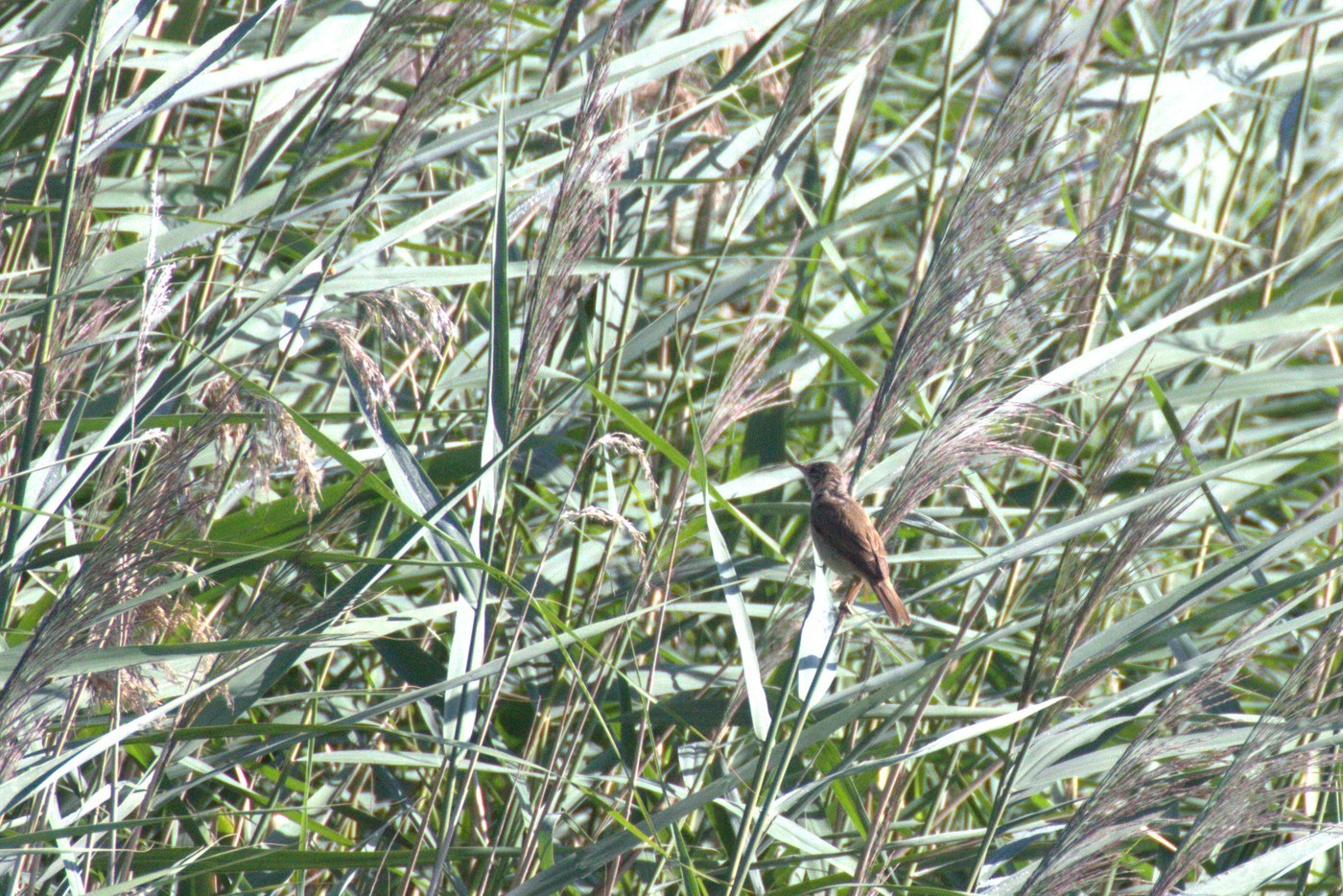
Key Field Marks
- Size & shape: A medium-small warbler about 12-13 cm long, with a slim, streamlined body, rounded tail, and a fairly long, slightly downcurved, pointed bill typical of Acrocephalus warblers.
- Plumage: Uniformly plain warm brown to olive-brown above with no streaking, and pale buffy-white underparts washed warmer buff on the flanks; lacks any strong facial pattern.
- Face: A faint, indistinct pale supercilium (eyebrow) that is short and does not extend far behind the eye, plus a subtle pale eye-ring — the face looks notably plain compared to many other warblers.
- Legs: Grayish to olive-brown, unremarkable.
- Structure: Longish, rounded tail often held slightly cocked or fanned; wings relatively short and rounded, giving a fluttering, low flight between reed stems.
- Behavior: Skulking and hard to see, clambering vertically among reed stems using strong feet; sings persistently, often from a hidden perch low in the reeds, occasionally climbing higher to sing in the open.
Separating It From Similar Species
- Marsh Warbler: Virtually identical in plumage but told by voice (Marsh Warbler is a rich mimic with varied, jumbled phrases vs. Reed Warbler's repetitive churring); Marsh Warbler also has slightly pinker legs and a shorter bill, but calls are the safest distinction.
- Sedge Warbler: Shows a bold, broad creamy supercilium and dark-streaked crown/back, unlike the plain-faced, unstreaked Reed Warbler.
- Blyth's Reed Warbler: Very similar but with a shorter bill, more rounded head, and different, harsher/more varied song with mimicry; a rare vagrant outside its normal range.
- Habitat cue: True Reed Warbler is almost always found within dense reed beds (Phragmites), while Sedge and Marsh Warblers more often use drier scrub, waterside vegetation, or nettle beds.
Where & When to See It
- Habitat: Dense reed beds (Phragmites) bordering lakes, rivers, canals, and marshes; strongly tied to reeds for both nesting (woven cup nests attached to reed stems) and foraging.
- Range: Breeds across most of Europe (except the far north) east through temperate Asia to Central Asia; a long-distance migrant wintering in sub-Saharan Africa.
- Season: Summer visitor, typically arriving in reed beds from mid-April through May and departing by September; a classic host species for the Common Cuckoo across much of its European range.
Voice & Song Cues
- Song is a persistent, rhythmic, churring chatter built from repeated two- or three-note phrases — often rendered as "chirruc-chirruc-jag-jag-jag" — delivered in a steady, almost mechanical rhythm without the wild mimicry of Marsh Warbler.
- Occasionally incorporates a few mimicked phrases, but far less varied and fluent than Marsh Warbler's song.
- Call is a short, dry "churr" or soft "tuc" given from cover, useful for locating a skulking bird before it's seen.
Frequently asked questions
How do I tell a Eurasian Reed Warbler from a Marsh Warbler?
Plumage is nearly identical, so song is the most reliable clue: Reed Warbler repeats simple churring two- or three-note phrases rhythmically, while Marsh Warbler sings a rich, fast, highly varied song full of mimicry of other species.
Where should I look for Eurasian Reed Warblers?
Search dense reed beds (Phragmites) around lakes, rivers, and marshes — this species is a reed-bed specialist and is rarely found away from reeds during the breeding season.
Why is the Eurasian Reed Warbler linked to the Common Cuckoo?
It is one of the Common Cuckoo's most frequent host species in Europe; cuckoos often lay eggs mimicking Reed Warbler egg patterns in reed-bed nests.
What does a Eurasian Reed Warbler look like?
A plain warm-brown warbler with unstreaked upperparts, buffy underparts, a faint short supercilium, and a slim, slightly downcurved bill — overall a rather nondescript-looking bird best identified by habitat and voice.
When do Eurasian Reed Warblers arrive in Europe?
They are summer migrants, typically arriving in reed beds from mid-April into May and departing for sub-Saharan Africa by September.