
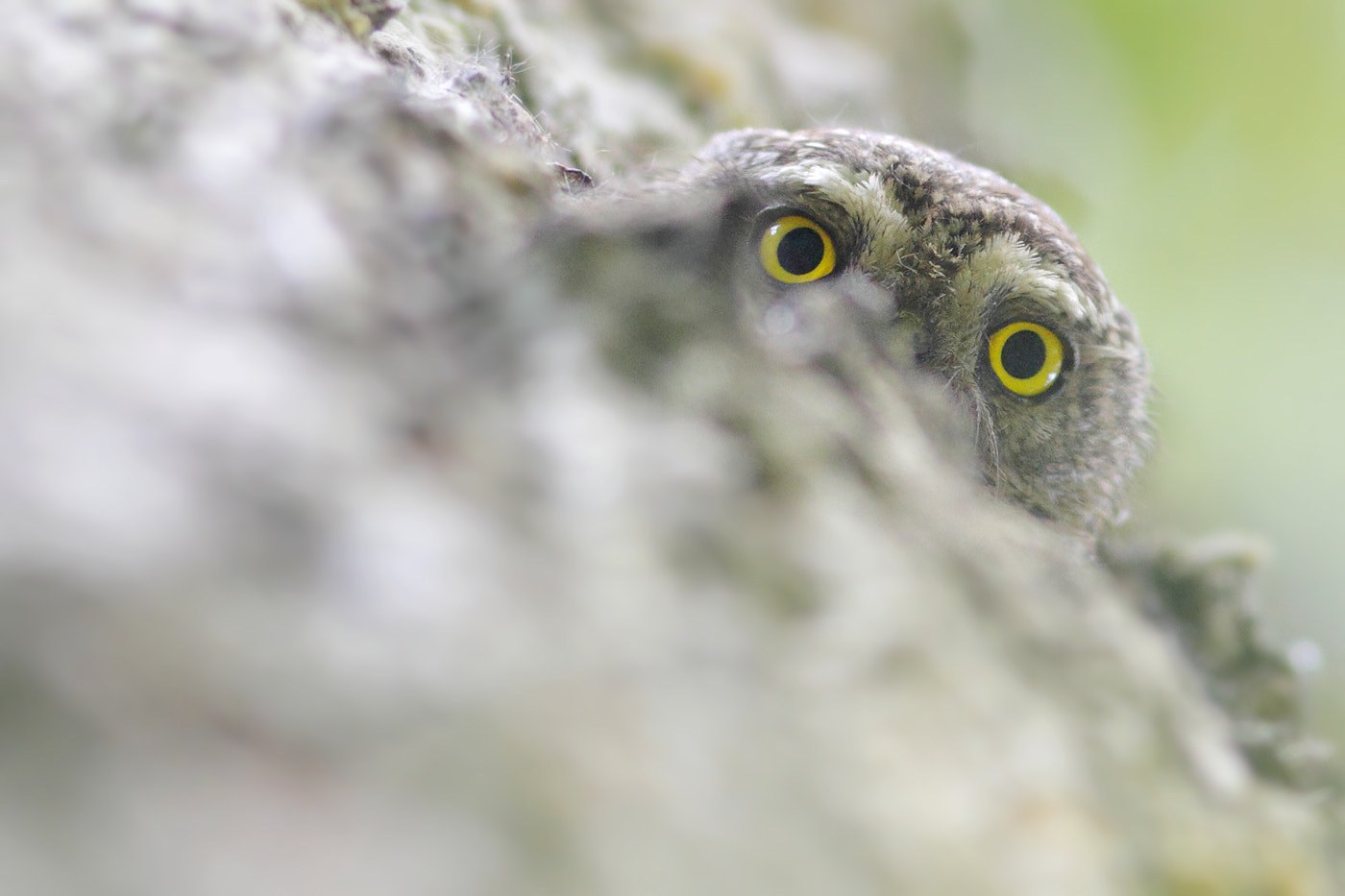
Eurasian Pygmy Owl
Glaucidium passerinum
Europe's smallest owl, a sparrow-sized predator of northern coniferous forest that hunts by day as often as by night.
- Size
- 15-19 cm (6-7.5 in) long, 32-39 cm wingspan
- Habitat
- dense coniferous and boreal forest, especially old spruce and pine stands
- Type
- owl
Spotted a bird like this?
Identify any bird from a photo, free.
Overview
The Eurasian Pygmy Owl is a tiny, compact owl, barely larger than a sparrow, with a rounded head lacking ear tufts, pale yellow eyes, and grey-brown plumage finely spotted with white. Despite its diminutive size, it is a bold and effective predator, sometimes tackling birds nearly its own size.
It inhabits dense boreal and montane coniferous forest across northern and central Europe, where its small size and quiet habits make it easy to overlook despite being active for parts of the day.
How to identify it
Key field marks
- Very small size, close to sparrow-sized
- Rounded head with no ear tufts
- Pale yellow eyes
- Fine white spotting on greyish-brown upperparts
- Often perches with tail cocked upward, unlike most owls
Similar species
- Little Owl is larger, more heavily spotted, and favors open farmland rather than dense conifer forest.
- Tengmalm's Owl (Boreal Owl) is noticeably larger with a squarer facial disc.
Its tiny size and preference for dense conifer forest, combined with a habit of cocking its tail, help distinguish it from other small owls.
Habitat & range
Habitat
Strongly tied to mature coniferous and boreal forest, particularly spruce and pine woodland with old trees offering woodpecker holes for nesting.
Range
Found across Scandinavia, the Alps, and other mountain ranges of central Europe, extending through the boreal forest belt of Russia to Siberia.
Migration
Mostly resident, though some individuals, particularly juveniles, may wander or shift altitude outside the breeding season.
Behavior & voice
Behavior
Unusually for an owl, the Eurasian Pygmy Owl is active at dawn, dusk, and even during the day, hunting from perches within dense cover. It often cocks and flicks its tail, a habit shared by few other owls.
Voice
The male's territorial call is a soft, evenly spaced series of piping whistles, often given in short bursts and audible over some distance in quiet forest.
Feeding
Hunts small mammals like voles and shrews as well as small birds, which it may cache in tree holes for later use.
Nesting and breeding
Nests in old woodpecker holes, particularly those of Great Spotted Woodpecker, laying 4-6 eggs in spring, incubated by the female for around four weeks.
Frequently asked questions
Is the Eurasian Pygmy Owl the smallest owl in Europe?
Yes, it is the smallest owl species found in Europe, barely bigger than a sparrow.
Is the Eurasian Pygmy Owl active during the day?
It is unusually diurnal for an owl, often hunting at dawn, dusk, and even in daylight.
What habitat does the Eurasian Pygmy Owl prefer?
Dense, mature coniferous and boreal forest, especially old spruce and pine stands.
Where does the Eurasian Pygmy Owl nest?
In old woodpecker holes, especially those excavated by Great Spotted Woodpeckers.
What does the Eurasian Pygmy Owl hunt?
Small mammals such as voles, and small birds, sometimes prey nearly its own size.
Eurasian Pygmy Owl guides
In-depth guides for identifying, finding, and understanding Eurasian Pygmy Owl.
Other birds you may enjoy
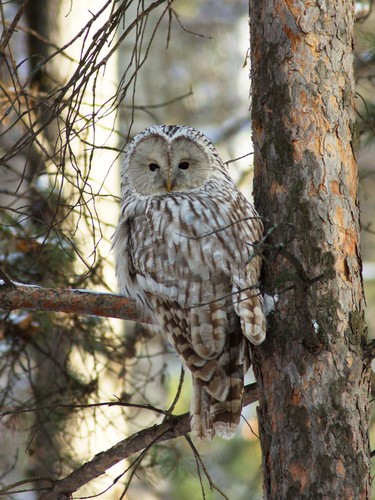
Ural Owl
50-62 cm long, wingspan about 1.0-1.3 m
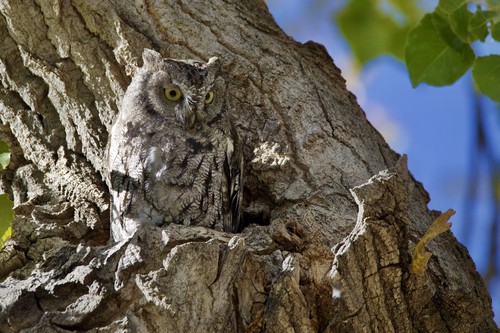
Western Screech-Owl
19-25 cm (7.5-10 in) long, about 55 cm (21.5 in) wingspan
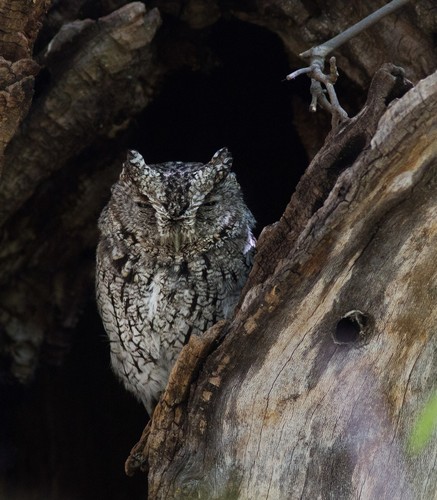
Whiskered Screech-Owl
17-19 cm (6.7-7.5 in) long, 43 cm wingspan
Tawny Owl
37-43 cm (15-17 in) long, 81-96 cm wingspan
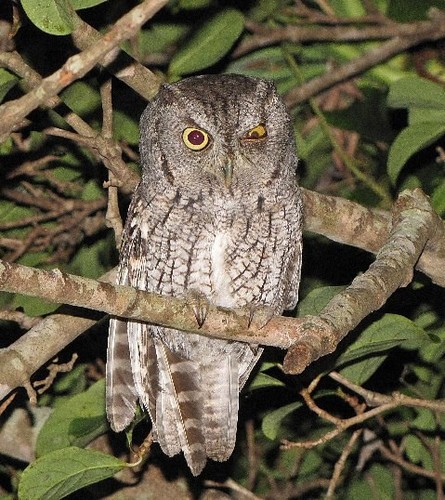
Screech Owl
16-25 cm long, wingspan about 46-61 cm
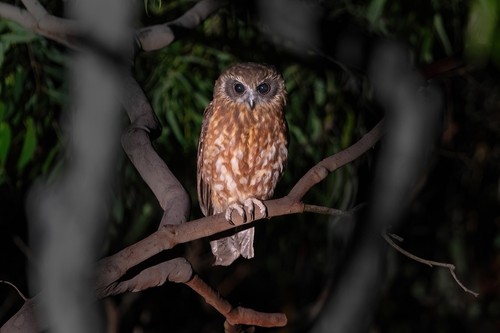
Southern Boobook
27-36 cm (11-14 in) long
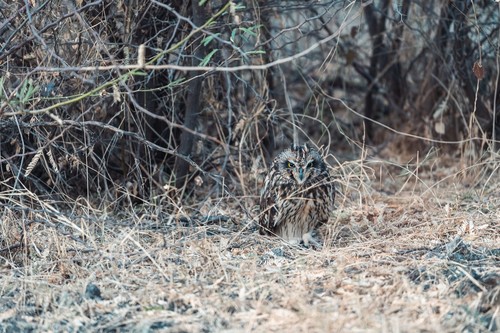
Short-eared Owl
34-42 cm (13-17 in) long, 85-110 cm wingspan
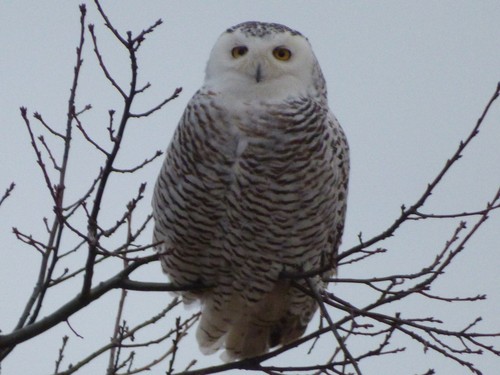
Snowy Owl
52-71 cm (20-28 in) long, 125-150 cm (49-59 in) wingspan
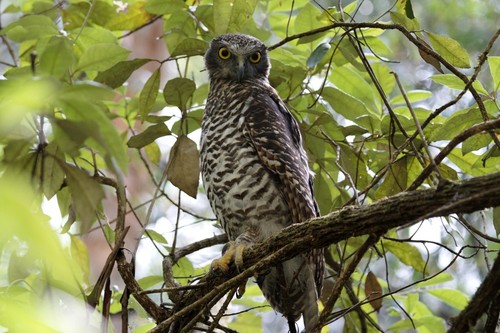
Powerful Owl
60-65 cm (24-26 in) long, 112-135 cm (44-53 in) wingspan
Northern Saw-whet Owl
18-21 cm (7-8.5 in) long, 42-56 cm (17-22 in) wingspan
Northern Pygmy-Owl
16-18 cm (6.3-7.1 in) long, 35-39 cm wingspan
Spotted Owl
43-48 cm (17-19 in) long, 100-114 cm wingspan