
Eurasian Pygmy Owl Identification Guide
Europe's smallest owl, a sparrow-sized predator of boreal and montane conifer forests, best located by its evenly spaced tooting call.
Read the full Eurasian Pygmy Owl encyclopedia entry →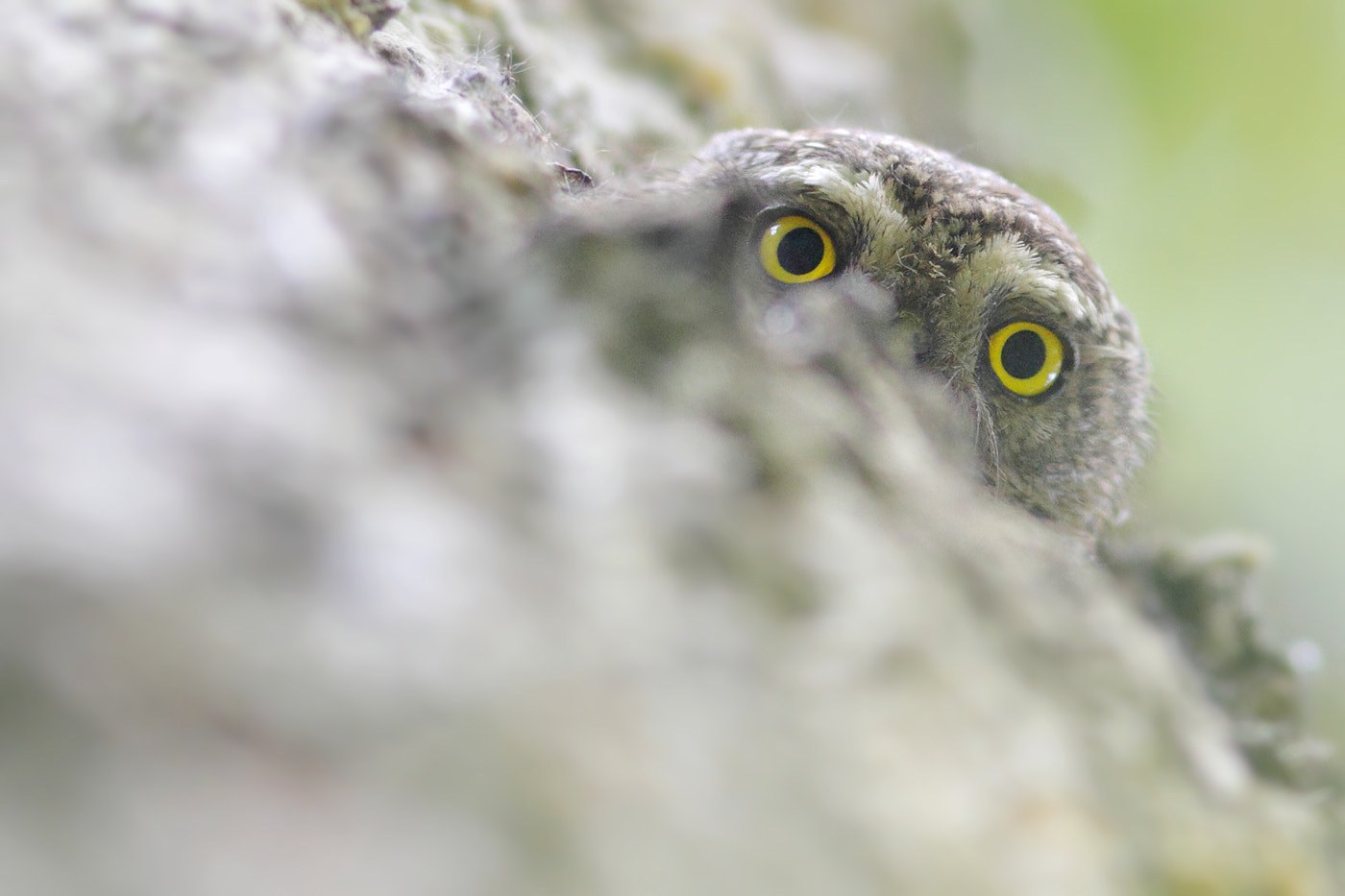
Key Field Marks
- Size & shape: Tiny — about 15-19 cm long, roughly sparrow to starling sized, making it the smallest owl in Europe. Compact and rounded with a relatively long tail often held cocked up, and a proportionally small, rounded head lacking ear tufts.
- Plumage: Grayish-brown to rufous-brown above with fine white spotting on the crown and pale streaking below on a whitish background; the underparts show buffy-brown streaks rather than bars.
- Facial disc: Poorly developed compared to most owls, giving a more hawk-like, small-headed look; pale eyebrows and a subtle facial pattern rather than a distinct disc.
- Eyes: Yellow, relatively small for an owl, adding to the fierce, hawk-like impression.
- Nape pattern: Shows a pair of pale, dark-bordered spots on the back of the head resembling false eyes — a feature shared with several small owls.
- Behavior: Highly diurnal and crepuscular for an owl, often hunting in daylight from an exposed perch atop a conifer; flicks and cocks its long tail frequently, and flies with fast, direct woodpecker-like wingbeats.
Separating It From Similar Species
- Eurasian Scops Owl: Larger, with obvious ear tufts and cryptic bark-like camouflage plumage; scops owl is strictly nocturnal and rarely seen perched in the open by day.
- Little Owl: Similar size range but stockier, flatter-headed, with a more horizontal stance, spotted crown, and yellow eyes set in a flatter face; little owl favors open farmland rather than dense conifer forest.
- Tengmalm's (Boreal) Owl: Noticeably larger, with a distinct square facial disc and dark-rimmed "surprised" expression, and is strictly nocturnal, unlike the day-active pygmy owl.
- Silhouette: The long, frequently cocked tail and small rounded head with weak facial disc are the quickest way to rule out other small owls at a glance.
Where & When to See It
- Habitat: Mature boreal and montane coniferous forest (spruce, pine, fir), especially with old woodpecker holes for nesting; in the Alps and other mountain ranges found up to the treeline.
- Range: Resident across the taiga belt of Scandinavia and Russia, the Alps, Carpathians, and other central European mountain forests; largely sedentary with only local, short-distance winter movements.
- Season: Present year-round; most vocal and easiest to detect in late winter and early spring (roughly February-April) during the breeding display period, calling at dawn and dusk.
Voice & Song Cues
- The song is a series of clear, evenly spaced, whistled "poo...poo...poo" notes on a single pitch, delivered at a steady, unhurried rhythm — quite unlike the irregular tooting of Little Owl.
- Also gives a faster, rising-then-falling trill during excitement or alarm.
- Because it is so small and easily overlooked in dense conifers, voice is often the most reliable way to detect its presence; listen especially at first light in coniferous forest during late winter.
Frequently asked questions
How small is the Eurasian Pygmy Owl compared to other owls?
It is Europe's smallest owl, only about 15-19 cm long — roughly the size of a large sparrow or starling.
Is the Eurasian Pygmy Owl active at night or during the day?
Unlike most owls, it is notably diurnal and crepuscular, frequently hunting from exposed perches in daylight, especially at dawn and dusk.
What is the best way to detect a Eurasian Pygmy Owl?
Listen for its song: a series of clear, evenly spaced, single-pitch whistled 'poo' notes, most often given at dawn in coniferous forest during late winter and early spring.
How do you tell Eurasian Pygmy Owl from Little Owl?
Pygmy Owl is smaller, longer-tailed (often cocked), rounder-headed with a weaker facial disc, and lives in dense conifer forest, while Little Owl is stockier, flat-headed, and prefers open farmland.
Does the Eurasian Pygmy Owl have ear tufts?
No, it lacks ear tufts entirely, which helps separate it from the similarly small but tufted Eurasian Scops Owl.