
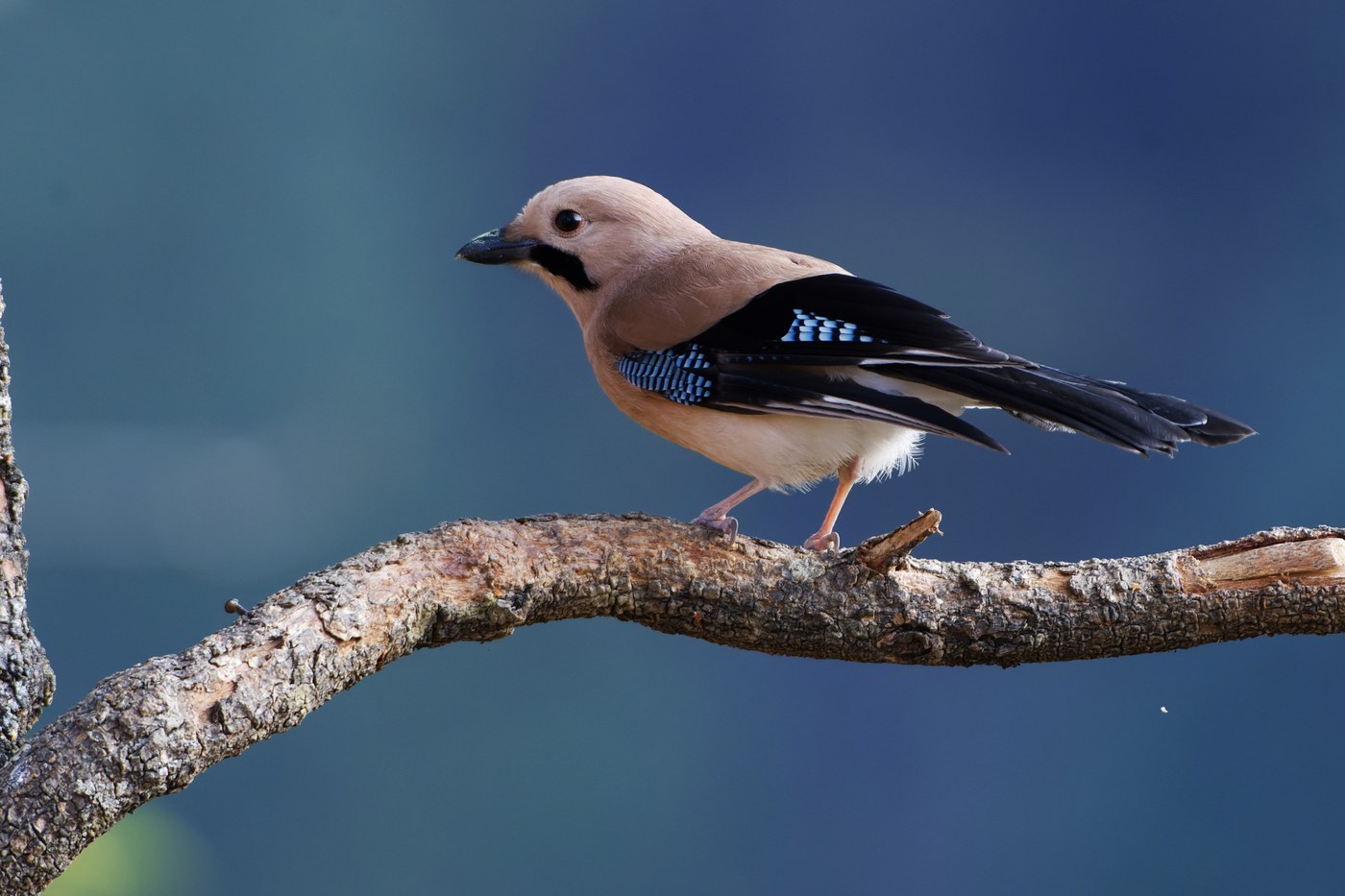
Eurasian Jay
Garrulus glandarius
A colorful, secretive woodland corvid famous for its striking blue wing patch and habit of hoarding acorns.
- Size
- 32-35 cm long; wingspan around 52-58 cm
- Habitat
- Deciduous and mixed woodland, forest edges, and parks with mature trees, especially oaks
- Type
- songbird
Spotted a bird like this?
Identify any bird from a photo, free.
Overview
The Eurasian Jay is a medium-sized, strikingly colored member of the crow family that inhabits wooded landscapes across much of Europe and Asia. Its plumage is a warm pinkish-brown overall, offset by a black moustachial stripe, a whitish throat, and a black tail contrasting with a bright white rump patch visible in flight.
The most eye-catching feature is a small patch on the upperwing coverts showing vivid barred blue, black, and white plumage, a pattern unique among European birds and frequently used historically for decoration in the form of shed or found feathers. The crown feathers form a streaked crest that can be raised when the bird is agitated or alert.
Sexes look alike. Subspecies vary somewhat in overall color tone and head pattern across the wide range of the species.
How to identify it
Key field marks
- Pinkish-brown body plumage with a black moustachial stripe
- Striking barred blue, black, and white patch on the upperwing
- Black tail with a conspicuous white rump, obvious in flight
- Streaked, somewhat shaggy crown crest
- Often detected first by its harsh alarm call before being seen
Similar species
- No other bird within its range shares the same combination of pinkish-brown body and blue-barred wing patch, making the Eurasian Jay distinctive once observed, although its shy, retiring habits often mean it is heard rather than seen.
- In flight, the white rump and rounded wings distinguish it from other corvids like the Eurasian Magpie or crows, which lack the blue wing patch and pink body tone.
Habitat & range
Habitat
Eurasian Jays favor deciduous and mixed woodland, particularly areas with oak trees, as well as forest edges, hedgerows, and well-wooded parks and gardens.
Range
The species ranges very widely across Europe, North Africa, and temperate Asia, from Britain and Scandinavia eastward through Russia, the Middle East, the Himalayas, to China, Korea, and Japan.
Migration
Most populations are resident, though some northern and eastern birds show irruptive movements in years of poor acorn or seed crops, dispersing further than usual in search of food.
Behavior & voice
Behavior
Eurasian Jays are typically shy and wary compared to other corvids, often staying within cover of trees and flying off with a distinctive floppy, rowing wingbeat when disturbed. They are highly vocal and often first detected by call.
Voice
The most familiar call is a harsh, screeching "skaaak" alarm call, but Jays are also accomplished mimics, capable of imitating the calls of birds of prey such as Common Buzzards as well as other sounds, including man-made noises.
Feeding
Acorns form a major part of the diet, especially in autumn, when Jays cache thousands of acorns individually in the ground for later retrieval, a behavior that makes them important agents of oak tree dispersal and forest regeneration. They also eat other seeds, nuts, insects, small vertebrates, and the eggs and young of smaller birds.
Nesting and breeding
Nests are built in trees or large shrubs from twigs, typically well concealed within foliage. Females usually lay 3-6 eggs, and pairs are generally monogamous and territorial during the breeding season.
Frequently asked questions
How do you identify a Eurasian Jay?
Look for a pinkish-brown bird with a black moustache stripe, a black tail with a white rump, and a distinctive barred blue, black, and white patch on the wing.
Why do Jays bury acorns?
Eurasian Jays cache large numbers of acorns in the ground each autumn as a food store for winter, and the acorns they fail to retrieve often grow into new oak trees, making Jays important for forest regeneration.
What does a Eurasian Jay sound like?
It gives a harsh, screeching alarm call and is also a skilled mimic, able to imitate birds of prey and other sounds.
Where do Eurasian Jays live?
They live in deciduous and mixed woodland, especially oak woods, across most of Europe, North Africa, and temperate Asia.
Are Eurasian Jays related to Magpies?
Yes, both are members of the crow family (Corvidae), though Jays are smaller, more colorful, and generally shyer and more woodland-associated than Magpies.
Eurasian Jay guides
In-depth guides for identifying, finding, and understanding Eurasian Jay.
Other birds you may enjoy

Black Redstart
13-14.5 cm (5.1-5.7 in) long, 23-26 cm wingspan

Black-throated Sparrow
12-14 cm (4.7-5.5 in) long, about 19-20 cm (7.5-8 in) wingspan

Greater Bird-of-paradise
Body about 43 cm; males with additional flank plumes up to 50 cm and long tail wires

Blue Tit
11-12 cm (4.3-4.7 in) long, 17-20 cm wingspan

Red-billed Quelea
11.5–13 cm long, wingspan about 20–22 cm
White-plumed Antbird
13-14 cm (5-5.5 in) long

Pyrrhuloxia
19-22 cm (7.5-8.7 in) long, 30 cm wingspan

Blue-gray Tanager
16-18 cm (6-7 in) long

Blackburnian Warbler
11-13 cm (4.3-5.1 in) long, 20-22 cm wingspan

Bluethroat
13-14 cm (5.1-5.5 in) long, 20-22 cm wingspan

Eurasian Nuthatch
12-14.5 cm (4.7-5.7 in) long, 22.5-27 cm wingspan

Wood Thrush
19-21 cm (7.5-8.3 in) long, about 33 cm (13 in) wingspan