
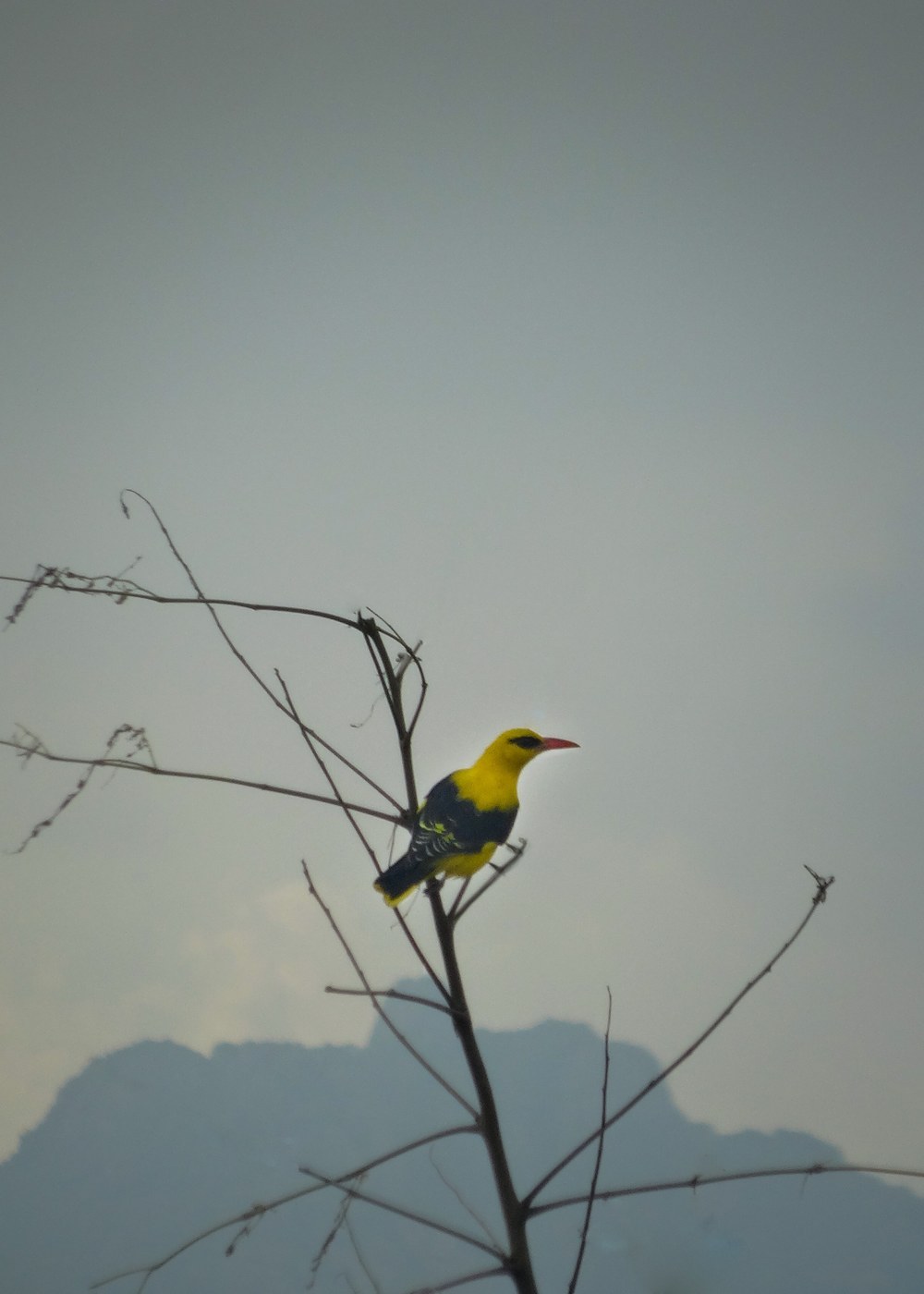
Eurasian Golden Oriole
Oriolus oriolus
A brilliant golden-yellow songbird with black wings, surprisingly hard to spot despite its vivid color thanks to its shy, canopy-dwelling habits.
- Size
- 22-25 cm (9-10 in) long, 44-47 cm wingspan
- Habitat
- broadleaf woodland, riverine forest, orchards, and parkland
- Type
- songbird
Spotted a bird like this?
Identify any bird from a photo, free.
Overview
The Eurasian Golden Oriole is one of Europe's most vividly colored songbirds, yet it is far more often heard than seen. Males are a stunning golden yellow with contrasting jet-black wings and a black stripe through the eye, while females and juveniles are duller, olive-green above and streaky whitish-yellow below, providing better camouflage among leaves.
Despite its brilliant plumage, the oriole is a shy, canopy-loving bird that spends most of its time hidden among dense foliage, revealing its presence chiefly through its fluty, far-carrying song.
How to identify it
Key field marks
- Male: vivid golden-yellow body, black wings, black eye-stripe, pinkish-red bill
- Female/juvenile: olive-green above, pale and streaked below, less contrasting than the male
- Stocky, thrush-like shape with a relatively short tail
- Fast, slightly undulating flight, often glimpsed briefly crossing a gap in the canopy
Similar species
Adult males are unmistakable if seen well; no other European songbird combines gold and black in this way. Females can be mistaken for a green woodpecker in flight at a distance, but the oriole's shape and undulating flight differ.
Habitat & range
Range
Breeds across most of Europe (though scarce and declining in the northwest) and western/central Asia; winters in sub-Saharan Africa.
Habitat
Prefers mature broadleaf woodland, especially with tall poplars, oaks, or willows, riverine forest, orchards, and large parks with tall trees.
Migration
A long-distance migrant, arriving on breeding grounds in late spring and departing for African wintering areas by late summer.
Behavior & voice
Behavior
Spends most of its time high in the canopy, moving between trees in fast, direct flights and remaining well hidden among foliage despite its bright color.
Voice
The song is a rich, fluty, far-carrying "weela-wee-oo" phrase, often likened to a mellow whistle; it also gives a harsh, cat-like alarm call.
Feeding
Feeds on insects, especially caterpillars (including hairy species avoided by many other birds), as well as fruit and berries later in the season.
Nesting and breeding
Builds a distinctive hammock-like nest slung between a forked branch high in a tree, woven from grass, bark strips, and plant fibers. Lays 3-4 eggs, incubated mainly by the female.
Frequently asked questions
Why is the Golden Oriole so hard to see despite its bright color?
It spends most of its time high in dense tree canopy and is generally shy, so despite its vivid plumage it is often detected by song rather than sight.
What does the Golden Oriole sound like?
Its song is a rich, fluty, far-carrying whistle often rendered as "weela-wee-oo," along with a harsh, cat-like alarm call.
How do male and female Golden Orioles differ?
Males are vivid golden-yellow with black wings, while females and juveniles are duller olive-green above with streaky pale underparts.
Where does the Eurasian Golden Oriole spend the winter?
It migrates to sub-Saharan Africa for the winter, returning to Europe and western Asia to breed.
Eurasian Golden Oriole guides
In-depth guides for identifying, finding, and understanding Eurasian Golden Oriole.
Other birds you may enjoy

Black Redstart
13-14.5 cm (5.1-5.7 in) long, 23-26 cm wingspan

Black-throated Sparrow
12-14 cm (4.7-5.5 in) long, about 19-20 cm (7.5-8 in) wingspan

Greater Bird-of-paradise
Body about 43 cm; males with additional flank plumes up to 50 cm and long tail wires

Blue Tit
11-12 cm (4.3-4.7 in) long, 17-20 cm wingspan

Red-billed Quelea
11.5–13 cm long, wingspan about 20–22 cm
White-plumed Antbird
13-14 cm (5-5.5 in) long

Pyrrhuloxia
19-22 cm (7.5-8.7 in) long, 30 cm wingspan

Blue-gray Tanager
16-18 cm (6-7 in) long

Blackburnian Warbler
11-13 cm (4.3-5.1 in) long, 20-22 cm wingspan

Bluethroat
13-14 cm (5.1-5.5 in) long, 20-22 cm wingspan

Eurasian Nuthatch
12-14.5 cm (4.7-5.7 in) long, 22.5-27 cm wingspan

Wood Thrush
19-21 cm (7.5-8.3 in) long, about 33 cm (13 in) wingspan