
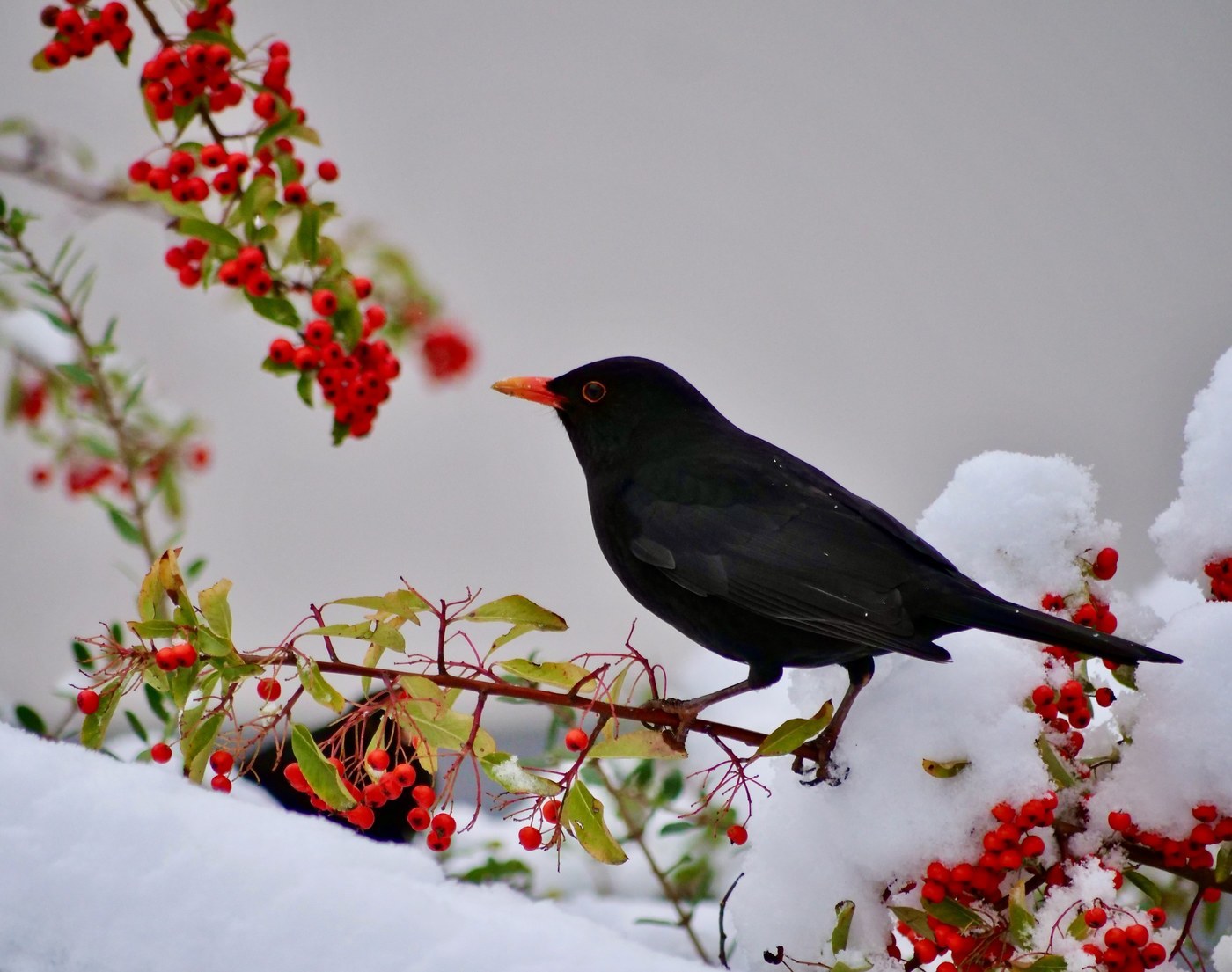
Eurasian Blackbird
Turdus merula
A common European thrush; the male is glossy black with a bright orange-yellow bill and eye-ring, while the female is dusky brown.
- Size
- 23.5-29 cm (9-11.5 in) long, 34-38.5 cm wingspan
- Habitat
- woodlands, hedgerows, parks, and gardens
- Type
- songbird
Spotted a bird like this?
Identify any bird from a photo, free.
Overview
The Eurasian Blackbird is a familiar thrush found throughout gardens, parks, and woodlands across its range. The male is entirely glossy black with a striking orange-yellow bill and matching eye-ring, while the female and juveniles are dark brown, sometimes with faint mottling on the breast, and a duller, brownish bill. Its melodious, fluting song is considered one of the finest of any European songbird.
Often seen hopping across lawns, pausing to cock its head while listening and watching for earthworms, the Blackbird is a familiar and much-loved garden companion across much of its range.
How to identify it
Key field marks
- Male: all-black plumage, bright orange-yellow bill and eye-ring
- Female/juvenile: dark brown overall, sometimes faintly mottled below, duller bill
- Medium-sized thrush shape, longish tail often held cocked
Similar species
- Common Starling is smaller and stockier with a shorter tail and glossy, speckled plumage.
- Female Blackbirds can resemble other brown thrushes but lack the spotted breast pattern of species like the Song Thrush.
- Ring Ouzel, a scarcer relative, shows a white breast crescent absent in the Blackbird.
Habitat & range
Habitat
Inhabits woodlands, hedgerows, farmland, parks, and gardens, thriving especially in areas with lawns or open ground for foraging alongside cover for nesting.
Range
Widespread across Europe, North Africa, and western Asia; introduced populations exist in Australia and New Zealand.
Migration
Partially migratory; northern and eastern populations move south in winter, while many western European birds are resident year-round.
Behavior & voice
Behavior
Forages mainly on the ground, running and hopping across lawns and leaf litter while listening and watching for movement, then pulling earthworms from the soil.
Voice
A rich, melodious, fluting song delivered from a high perch, often at dawn and dusk; alarm call is a loud, chattering "chook-chook-chook" or shrill "seee."
Feeding
Eats earthworms, insects, and other invertebrates, along with berries and fruit, especially in autumn and winter.
Nesting
Builds a sturdy cup nest of grass, twigs, and mud in a shrub, hedge, or tree; lays 3-5 pale blue-green eggs with reddish-brown speckling, often raising multiple broods per season.
Frequently asked questions
How do you tell a male from a female Eurasian Blackbird?
Males are entirely glossy black with a bright orange-yellow bill and eye-ring, while females are dark brown with a duller bill and sometimes faint mottling on the breast.
Is the Eurasian Blackbird related to the American Blackbird?
No, despite the shared name, the Eurasian Blackbird is a true thrush (genus Turdus), unrelated to New World blackbirds, which belong to a different family.
What does a Blackbird's song sound like?
A rich, slow, fluting melody, often considered one of the most beautiful songs among European birds, typically delivered from a high perch at dawn and dusk.
What do Blackbirds eat?
Mainly earthworms and insects pulled from lawns and soil, along with berries and fruit, especially in autumn and winter.
Eurasian Blackbird guides
In-depth guides for identifying, finding, and understanding Eurasian Blackbird.
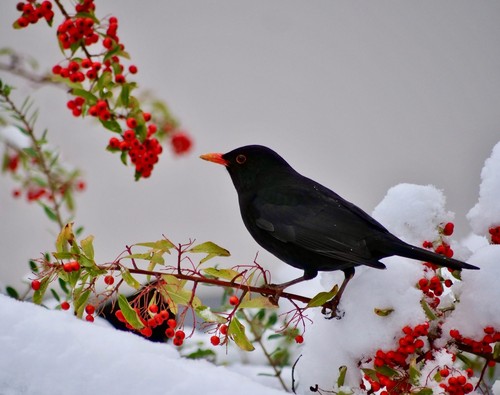
Eurasian Blackbird identified by the community
Real birds identified with Bird Identifier.
Other birds you may enjoy

Black Redstart
13-14.5 cm (5.1-5.7 in) long, 23-26 cm wingspan

Black-throated Sparrow
12-14 cm (4.7-5.5 in) long, about 19-20 cm (7.5-8 in) wingspan

Greater Bird-of-paradise
Body about 43 cm; males with additional flank plumes up to 50 cm and long tail wires

Blue Tit
11-12 cm (4.3-4.7 in) long, 17-20 cm wingspan

Red-billed Quelea
11.5–13 cm long, wingspan about 20–22 cm
White-plumed Antbird
13-14 cm (5-5.5 in) long

Pyrrhuloxia
19-22 cm (7.5-8.7 in) long, 30 cm wingspan

Blue-gray Tanager
16-18 cm (6-7 in) long

Blackburnian Warbler
11-13 cm (4.3-5.1 in) long, 20-22 cm wingspan

Bluethroat
13-14 cm (5.1-5.5 in) long, 20-22 cm wingspan

Eurasian Nuthatch
12-14.5 cm (4.7-5.7 in) long, 22.5-27 cm wingspan

Wood Thrush
19-21 cm (7.5-8.3 in) long, about 33 cm (13 in) wingspan