Eurasian Blackbird Identification Guide
A common and familiar thrush across Europe, Asia, and North Africa, with glossy all-black males sporting a bright yellow-orange bill and eye-ring, while females are a more nondescript dark brown.
Read the full Eurasian Blackbird encyclopedia entry →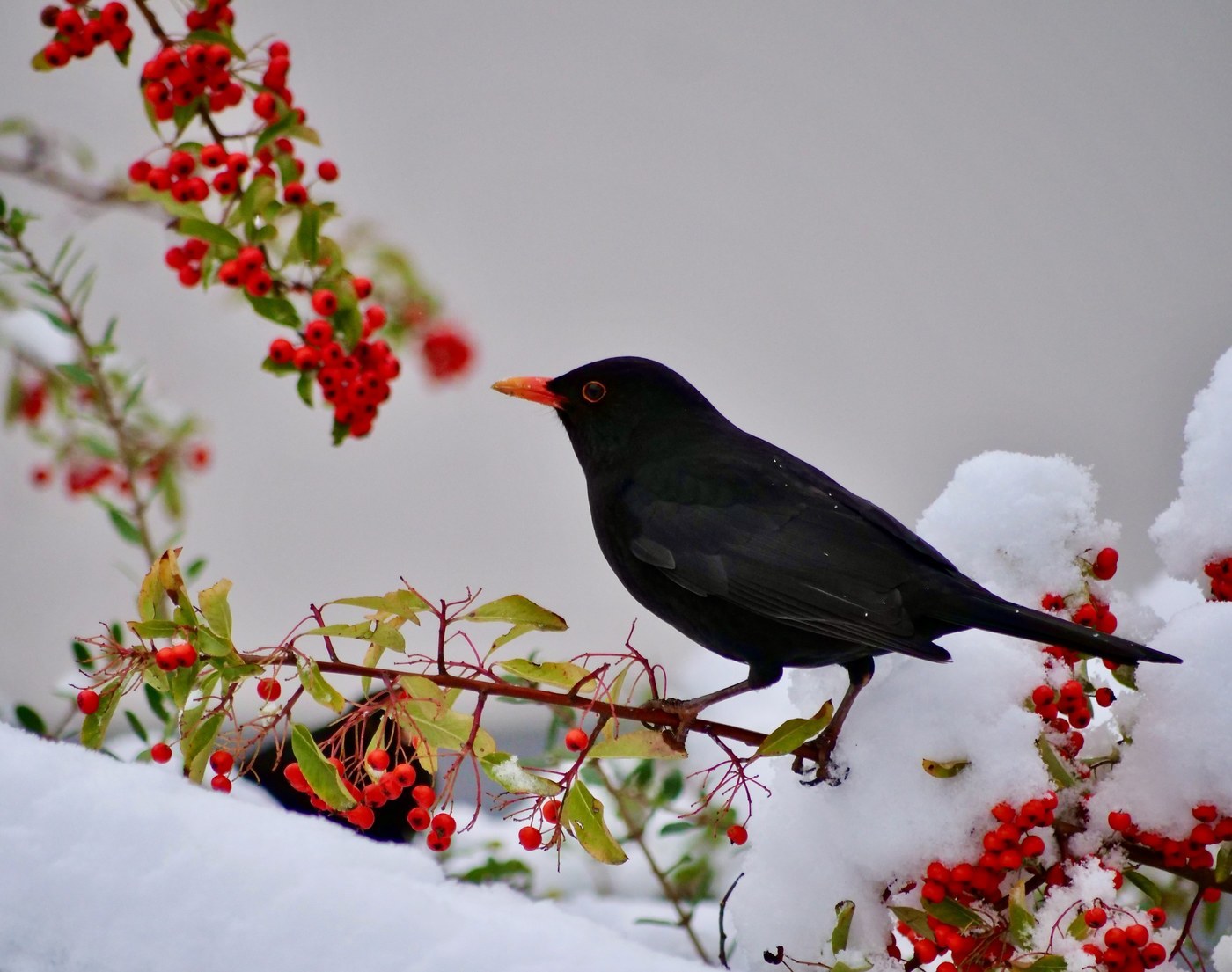
Overview
The Eurasian Blackbird (Turdus merula), often simply called "Blackbird" in Britain and Europe, is a widespread and familiar member of the thrush family found across Europe, western Asia, and North Africa, and introduced to Australia and New Zealand. It is one of the most commonly encountered garden and woodland birds throughout its range.
Key Field Marks
-
Size and shape: A medium-sized thrush, about 24-25 cm (9.5-10 in) long, with a fairly long tail often held slightly cocked or drooped, and an upright, alert posture, especially when foraging on open ground.
-
Male plumage: Glossy, uniform jet-black plumage year-round, set off by a bright yellow-orange bill and a narrow yellow eye-ring — a striking and easily recognized combination.
-
Female plumage: Dark sooty-brown overall, sometimes with faint mottling on the breast, and a duller brownish or dusky-yellow bill, considerably less conspicuous than the male and easily confused with other brown thrushes at a glance.
-
Juveniles: Rufous-brown with pale spotting, resembling other young thrushes before molting into adult-type plumage.
-
Behavior: Frequently seen foraging on lawns and open ground with a distinctive run-stop-cock-head posture, and flicks its tail and wings while giving alarm calls.
Separating Eurasian Blackbird from Similar Species
Male Eurasian Blackbirds are essentially unmistakable due to the combination of solid black plumage with a bright orange-yellow bill — no similar all-black garden bird in its range shares this bill color. Females can be confused with female Ring Ouzel (which shows a pale crescent across the breast and paler fringing on the wing) or with Song Thrush and other Turdus species, but lack the bold spotting of Song Thrush and are overall more uniformly dark brown. Common Starling is superficially blackish but is smaller, shorter-tailed, and glossy with a more triangular silhouette and different gait (a fast waddling walk versus the blackbird's run-and-stop).
Where and When to See One
Eurasian Blackbirds are common and widespread residents across most of Europe, parts of North Africa, and western/central Asia, occupying gardens, parks, woodland edge, farmland hedgerows, and scrub — one of the most familiar birds of European towns and gardens. Northern and eastern populations are partial migrants, moving south and west in winter, while birds in milder western and southern Europe are largely resident and can be seen year-round. Introduced populations are established and resident in Australia and New Zealand.
Behavior
Blackbirds forage mainly on the ground, running a few steps, pausing to look and listen, then flicking leaf litter aside or probing for earthworms and invertebrates; they also eat berries and fruit, especially in autumn and winter. They are highly territorial, especially males in the breeding season, and are often one of the first birds to start the dawn chorus and one of the last to stop singing in the evening.
Voice
The song is a rich, relaxed, fluty, and melodious series of warbling phrases, often considered one of the most beautiful songs among common garden birds, typically delivered from an elevated perch at dawn and dusk. The alarm call is a loud, harsh, chattering "chook-chook-chook," often given repeatedly and with increasing agitation when a predator (such as a cat) is nearby.
Quick Reference
- Males: glossy all-black with bright orange-yellow bill and eye-ring
- Females: dark sooty brown, duller bill, more nondescript
- Common resident of gardens, parks, and woodland edge across Europe/W. Asia/N. Africa
- Rich, fluty song at dawn/dusk; loud chattering alarm call
Frequently asked questions
How can you tell a male from a female Eurasian Blackbird?
Males are glossy solid black with a bright orange-yellow bill and eye-ring, while females are dark brown overall with a duller, less colorful bill and sometimes faint breast mottling.
Is the Eurasian Blackbird related to the New World blackbirds like grackles?
No, despite the shared common name, the Eurasian Blackbird is a true thrush (family Turdidae, genus Turdus), closely related to American Robin, while New World blackbirds belong to the unrelated family Icteridae.
What does a Eurasian Blackbird's song sound like?
It gives a rich, mellow, fluty series of warbling phrases, often cited as one of the most musical songs of common European garden birds, typically sung from a high perch at dawn and dusk.
Where do Eurasian Blackbirds typically forage?
Mostly on open ground such as lawns and leaf litter, where they run, pause, and probe or flick aside debris to find earthworms and invertebrates, supplementing their diet with berries and fruit.
Eurasian Blackbird identified by the community
Recent Eurasian Blackbird sightings identified with Bird Identifier.