
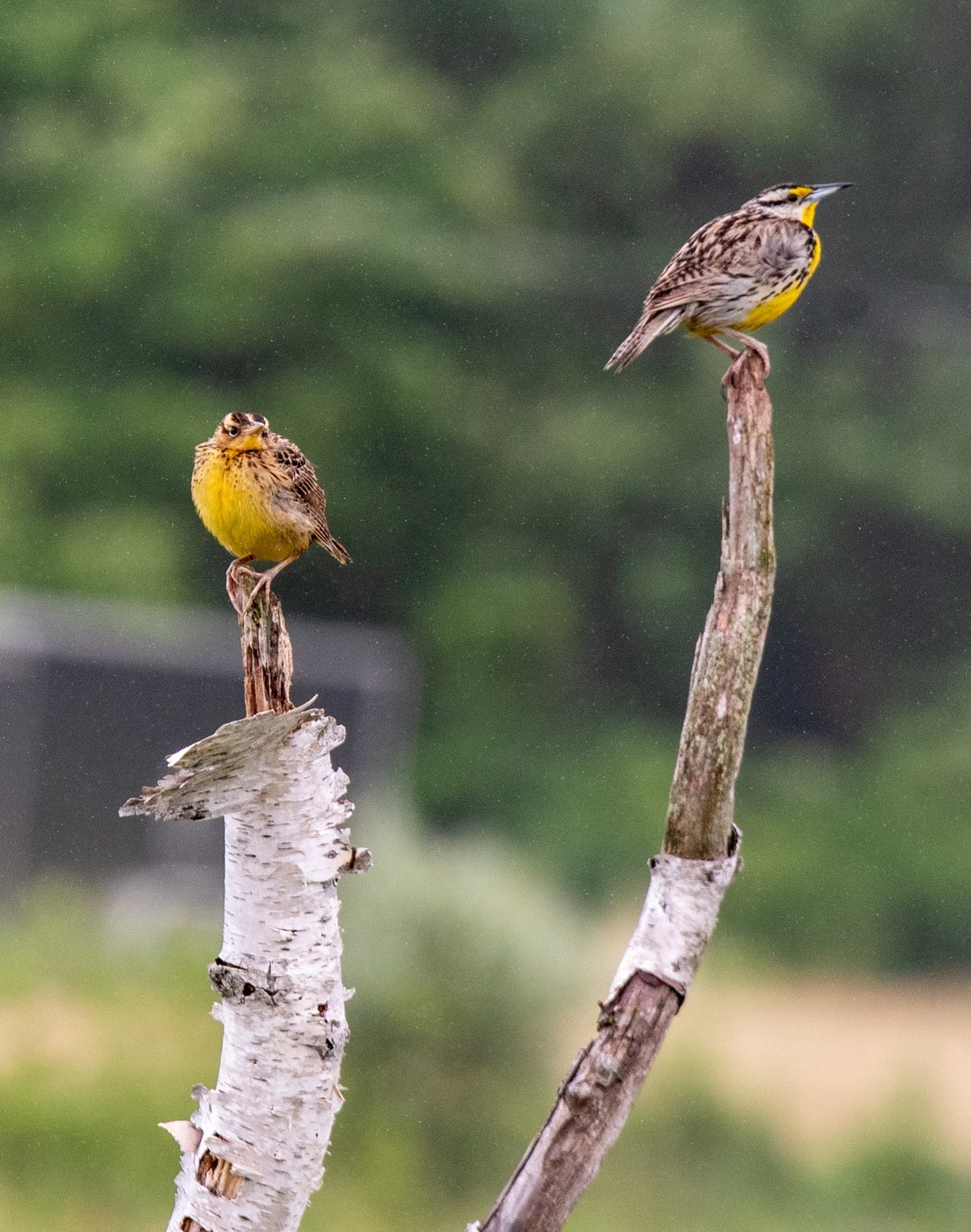
Eastern Meadowlark
Sturnella magna
A grassland songbird with a bright yellow breast crossed by a bold black V and a rich, flute-like whistled song.
- Size
- 19-26 cm (7.5-10.2 in) long, 35-40 cm wingspan
- Habitat
- grasslands, pastures, hayfields, and prairies
- Type
- songbird
Spotted a bird like this?
Identify any bird from a photo, free.
Overview
The Eastern Meadowlark is a chunky, ground-dwelling songbird of open grasslands, easily recognized by its bright lemon-yellow underparts marked with a bold black V across the chest. Despite the name and superficial resemblance to European starlings in shape, meadowlarks are actually members of the blackbird family (Icteridae), not true larks. The upperparts are cryptically patterned in brown, black, and buff, providing excellent camouflage in grass, while the head shows bold black-and-white stripes.
Eastern Meadowlarks are best known for their clear, whistled song, often described as sounding like "spring-of-the-year" and delivered from fence posts or utility wires across open farmland and prairie.
How to identify it
Key Field Marks
- Bright yellow throat and breast with a bold black V-shaped bib
- Streaked, mottled brown-and-black upperparts for camouflage in grass
- Short tail with white outer tail feathers, flashed conspicuously in flight
- Stout, straight bill and flat-headed profile
- Distinctive stiff-winged, fluttering flight low over fields
Similar Species
- Western Meadowlark is nearly identical in plumage but has a more yellow malar (cheek) area extending onto the face and a very different, more flute-like, gurgling song; ranges overlap in the Great Plains where identification by voice is most reliable.
- Range and habitat generally separate the two species, with Eastern favoring wetter, more easterly grasslands.
Habitat & range
Habitat
Eastern Meadowlarks require open grassland habitats such as native prairie, hayfields, pastures, and airport grasslands, avoiding areas with dense shrubs or trees.
Range
Found across the eastern and central United States, extending into southeastern Canada, Mexico, and parts of Central and South America (as disjunct subspecies).
Migration
Northern populations are migratory, moving south for the winter, while populations in the southern and central United States are largely resident year-round.
Behavior & voice
Behavior
Eastern Meadowlarks walk and forage on the ground, often flicking their tail to flash white outer feathers. In flight they alternate several rapid, stiff wingbeats with short glides, a distinctive flight style shared with Western Meadowlark.
Voice
The song is a clear, slurred, flute-like whistle, often rendered as "spring-of-the-year" or "see-you, see-yeeer." Calls include a harsh, buzzy chatter and a distinctive dzert flight note.
Feeding
Forages mainly on the ground, probing soil and grass for insects such as grasshoppers, crickets, and caterpillars, and supplementing its diet with seeds and waste grain, especially in winter.
Nesting & Breeding
Females build a domed, grass-woven nest on the ground, often with a woven entrance tunnel, well hidden in dense grass. She incubates 3-5 eggs alone, and pairs may be monogamous or males may mate with more than one female.
Frequently asked questions
Is the Eastern Meadowlark actually a lark?
No, despite its name it is a member of the blackbird family (Icteridae), not a true lark; the name reflects a superficial resemblance to Old World larks.
How do you tell an Eastern Meadowlark from a Western Meadowlark?
The two species look nearly identical, but their songs differ markedly: Eastern gives a clear, slurred whistle, while Western gives a more complex, gurgling, flute-like song; range and subtle facial pattern differences can also help.
Why are Eastern Meadowlark populations declining?
Loss and fragmentation of native grassland and hayfield habitat, along with earlier and more frequent hay mowing that destroys ground nests, have driven significant population declines.
What does an Eastern Meadowlark eat?
It primarily eats insects like grasshoppers and crickets during the breeding season, switching to seeds and waste grain in colder months.
Where do Eastern Meadowlarks nest?
They build a well-hidden, domed nest of woven grass directly on the ground within dense grassland or hayfield vegetation.
Eastern Meadowlark guides
In-depth guides for identifying, finding, and understanding Eastern Meadowlark.
Other birds you may enjoy

Black Redstart
13-14.5 cm (5.1-5.7 in) long, 23-26 cm wingspan

Black-throated Sparrow
12-14 cm (4.7-5.5 in) long, about 19-20 cm (7.5-8 in) wingspan

Greater Bird-of-paradise
Body about 43 cm; males with additional flank plumes up to 50 cm and long tail wires

Blue Tit
11-12 cm (4.3-4.7 in) long, 17-20 cm wingspan

Red-billed Quelea
11.5–13 cm long, wingspan about 20–22 cm
White-plumed Antbird
13-14 cm (5-5.5 in) long

Pyrrhuloxia
19-22 cm (7.5-8.7 in) long, 30 cm wingspan

Blue-gray Tanager
16-18 cm (6-7 in) long

Blackburnian Warbler
11-13 cm (4.3-5.1 in) long, 20-22 cm wingspan

Bluethroat
13-14 cm (5.1-5.5 in) long, 20-22 cm wingspan

Eurasian Nuthatch
12-14.5 cm (4.7-5.7 in) long, 22.5-27 cm wingspan

Wood Thrush
19-21 cm (7.5-8.3 in) long, about 33 cm (13 in) wingspan