
Eastern Meadowlark Identification Guide
A stocky grassland songbird with a bright yellow breast crossed by a bold black V, streaky brown camouflaged upperparts, and a habit of flushing low over fields on stiff, fluttery wingbeats.
Read the full Eastern Meadowlark encyclopedia entry →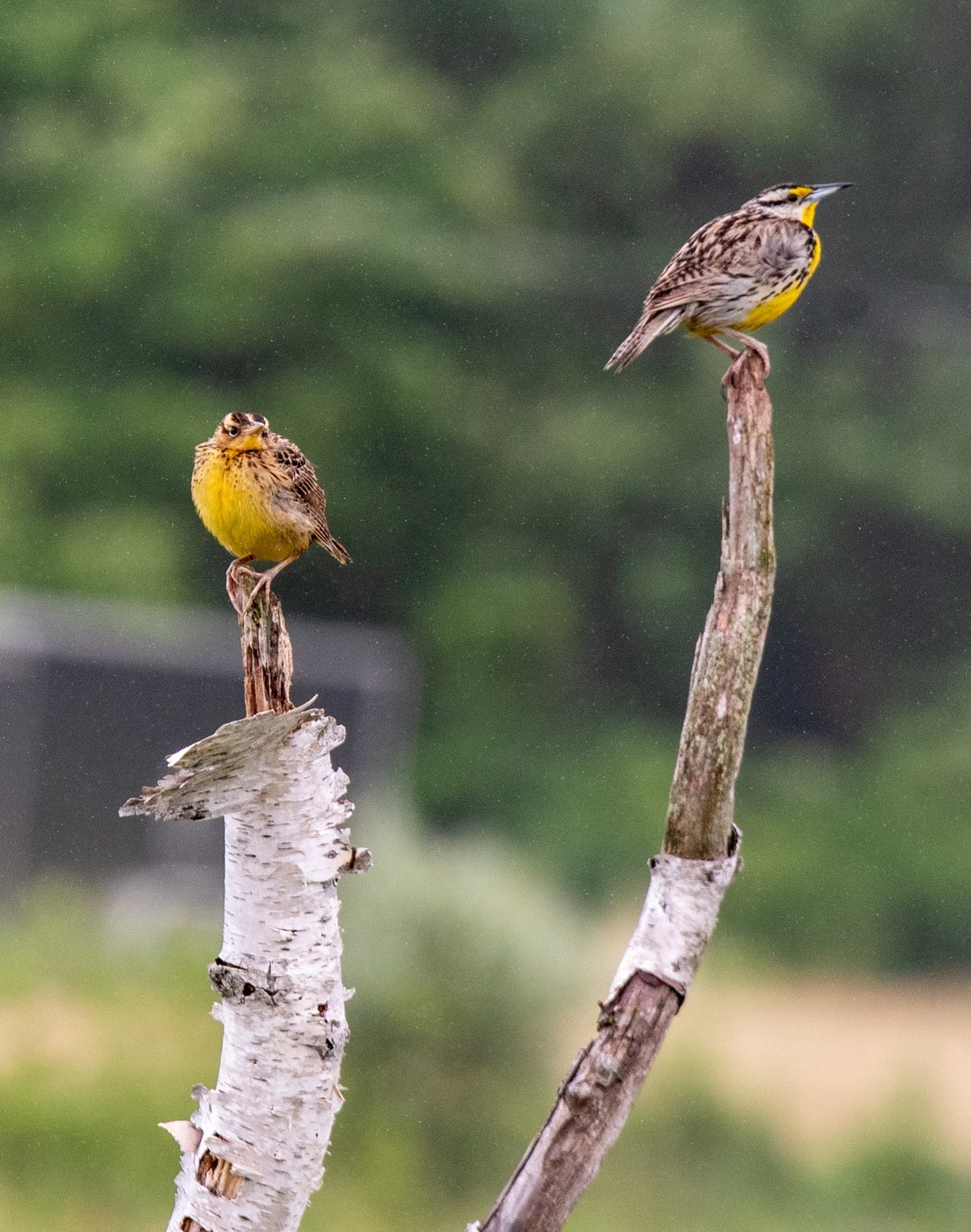
Key Field Marks
- Size & shape: A robin-sized but shorter-tailed, chunky grassland bird (8.5-9 in / 21-23 cm) with a flat head, long, spike-like bill, and a short tail that flares to reveal white outer feathers in flight.
- Underparts: Bright lemon-yellow breast and belly crossed by a bold black "V" or necklace across the upper chest.
- Upperparts: Intricately patterned brown, black, and buff streaking that provides excellent camouflage in grass — birds can be nearly invisible standing still in a field.
- Face: Black-and-white striped crown with a pale central stripe; yellow extending onto the malar/cheek area (a key difference from Western Meadowlark, which shows more white on the cheek).
- Flight: Distinctive stiff-winged, fluttering flight low over fields interspersed with short glides, flashing white outer tail feathers.
Separating from Similar Species
- Western Meadowlark: Nearly identical in plumage; best separated by voice (Eastern's flutey whistle vs. Western's bubbly, complex song) and subtle plumage — Western shows more white on the malar/cheek where yellow extends further up on Eastern. Range overlaps broadly in the central U.S., where hybridization and lookalikes make voice essential for certainty.
- Dickcissel: Much smaller, with a stubbier bill and lacking the meadowlark's bold black chest V and camouflaged back pattern.
Habitat & Range
Found in grasslands, pastures, hayfields, airports, and roadside meadows across the eastern and central United States south through Mexico and Central America into parts of South America (where southern subspecies occur). Requires open grassy habitat with some vegetation height for nesting and singing perches (fence posts, shrubs); has declined significantly with loss of grassland and hayfield habitat and earlier mowing schedules that destroy ground nests.
Seasonal Notes
Largely resident in the southern part of its range; northern populations migrate short distances south for winter, sometimes forming loose flocks in fields and stubble. Males sing conspicuously from fence posts, utility wires, or shrubs throughout the breeding season (spring through mid-summer).
Voice
A clear, slurred, flute-like whistle usually rendered as "spring-of-the-year" or "see-you, see-yeeer" — simpler and more melancholic than the bubbling, warbled song of Western Meadowlark. Call is a harsh, buzzy "dzert" or rattling chatter given in flight or alarm.
Frequently asked questions
How do you tell Eastern from Western Meadowlark?
Song is the most reliable clue: Eastern gives a simple, clear, flute-like whistled phrase, while Western gives a more complex, bubbly, gurgling series of notes. Plumage is nearly identical, though Eastern shows a bit more yellow extending onto the cheek.
What does the black V on the chest mean?
It's simply the diagnostic breast pattern of meadowlarks — a bold black chevron across an otherwise bright yellow breast, shared by both Eastern and Western species.
Why are Eastern Meadowlarks hard to see in fields?
Their intricately streaked brown, black, and buff upperparts blend seamlessly with dried grass, so they often go unnoticed until they flush and flash yellow underparts and white outer tail feathers.
Are Eastern Meadowlarks actually larks?
No — despite the name, meadowlarks are members of the blackbird family (Icteridae), not true larks; the name reflects their lark-like grassland habits and shape.