
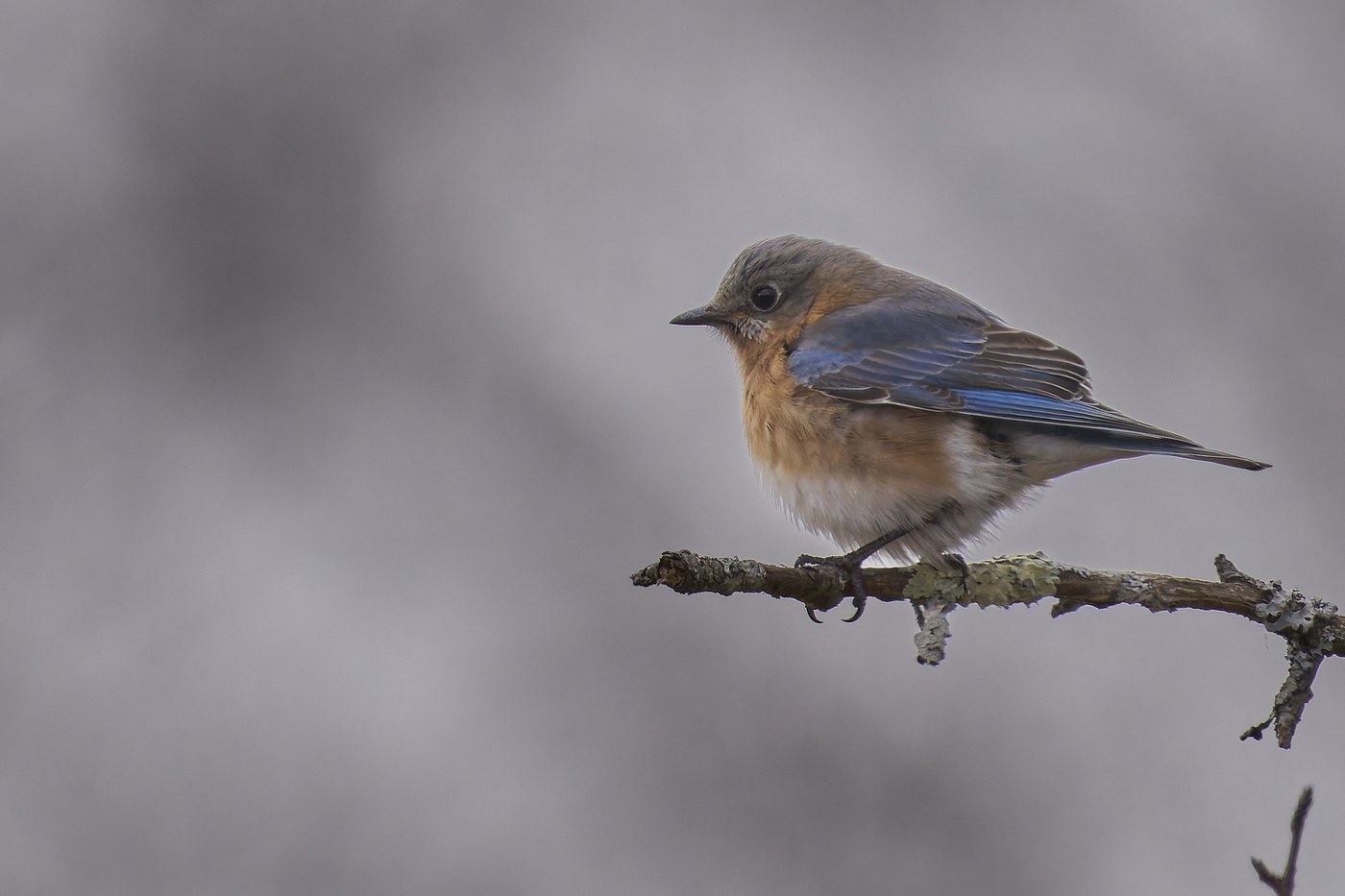
Eastern Bluebird
Sialia sialis
A small thrush with vivid blue upperparts and a warm rusty-orange breast, often seen perched on fences and wires over open fields.
- Size
- 16-21 cm (6.3-8.3 in) long, 25-32 cm (10-12.5 in) wingspan
- Habitat
- open fields, meadows, orchards, and open woodlands with scattered trees
- Type
- songbird
Spotted a bird like this?
Identify any bird from a photo, free.
Overview
The Eastern Bluebird is a small member of the thrush family known for its brilliant coloring and gentle, appealing presence in open countryside across the eastern United States. Males have deep blue upperparts, a rusty-orange throat, breast, and flanks, and a white belly. Females show a similar pattern but in muted tones, with grayish-blue wings and tail and a paler orange-buff breast.
Once in decline due to competition for nest cavities with introduced House Sparrows and European Starlings, Eastern Bluebird populations have recovered significantly thanks to widespread nest box programs, making them a conservation success story and a popular symbol of backyard bird conservation.
How to identify it
Key Field Marks
- Male: deep blue upperparts with a rusty-orange throat, breast, and flanks, white belly
- Female: duller grayish-blue above with a paler orange breast
- Plump, short-legged posture, often perched upright on wires, fences, or low branches
- Short, straight bill
Similar Species
- Western Bluebird: male shows blue on the throat (not orange) and often has a chestnut patch on the back, and the range is largely separate (western North America) with limited overlap.
- Mountain Bluebird: male is entirely sky blue without any orange, and female is grayer overall; found in more open, treeless habitat farther west.
- Indigo Bunting: male is entirely blue without any orange breast, and is much smaller with a stubby conical bill, unlike the bluebird's thrush-like shape.
Habitat & range
Habitat
Eastern Bluebirds favor open habitats with scattered trees for nesting and perching, including fields, meadows, pastures, orchards, golf courses, and open woodland edges.
Range
They are found year-round or seasonally across the eastern United States, from the Great Plains to the Atlantic coast, and south into parts of Mexico and Central America in some populations.
Migration
Northern populations migrate south for winter, while many populations in the mid-latitude and southern parts of the range are year-round residents; wintering birds often form small flocks.
Behavior & voice
Behavior
Eastern Bluebirds often perch conspicuously on wires, fence posts, or low branches, watching the ground for insect prey before dropping down to catch it, a foraging technique called "drop feeding" or ground sallying.
Voice
The song is a soft, warbling series of low whistled phrases, often described as "chur-lee, chur-chur-lee"; calls include a soft, musical "tu-a-wee."
Feeding
Insects such as beetles, crickets, and caterpillars make up much of the diet during the breeding season, while berries and small fruits become more important in fall and winter.
Nesting & Breeding
Eastern Bluebirds are secondary cavity nesters, using old woodpecker holes, natural cavities, or nest boxes, which have been critical to the species' recovery from historical declines. They typically lay 3-6 pale blue eggs and often raise two or three broods per season.
Frequently asked questions
Why did Eastern Bluebird populations decline and then recover?
Populations declined in the 20th century largely due to competition for nest cavities with introduced House Sparrows and European Starlings, along with habitat loss; widespread installation of bluebird nest boxes by conservationists has since helped populations recover significantly.
How can I attract Eastern Bluebirds to my yard?
Providing a properly sized and placed nest box in open habitat, along with mealworms and minimizing pesticide use to preserve insect food sources, can help attract nesting bluebirds.
Do Eastern Bluebirds migrate?
Populations in the northern part of the range typically migrate south for winter, while many bluebirds in the central and southern U.S. remain year-round, sometimes joined by wintering flocks.
How do male and female Eastern Bluebirds differ?
Males are more vividly colored with deep blue upperparts and a bright rusty-orange breast, while females show the same pattern in duller, more grayish-blue and pale orange tones.
What do Eastern Bluebirds eat?
They eat mainly insects during the breeding season, such as beetles and caterpillars, and shift toward berries and small fruits in fall and winter.
Eastern Bluebird guides
In-depth guides for identifying, finding, and understanding Eastern Bluebird.
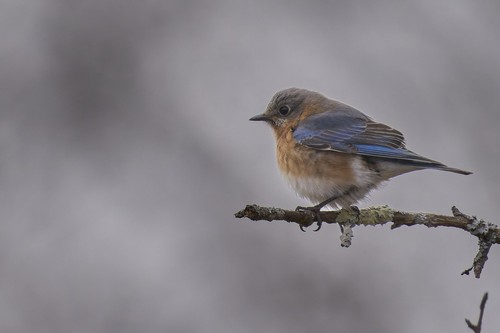
Eastern Bluebird identified by the community
Real birds identified with Bird Identifier.
Other birds you may enjoy

Black Redstart
13-14.5 cm (5.1-5.7 in) long, 23-26 cm wingspan

Black-throated Sparrow
12-14 cm (4.7-5.5 in) long, about 19-20 cm (7.5-8 in) wingspan

Greater Bird-of-paradise
Body about 43 cm; males with additional flank plumes up to 50 cm and long tail wires

Blue Tit
11-12 cm (4.3-4.7 in) long, 17-20 cm wingspan

Red-billed Quelea
11.5–13 cm long, wingspan about 20–22 cm
White-plumed Antbird
13-14 cm (5-5.5 in) long

Pyrrhuloxia
19-22 cm (7.5-8.7 in) long, 30 cm wingspan

Blue-gray Tanager
16-18 cm (6-7 in) long

Blackburnian Warbler
11-13 cm (4.3-5.1 in) long, 20-22 cm wingspan

Bluethroat
13-14 cm (5.1-5.5 in) long, 20-22 cm wingspan

Eurasian Nuthatch
12-14.5 cm (4.7-5.7 in) long, 22.5-27 cm wingspan

Wood Thrush
19-21 cm (7.5-8.3 in) long, about 33 cm (13 in) wingspan