Eastern Bluebird Identification Guide
A chunky, big-eyed thrush with vivid blue upperparts and a warm rusty-orange breast, commonly seen perched on wires and fence posts over open country.
Read the full Eastern Bluebird encyclopedia entry →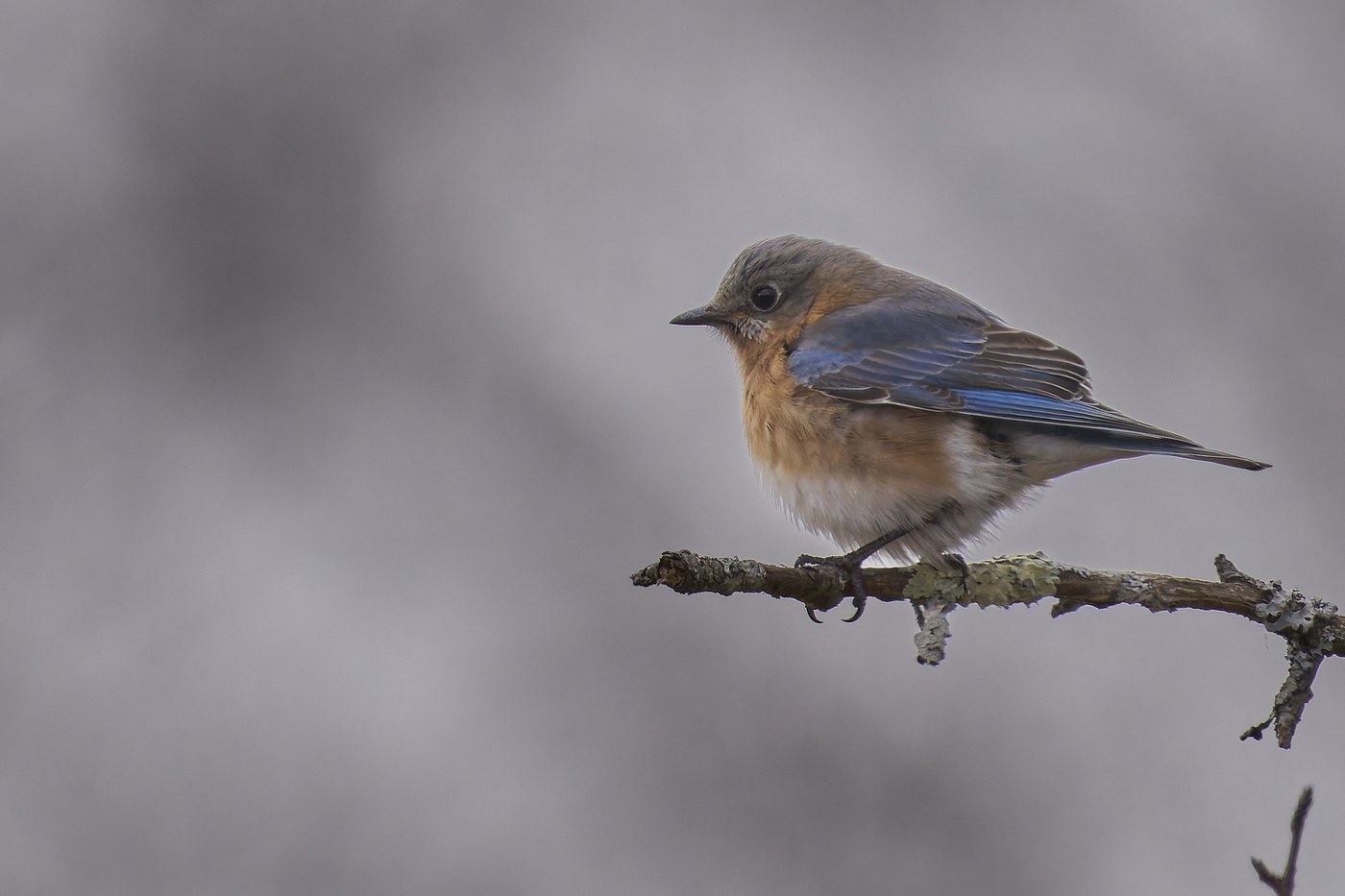
Key Field Marks
- Size & shape: A small thrush (6.5-7 in / 16-18 cm) with a plump body, large head, big dark eye, and short, straight bill; sits upright on exposed perches.
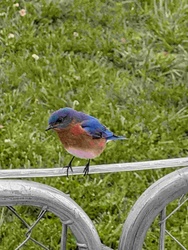
- Male: Rich, deep blue on the head, back, wings, and tail; warm rusty-orange throat, breast, and flanks; white belly and undertail.
- Female: Similar pattern but much duller — grayish-blue wash on the back and wings with a paler, muted orange breast; more subdued overall than the male.
- Juvenile: Grayish-brown with a spotted breast (typical of young thrushes) but shows blue tinges in the wings and tail that reveal its identity.
- Behavior: Perches conspicuously on wires, fence lines, and low branches, then drops to the ground to catch insects before returning to a perch; also flutters up to pick berries in fall/winter.
Separating from Similar Species
- Western Bluebird: Male has a blue (not rusty) throat and often a rusty patch on the back/shoulders; ranges barely overlap and mostly separated by range (West vs. East), with some contact in the southern Great Plains.
- Mountain Bluebird: Male is sky-blue overall with no rusty breast at all; female is grayer with little to no orange. Found farther west.
- Indigo Bunting: All-blue male lacks any rusty breast and has a stout seed-eating bill, not a thrush-like bill.
Habitat & Range
Found in open country with scattered trees — farmland, orchards, golf courses, roadsides, forest edges, and parks — across the eastern half of North America from southern Canada to Florida and into the Gulf states and eastern Mexico. Strongly dependent on cavities for nesting, historically old woodpecker holes but now heavily reliant on human-provided nest boxes, which fueled a major population recovery after mid-20th-century declines caused by competition from introduced European Starlings and House Sparrows.
Seasonal Notes
Present year-round across much of its range, though northern populations migrate south for winter, sometimes forming loose flocks that roam fields and hedgerows feeding on berries (sumac, holly, dogwood) when insects are scarce. Nest box trails have made this one of the most reliably observed cavity nesters in eastern North America during the breeding season (March-July).
Voice
A soft, musical, slightly burry "chur-lee" or "tru-ly," often given in a rolling series; flight call is a soft, downslurred "few" or "pfew," frequently the first clue to a bluebird flying overhead before it's seen.
Frequently asked questions
How do you tell a male from a female Eastern Bluebird?
Males are vividly blue above with a bright rusty-orange breast; females show the same pattern but in much duller, grayer-blue and paler orange tones.
What is the difference between Eastern and Western Bluebird?
Eastern Bluebird males have a rusty-orange throat, while Western Bluebird males have a blue throat and often rusty patches on the back; their ranges mostly don't overlap, meeting only in parts of the southern Great Plains and Southwest.
Where do Eastern Bluebirds nest?
In cavities — old woodpecker holes, natural tree hollows, or, very commonly today, human-supplied nest boxes placed along field edges and open habitat.
Do Eastern Bluebirds migrate?
Northern populations migrate south for winter and may join loose foraging flocks, while birds in the southern half of the range are largely year-round residents.
Eastern Bluebird identified by the community
Recent Eastern Bluebird sightings identified with Bird Identifier.