
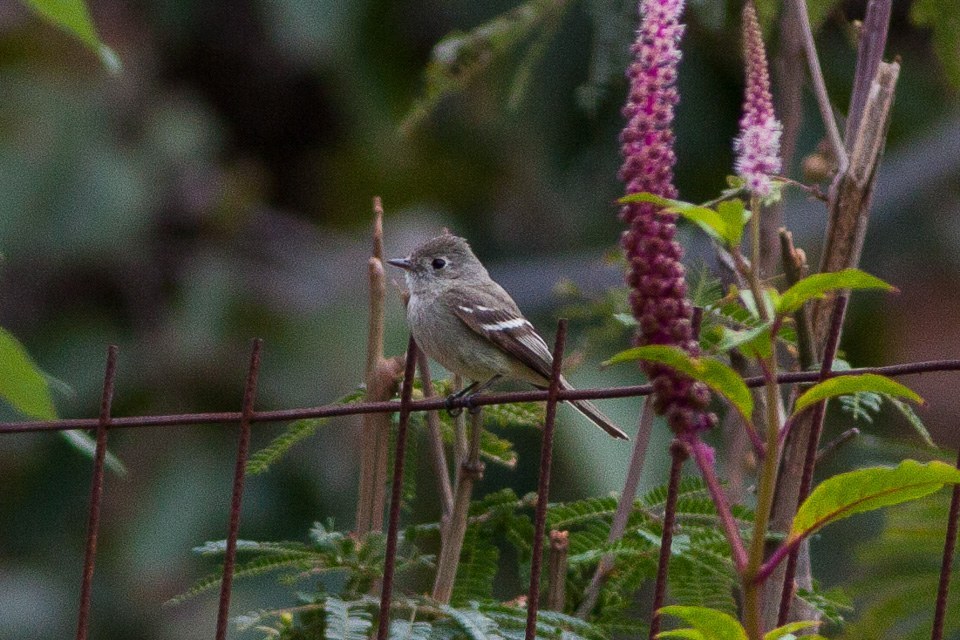
Dusky Flycatcher
Empidonax oberholseri
A gray-olive Empidonax flycatcher of open western mountain shrublands and forest edges, closely resembling several relatives and best told apart by voice.
- Size
- 13-15 cm (5-6 in) long, 21-22 cm wingspan
- Habitat
- open montane shrublands, forest edges, and second-growth conifer stands of the western mountains
- Type
- songbird
Spotted a bird like this?
Identify any bird from a photo, free.
Overview
The Dusky Flycatcher is a small, subtly patterned Empidonax flycatcher found in relatively open, brushy habitats of the western mountains, favoring forest edges, clearings, and shrubby second growth rather than dense, closed-canopy forest. It shows grayish-olive upperparts, a modest whitish eye-ring, pale wing bars, and a faintly yellowish wash on the lower underparts, closely resembling several other small western Empidonax species.
As with most members of this genus, confident identification typically requires attention to voice, habitat, and subtle structural cues such as bill length and primary projection, rather than plumage alone.
How to identify it
Key Field Marks
- Grayish-olive upperparts with a whitish eye-ring, moderate in width
- Two pale wing bars
- Pale grayish-white throat and breast with a faint yellowish wash on the belly
- Intermediate primary projection and bill length compared to Hammond's and Gray Flycatchers
Similar Species
- Hammond's Flycatcher has a longer primary projection and shorter bill, and favors denser, more closed-canopy forest.
- Gray Flycatcher is paler overall, has a longer bill and tail, and characteristically dips its tail downward rather than flicking it upward.
- Voice remains the most reliable way to distinguish Dusky Flycatcher from its close relatives.
Habitat & range
Dusky Flycatchers breed in open montane habitats of the western United States and southwestern Canada, including shrubby forest edges, aspen groves, chaparral, and areas of regenerating conifer forest after fire or logging, generally at middle to higher elevations in the mountains.
The species winters mainly in Mexico, migrating through the interior western United States each spring and fall.
Behavior & voice
Voice
Gives a soft song of three distinct phrases, often rendered as sillit, gray-peet, brrk, along with a sharp whit call note, useful for separating it from similar species.
Feeding
Sallies from a low to mid-level perch in open, shrubby habitat to catch flying insects, and also gleans prey from foliage.
Nesting
Builds a compact cup nest of grass, bark strips, and plant fibers, typically placed in the fork of a shrub or small tree at low to moderate height.
Frequently asked questions
How do I identify a Dusky Flycatcher?
Look for a grayish-olive Empidonax flycatcher with a moderate eye-ring and wing bars in open, shrubby montane habitat; its distinctive three-part song is the most reliable identification clue.
How is the Dusky Flycatcher different from Hammond's Flycatcher?
Dusky Flycatcher has a shorter primary projection and longer bill than Hammond's Flycatcher, and it favors more open, shrubby habitat rather than dense forest canopy.
Where does the Dusky Flycatcher breed?
It breeds in open montane habitats such as shrubby forest edges, aspen groves, and regenerating conifer stands across the western United States and southwestern Canada.
Where do Dusky Flycatchers spend the winter?
They migrate to winter mainly in Mexico.
Dusky Flycatcher guides
In-depth guides for identifying, finding, and understanding Dusky Flycatcher.
Other birds you may enjoy

Black Redstart
13-14.5 cm (5.1-5.7 in) long, 23-26 cm wingspan

Black-throated Sparrow
12-14 cm (4.7-5.5 in) long, about 19-20 cm (7.5-8 in) wingspan

Greater Bird-of-paradise
Body about 43 cm; males with additional flank plumes up to 50 cm and long tail wires

Blue Tit
11-12 cm (4.3-4.7 in) long, 17-20 cm wingspan

Red-billed Quelea
11.5–13 cm long, wingspan about 20–22 cm
White-plumed Antbird
13-14 cm (5-5.5 in) long

Pyrrhuloxia
19-22 cm (7.5-8.7 in) long, 30 cm wingspan

Blue-gray Tanager
16-18 cm (6-7 in) long

Blackburnian Warbler
11-13 cm (4.3-5.1 in) long, 20-22 cm wingspan

Bluethroat
13-14 cm (5.1-5.5 in) long, 20-22 cm wingspan

Eurasian Nuthatch
12-14.5 cm (4.7-5.7 in) long, 22.5-27 cm wingspan

Wood Thrush
19-21 cm (7.5-8.3 in) long, about 33 cm (13 in) wingspan