
Dusky Flycatcher Identification Guide
A subtly plumaged western Empidonax flycatcher best separated from its many look-alikes by voice, habitat, and fine structural details like eye-ring shape and bill pattern.
Read the full Dusky Flycatcher encyclopedia entry →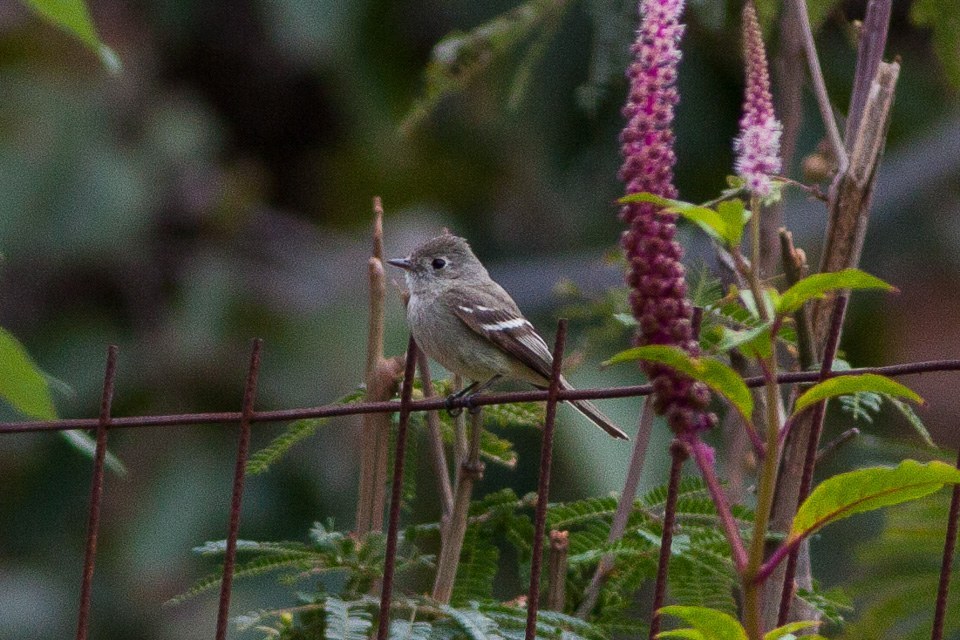
Key Field Marks
- Size & shape: A small, slim flycatcher typical of the Empidonax genus, with an upright perching posture, frequent tail-flicking, and a moderate primary projection (wingtip extension past the folded tertials) that is neither especially short nor especially long.
- Plumage: Grayish-olive upperparts, a whitish to pale gray throat and breast, and a pale belly with a faint yellowish wash; two whitish wingbars.
- Eye-ring: A fairly bold, often somewhat teardrop-shaped or slightly widened white eye-ring behind the eye — a helpful supporting mark.
- Bill: Fairly short and narrow, dark on the upper mandible with a pale to dull orange base on the lower mandible.
Separating It From Similar Species
Empidonax flycatchers are famously difficult to separate by sight alone; voice is the most reliable clue, but structure and habitat help narrow the choices:
- Hammond's Flycatcher: Shorter-tailed with a larger-headed appearance, generally darker and grayer overall, and a shorter primary projection; often forages higher in the canopy of denser conifer forest.
- Gray Flycatcher: Paler and grayer overall, has a longer bill that is mostly pale (pinkish) with only a dark tip, and characteristically dips its tail downward (rather than flicking it up) — and prefers more open sagebrush and juniper habitat.
- Least Flycatcher: Shows a bolder, more complete white eye-ring, a relatively larger head, and gives a sharp, distinctive "che-bek" call; found more in the East and in aspen/deciduous habitats.
- Best practice: Because of the extensive overlap in plumage between these species, always try to confirm identification with vocalizations whenever possible, especially the song.
Habitat, Range & Season
Breeds in brushy montane forest edges, open coniferous and mixed woodland, chaparral, and shrubby mountain slopes across the western United States and southwestern Canada, generally at mid- to high elevations. It arrives on breeding grounds in spring and departs by early fall, wintering in Mexico.
Voice
The song is a distinctive burry, three-part phrase often rendered as "sillit... brrk... grrreep," with each phrase having a different quality; the call is a sharp, dry "whit." Voice is by far the most reliable way to confirm identification against similar Empidonax species.
Frequently asked questions
Why is the Dusky Flycatcher considered a hard bird to identify?
It belongs to the genus Empidonax, a group of small flycatchers that look extremely similar to each other in plumage; reliable identification usually depends on voice, structure, and habitat rather than color pattern alone.
What is the most reliable way to confirm a Dusky Flycatcher?
Voice — its distinctive three-part burry song ("sillit... brrk... grrreep") is much more diagnostic than plumage, which overlaps heavily with Hammond's and Gray Flycatchers.
How can I separate a Dusky Flycatcher from a Gray Flycatcher by behavior?
Gray Flycatchers characteristically dip their tail downward while perched, while Dusky Flycatchers do not show this habit as consistently and tend to use brushier, less open habitat.
Where and when should I look for a Dusky Flycatcher?
In brushy edges of montane coniferous and mixed forest and chaparral in the western US and southwestern Canada during the breeding season (spring through summer); it winters in Mexico.