
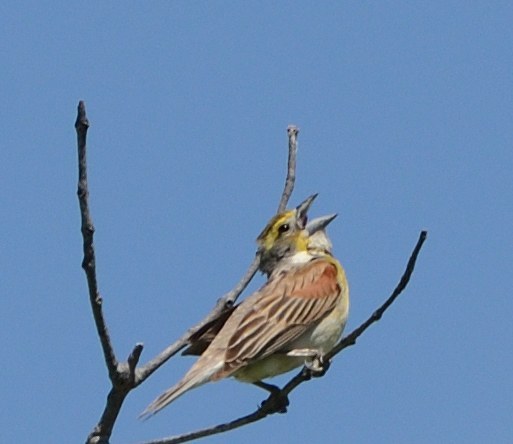
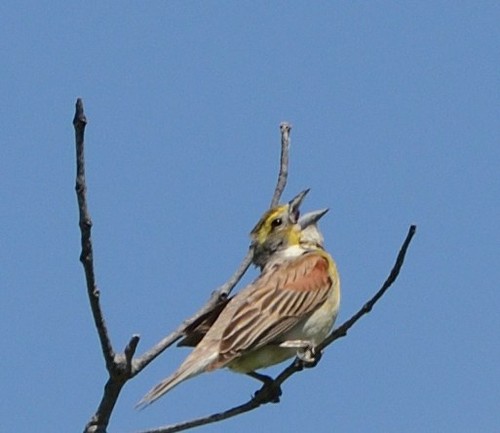
Dickcissel
Spiza americana
A grassland songbird resembling a small meadowlark, with breeding males showing a yellow breast, black bib, and a name derived from its buzzy, insect-like song.
- Size
- 14-16 cm (5.5-6.3 in) long, 24-26 cm wingspan
- Habitat
- grasslands, prairies, hayfields, and weedy agricultural fields
- Type
- songbird
Spotted a bird like this?
Identify any bird from a photo, free.
Overview
The Dickcissel is a stocky, sparrow-like grassland bird whose breeding male resembles a miniature meadowlark, with a yellow breast marked by a black V-shaped bib, a gray head with a yellow eyebrow stripe, and chestnut shoulder patches. Females and non-breeding males are much plainer, streaky brown above with a buffy breast lightly washed in yellow, lacking the bold black bib. The species' name is onomatopoeic, echoing the buzzy, mechanical quality of the male's song.
Dickcissels are known for highly variable and sometimes nomadic breeding distributions from year to year, with populations shifting location based on rainfall and grassland conditions across the Great Plains and Midwest, and for forming enormous, dense winter flocks in South America that can number in the millions.
How to identify it
Key Field Marks
- Adult male: yellow breast with black V-bib, gray head, yellow eyebrow stripe, chestnut shoulder patch
- Female/non-breeding male: streaky brown above, buffy breast with faint yellow wash, no black bib
- Stout, conical bill typical of a seed-eating songbird
- Chestnut wing patch visible on both sexes, though more subdued on females
Similar Species
- Eastern/Western Meadowlark are much larger with a longer bill and a fuller black V-bib, and prominent white outer tail feathers.
- House Sparrow males can show a superficially similar black throat patch but lack the yellow breast and chestnut shoulder.
Habitat & range
Habitat
Breeds in tallgrass prairie, hayfields, weedy pastures, and agricultural field margins, favoring areas with dense grass and scattered forbs.
Range
Breeds primarily across the Great Plains and Midwest of the United States, with populations that can shift substantially from year to year. Winters mainly in the llanos grasslands of Venezuela and Colombia in South America.
Migration
A long-distance migrant that forms enormous, dense flocks on its South American wintering grounds, sometimes numbering in the hundreds of thousands to millions of birds at a single roost.
Behavior & voice
Behavior
Males sing persistently from exposed perches such as fence posts, weed stalks, or utility wires to defend territory, and the species can be locally abundant one year and largely absent the next as breeding populations shift with habitat and weather conditions.
Voice
The song is a distinctive, buzzy, mechanical-sounding phrase often rendered as "dick, dick, ciss-ciss-ciss," which gives the bird its name.
Feeding
Feeds on insects during the breeding season and shifts heavily to grass and grain seeds outside the breeding season, when it can form large foraging flocks in agricultural fields.
Nesting & Breeding
The female builds a cup nest low in dense grass or a shrub, and the species is often polygynous, with dominant males mating with multiple females within a territory. She incubates 3-5 eggs alone.
Frequently asked questions
Why is it called a Dickcissel?
The name is onomatopoeic, imitating the buzzy, mechanical-sounding "dick, dick, ciss-ciss-ciss" song given by breeding males.
Why do Dickcissel populations vary so much from year to year in a given area?
Dickcissels are somewhat nomadic breeders, shifting their breeding locations from year to year based on grassland habitat conditions and rainfall across the Great Plains and Midwest.
How is a male Dickcissel different from a meadowlark?
Dickcissels are much smaller than meadowlarks, with a shorter bill, a smaller black bib, and a chestnut shoulder patch, and lack the meadowlark's prominent white outer tail feathers.
Where do Dickcissels spend the winter?
Most winter in the grassland llanos of Venezuela and Colombia in South America, where they can form enormous flocks numbering in the hundreds of thousands or more.
Dickcissel guides
In-depth guides for identifying, finding, and understanding Dickcissel.
Other birds you may enjoy
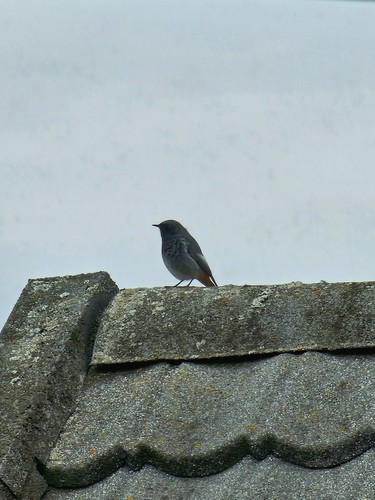
Black Redstart
13-14.5 cm (5.1-5.7 in) long, 23-26 cm wingspan
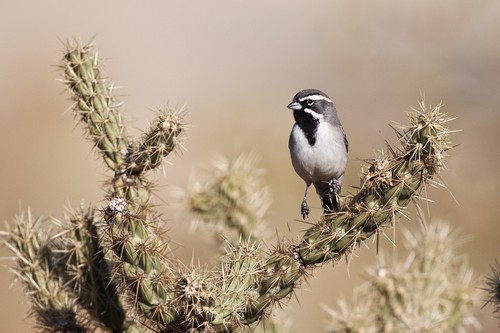
Black-throated Sparrow
12-14 cm (4.7-5.5 in) long, about 19-20 cm (7.5-8 in) wingspan
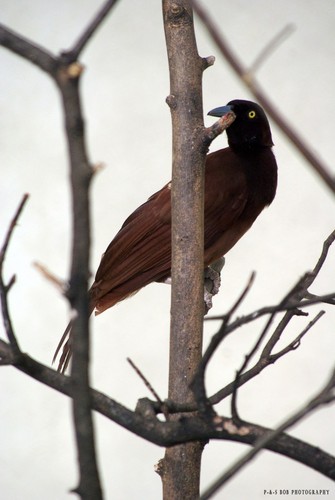
Greater Bird-of-paradise
Body about 43 cm; males with additional flank plumes up to 50 cm and long tail wires
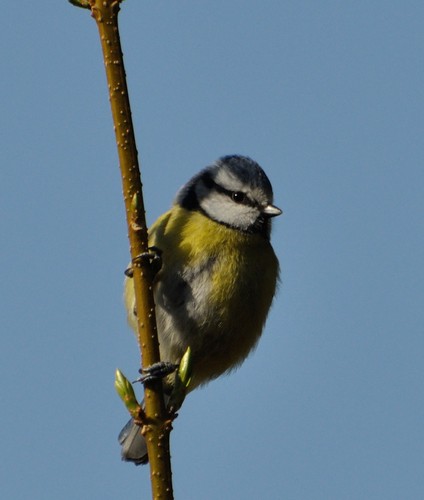
Blue Tit
11-12 cm (4.3-4.7 in) long, 17-20 cm wingspan
Red-billed Quelea
11.5–13 cm long, wingspan about 20–22 cm
White-plumed Antbird
13-14 cm (5-5.5 in) long
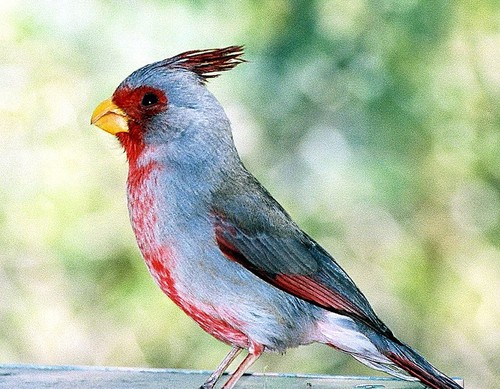
Pyrrhuloxia
19-22 cm (7.5-8.7 in) long, 30 cm wingspan
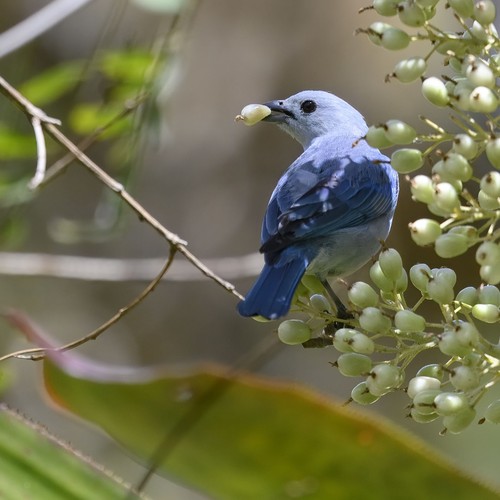
Blue-gray Tanager
16-18 cm (6-7 in) long
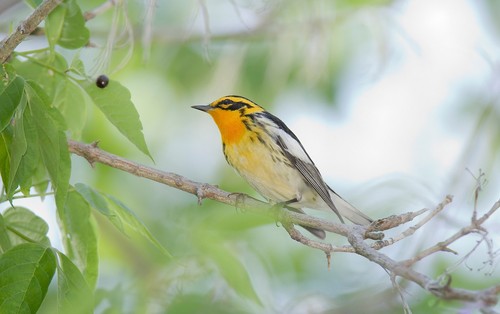
Blackburnian Warbler
11-13 cm (4.3-5.1 in) long, 20-22 cm wingspan
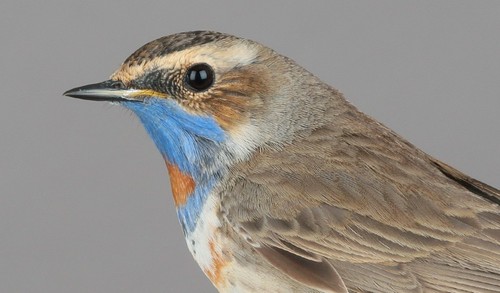
Bluethroat
13-14 cm (5.1-5.5 in) long, 20-22 cm wingspan
Eurasian Nuthatch
12-14.5 cm (4.7-5.7 in) long, 22.5-27 cm wingspan
Wood Thrush
19-21 cm (7.5-8.3 in) long, about 33 cm (13 in) wingspan