
Dickcissel Identification Guide
A grassland bunting relative with a meadowlark-like yellow breast and black bib, best known for its buzzy, name-saying song from prairie wires and weed stalks.
Read the full Dickcissel encyclopedia entry →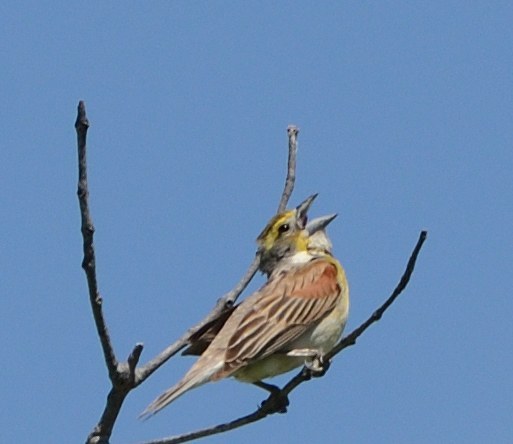
Key Field Marks
- Size & shape: Sparrow-sized (about 6-6.5 in / 15-17 cm), stocky and short-tailed with a large, conical, silver-gray bill typical of a seed-eating songbird.
- Breeding male: Gray head with a yellow eyebrow stripe, yellow breast crossed by a bold black V-shaped bib, chestnut-red patch on the shoulder (lesser coverts), and brown-streaked back.
- Female and nonbreeding male: Much duller and sparrow-like — buffy breast, faint or absent black bib, thin pale eyebrow — but retains the diagnostic chestnut shoulder patch and the oversized bill.
- Bill: Notably thick and pale, longer and heavier than most sparrows', a good mark on drab females and fall birds.
Separating It From Similar Species
- House Sparrow (female): The classic confusion pair. Dickcissel has a bigger, more conical bill, a warmer chestnut shoulder patch, and often a yellowish wash on the breast — features House Sparrows lack.
- Eastern/Western Meadowlark: Much larger, with a long spike-like bill, white outer tail feathers, and a flat-headed, ground-hugging silhouette; Dickcissel is far smaller and perches upright on wires and weeds rather than walking on open ground.
- Grasshopper and Savannah Sparrows: Smaller-billed and streakier below, lacking any yellow or chestnut shoulder patch.
Habitat, Range & Season
Dickcissels breed in tallgrass and mixed-grass prairie, hayfields, weedy pastures, and grain-crop margins across the Great Plains and Midwest, from the Dakotas south to Texas and east to Ohio, with local pockets farther east. They arrive in April–May and depart by September, wintering in enormous flocks in the Llanos grasslands of Venezuela and Colombia. Numbers and exact breeding locations shift year to year depending on grassland/hayfield conditions, sometimes called "boom and bust" nomadism.
Voice
The song gives the bird its name: a buzzy, mechanical "dick-dick-cissel" or "see-see-dick-cissel-cissel-cissel," delivered persistently from a fence wire, utility line, or tall forb throughout the breeding season. Flight calls include a dry, electric buzz.
Frequently asked questions
How can I tell a female Dickcissel from a House Sparrow?
Look for the Dickcissel's larger, more conical bill, chestnut patch on the shoulder (lesser coverts), and a yellowish tinge to the breast — House Sparrows lack the chestnut patch and yellow wash and have a smaller bill.
What does a Dickcissel sound like?
A buzzy, repetitive song often rendered as "dick-dick-cissel" or "see-see-dick-cissel-cissel," usually sung from an exposed wire or tall weed stalk.
Where is the best place to find Dickcissels?
Tallgrass prairie, hayfields, and weedy agricultural margins in the central US (Great Plains and Midwest) during the breeding season, roughly May through August.
Why do Dickcissel numbers vary so much from year to year at a given site?
The species is nomadic and tracks grassland/hayfield quality, so it may be abundant at a site one year and nearly absent the next depending on vegetation and rainfall conditions.