
Diamond Firetail
Stagonopleura guttata
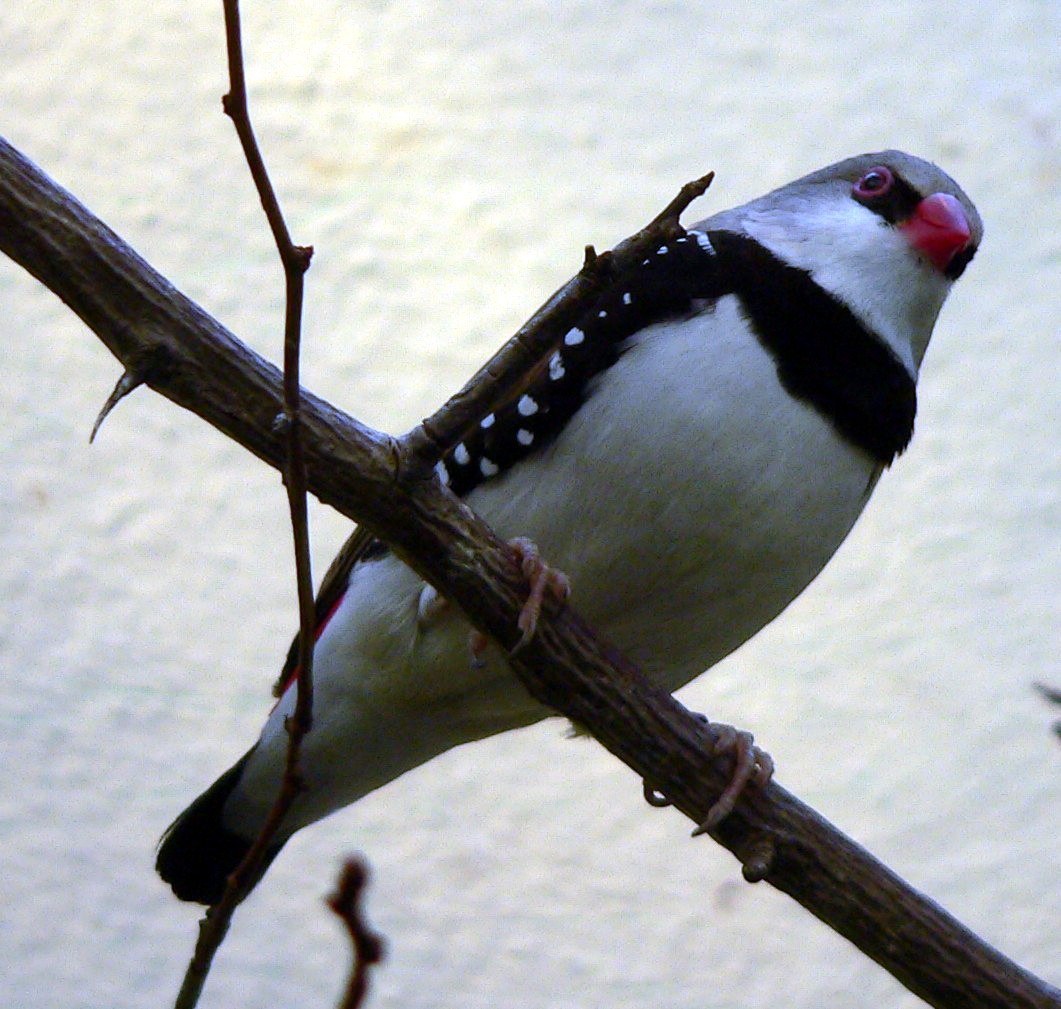
A striking grey, black, and white finch with a scarlet rump and bill, and bold white-spotted black flanks resembling diamonds.
- Size
- 11-12 cm (4-4.5 in) long
- Habitat
- dry woodlands and grassy box-gum woodland of southeastern Australia
- Type
- songbird
Spotted a bird like this?
Identify any bird from a photo, free.
Overview
The Diamond Firetail is one of Australia's most handsomely patterned grass finches, combining soft grey upperparts and a pale grey-white head with a bold black band across the breast that extends down the flanks, where it is boldly spotted with white markings resembling scattered diamonds. A bright scarlet-red rump and matching bright red bill complete its striking appearance, with a black patch around the eye adding further contrast.
Sexes are similar, though males typically show slightly bolder markings than females. The species is generally encountered in pairs or small flocks, foraging on the ground in grassy woodland where it feeds largely on fallen seed, and it can be a wary bird, often keeping close to cover.
Once more common and widespread, the Diamond Firetail has undergone significant declines across parts of its range in southeastern Australia due to the clearing and degradation of grassy woodland habitat, and it is now considered a species of conservation concern in several regions.
How to identify it
Key field marks
- Grey upperparts, pale grey-white head, black eye patch
- Broad black breast band extending along the flanks
- Bold white spots on black flanks, resembling diamonds
- Bright scarlet-red rump and bill
Similar species
The Red-browed Finch is smaller and plainer, lacking the bold black breast band and white-spotted flanks, with red confined to the eyebrow, rump, and bill rather than the more extensively patterned Diamond Firetail. No other Australian finch shares the Diamond Firetail's combination of white-spotted black flanks and scarlet rump.
Habitat & range
Habitat
Diamond Firetails favour dry, open eucalypt woodland, particularly grassy box-gum woodland, as well as farmland with scattered trees and grassy understorey.
Range
The species occurs across southeastern Australia, including inland New South Wales, Victoria, and southeastern South Australia, generally at lower to moderate elevations on the inland side of the Great Dividing Range.
Migration
Most populations are sedentary, though local movements can occur in response to food and water availability, and some populations have become increasingly fragmented as suitable woodland habitat has declined.
Behavior & voice
Behavior
Diamond Firetails are usually seen in pairs or small flocks, foraging quietly on the ground for fallen seed, and tend to be somewhat wary, retreating to cover when disturbed.
Voice
Its call is a soft, plaintive, drawn-out note, sometimes rendered as a nasal 'tee-yew', along with various contact notes given by flock members.
Feeding
It feeds mainly on the seeds of grasses and herbs found on the ground, supplemented by insects, particularly during the breeding season when extra protein is needed for chicks.
Nesting and breeding
The nest is a large, bulky, domed structure of grass with a tunnel entrance, built in a shrub, tree fork, or occasionally within the base of a raptor's nest for added protection; both parents share incubation and feeding of the young.
Frequently asked questions
How can I identify a Diamond Firetail?
Look for its grey body, broad black breast band extending along the flanks with bold white spots, and its bright scarlet rump and bill.
Why is the Diamond Firetail considered threatened?
Clearing and degradation of grassy woodland habitat in southeastern Australia has caused significant declines, leading to its Near Threatened status in several regions.
Where do Diamond Firetails live?
They inhabit dry, open woodland, especially grassy box-gum woodland, across southeastern Australia.
What do Diamond Firetails eat?
Mainly grass and herb seeds, with insects added to the diet during breeding.
Do Diamond Firetails nest near raptors?
They sometimes build their nest within or beside the nest of a bird of prey, which may offer some protection from other predators.
Diamond Firetail guides
In-depth guides for identifying, finding, and understanding Diamond Firetail.
Other birds you may enjoy

Black Redstart
13-14.5 cm (5.1-5.7 in) long, 23-26 cm wingspan

Black-throated Sparrow
12-14 cm (4.7-5.5 in) long, about 19-20 cm (7.5-8 in) wingspan

Greater Bird-of-paradise
Body about 43 cm; males with additional flank plumes up to 50 cm and long tail wires

Blue Tit
11-12 cm (4.3-4.7 in) long, 17-20 cm wingspan

Red-billed Quelea
11.5–13 cm long, wingspan about 20–22 cm
White-plumed Antbird
13-14 cm (5-5.5 in) long

Pyrrhuloxia
19-22 cm (7.5-8.7 in) long, 30 cm wingspan

Blue-gray Tanager
16-18 cm (6-7 in) long

Blackburnian Warbler
11-13 cm (4.3-5.1 in) long, 20-22 cm wingspan

Bluethroat
13-14 cm (5.1-5.5 in) long, 20-22 cm wingspan

Eurasian Nuthatch
12-14.5 cm (4.7-5.7 in) long, 22.5-27 cm wingspan

Wood Thrush
19-21 cm (7.5-8.3 in) long, about 33 cm (13 in) wingspan