
Diamond Firetail Identification Guide
A striking Australian finch with a bright red rump and bill, black face mask, and a bold black flank band spotted with white "diamonds" along its sides.
Read the full Diamond Firetail encyclopedia entry →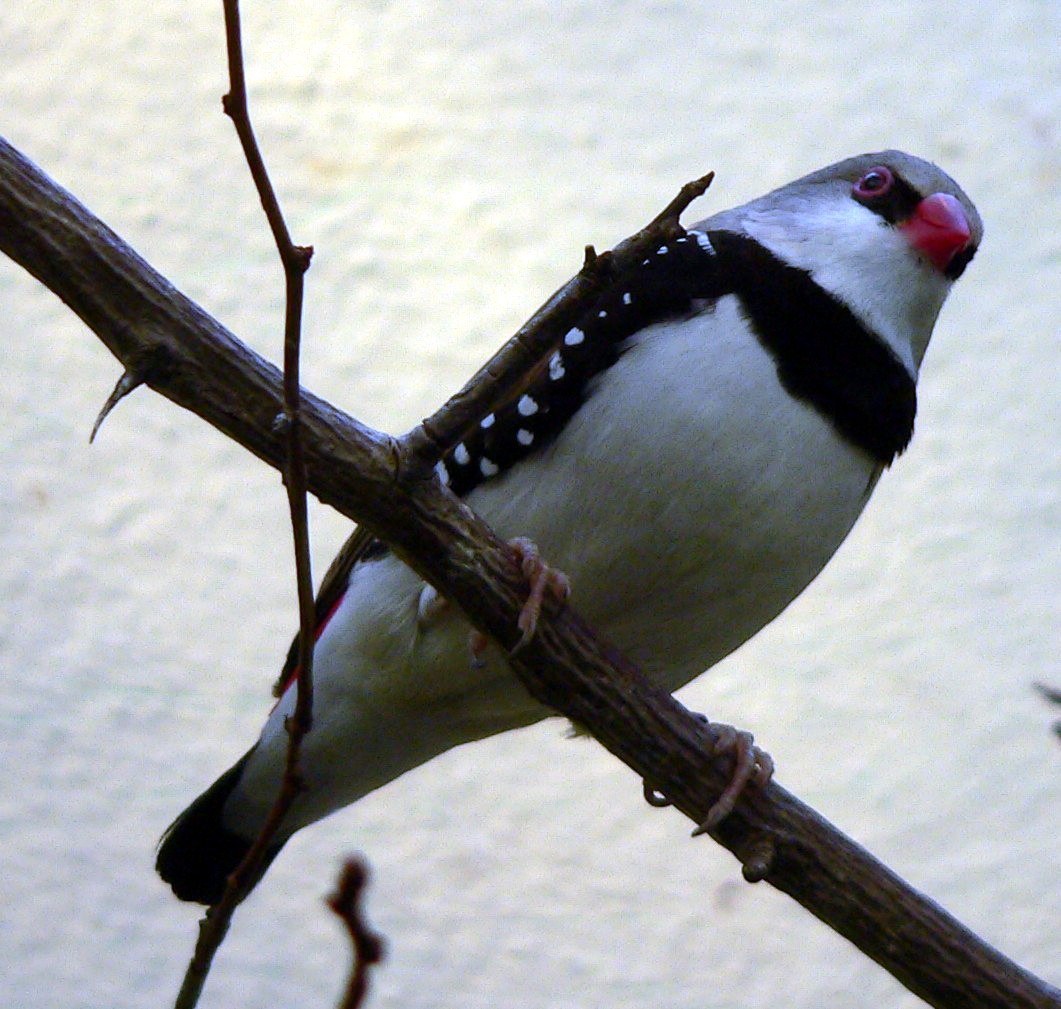
Overview
The Diamond Firetail (Stagonopleura guttata) is a boldly patterned estrildid finch of southeastern Australia's woodlands and grasslands, named for the row of white spots resembling diamonds along its black flank band.
Key Field Marks
- Size & shape: About 12 cm (4.75 in), a compact, short-tailed finch with a stout conical bill typical of estrildid finches.
- Head: Pale gray crown and nape with a black mask through the eye and lores, bordered by a fine white line above.
- Upperparts: Warm brown back and wings.
- Underparts: White breast and belly.
- Rump: Bright crimson-red rump, conspicuous in flight and at rest — one of the most eye-catching features.
- Flank band: Broad black band across the flanks, boldly spotted with a row of clean white spots (the "diamonds") — diagnostic for the species.
- Bill: Bright coral-red, short and conical, contrasting with the gray head.
- Sexes: Similar in plumage; juveniles are duller, with a blackish (not red) bill and less defined markings.
Similar Species
- Beautiful Firetail and Red-eared Firetail (limited range overlap in parts of southeastern Australia): Both are more finely barred overall rather than showing the bold black flank band with large white spots, and have less contrasting plain underparts — the clean white breast and bold-spotted black flank band separate Diamond Firetail.
- No other Australian finch combines a red rump, red bill, black eye mask, and a black-and-white spotted flank band in this way.
Habitat & Range
Resident in dry eucalypt woodland, grassy woodland edges, and adjacent farmland with scattered trees across southeastern Australia, from southeastern Queensland through New South Wales, Victoria, and into South Australia. Generally sedentary, though can wander locally outside the breeding season.
Behavior
Forages mainly on the ground in pairs or small flocks, eating grass seeds and occasionally insects, especially when feeding young. Builds a large, untidy domed nest of grass, often in a tree or occasionally taking over the outer chamber of a Babbler or raptor nest. Often perches in the open on fences, dead branches, or low shrubs.
Voice
Call is a distinctive, long, drawn-out, nasal "tee-yew" or plaintive whistled note, along with softer contact calls between flock members while foraging.
Best Viewing Tips
Check open eucalypt woodland edges and grassy paddocks with scattered trees in southeastern Australia; look for small flocks feeding on the ground or perched on fences, and confirm with the red rump, red bill, and bold black-and-white spotted flank band.
Frequently asked questions
Why is it called the Diamond Firetail?
It's named for the row of clean white spots resembling diamonds set within the broad black band across its flanks.
What color is the Diamond Firetail's bill?
Adults have a bright coral-red bill, while juveniles have a duller blackish bill until they mature.
Where is the Diamond Firetail found?
It is resident in dry eucalypt woodland and grassy woodland edges across southeastern Australia, including New South Wales, Victoria, and South Australia.
How do I distinguish a Diamond Firetail from a Beautiful Firetail?
Diamond Firetail has a bold black flank band with large white spots and plain white underparts, while Beautiful Firetail shows finer barring overall rather than a bold spotted flank band.