
Daurian Redstart
Phoenicurus auroreus
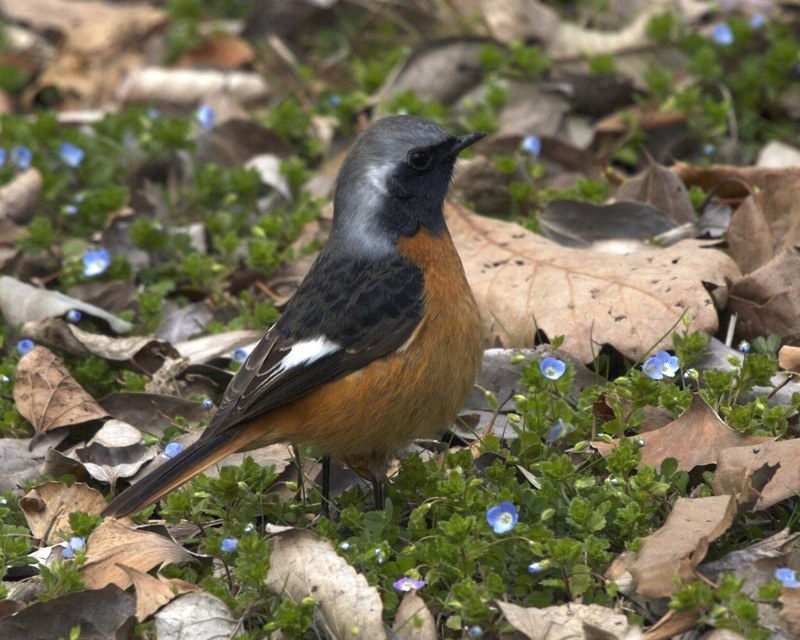
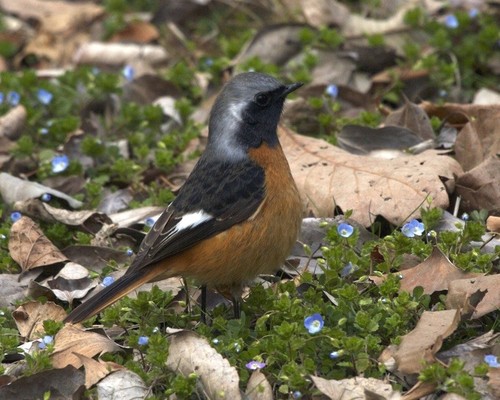
A striking small thrush relative; the male shows a grey crown, black face, and vivid orange underparts and rump set off by a white wing patch.
- Size
- 14-15 cm (5.5-6 in) long
- Habitat
- open woodland, scrub, farmland, gardens, and parks
- Type
- songbird
Spotted a bird like this?
Identify any bird from a photo, free.
Overview
The Daurian Redstart is a small, brightly patterned songbird in the Old World flycatcher family. The male is unmistakable, with a silvery-grey crown and nape, a black face and throat, and warm orange-rufous underparts, rump, and tail, all set off by a bold white patch on the folded wing. Females and immatures are much plainer, soft grey-brown overall with a paler orange wash on the rump and tail, and a smaller or absent wing patch.
The species frequently perches in the open on low branches, fences, or wires, characteristically quivering its rufous tail up and down, which helps draw attention to it even where plumage contrast is less obvious.
How to identify it
Key field marks
- Male: grey crown, black face and throat, bright orange underparts, rump, and tail, white wing patch
- Female: plain grey-brown with an orange-washed rump and tail
- Frequent tail-quivering while perched
- Upright posture on exposed perches
Similar species
- Common Redstart (Europe) has a similar shape but the male shows an orange breast with a white forehead rather than a fully black face, and ranges do not normally overlap.
- Black Redstart lacks the grey crown contrast and white wing patch is different in extent.
Habitat & range
Habitat
Uses open woodland, scrub, hedgerows, farmland, gardens, and parks, favoring areas with a mix of open ground and low cover.
Range
Breeds across northeastern China, Mongolia, Korea, and southeastern Russia; winters more widely across eastern and southern China, Korea, Japan, and northern Southeast Asia.
Migration
A short- to medium-distance migrant, moving south out of its breeding range for the winter, when it is a familiar garden and park visitor across much of East Asia.
Behavior & voice
Behavior
Perches conspicuously on low branches, fences, and wires, frequently flicking and quivering its rufous tail; often solitary and territorial, even on the wintering grounds.
Voice
A thin, wheezy song and a hard, ticking "tak-tak" or "hweet-tak-tak" call.
Feeding
Sallies from a perch to catch insects in flight or drops to the ground to seize prey, also eating spiders and berries, especially in winter.
Nesting
Builds a cup nest in a cavity, wall crevice, or among rocks; lays 4-6 pale blue eggs.
Frequently asked questions
How do you identify a male Daurian Redstart?
Look for a grey crown, black face and throat, bright orange-rufous underparts, rump, and tail, and a bold white patch on the wing.
What does a female Daurian Redstart look like?
Females are much plainer grey-brown overall, with an orange wash on the rump and tail but lacking the male's black face and bold wing patch.
Why does a Daurian Redstart quiver its tail?
It frequently flicks and quivers its rufous tail while perched, a habit thought to help with balance and possibly signal alertness to rivals or predators.
Where can you see a Daurian Redstart?
It breeds in northeastern China, Mongolia, Korea, and southeastern Russia, and winters across eastern China, Korea, Japan, and northern Southeast Asia in open woodland, scrub, and gardens.
Daurian Redstart guides
In-depth guides for identifying, finding, and understanding Daurian Redstart.
Other birds you may enjoy

Black Redstart
13-14.5 cm (5.1-5.7 in) long, 23-26 cm wingspan

Black-throated Sparrow
12-14 cm (4.7-5.5 in) long, about 19-20 cm (7.5-8 in) wingspan

Greater Bird-of-paradise
Body about 43 cm; males with additional flank plumes up to 50 cm and long tail wires

Blue Tit
11-12 cm (4.3-4.7 in) long, 17-20 cm wingspan

Red-billed Quelea
11.5–13 cm long, wingspan about 20–22 cm
White-plumed Antbird
13-14 cm (5-5.5 in) long

Pyrrhuloxia
19-22 cm (7.5-8.7 in) long, 30 cm wingspan

Blue-gray Tanager
16-18 cm (6-7 in) long

Blackburnian Warbler
11-13 cm (4.3-5.1 in) long, 20-22 cm wingspan

Bluethroat
13-14 cm (5.1-5.5 in) long, 20-22 cm wingspan

Eurasian Nuthatch
12-14.5 cm (4.7-5.7 in) long, 22.5-27 cm wingspan

Wood Thrush
19-21 cm (7.5-8.3 in) long, about 33 cm (13 in) wingspan