
Daurian Redstart Identification Guide
A small East Asian songbird with a silvery-gray crown, black face and throat, orange underparts and tail, and a bold white wing patch, common in gardens and parks in winter.
Read the full Daurian Redstart encyclopedia entry →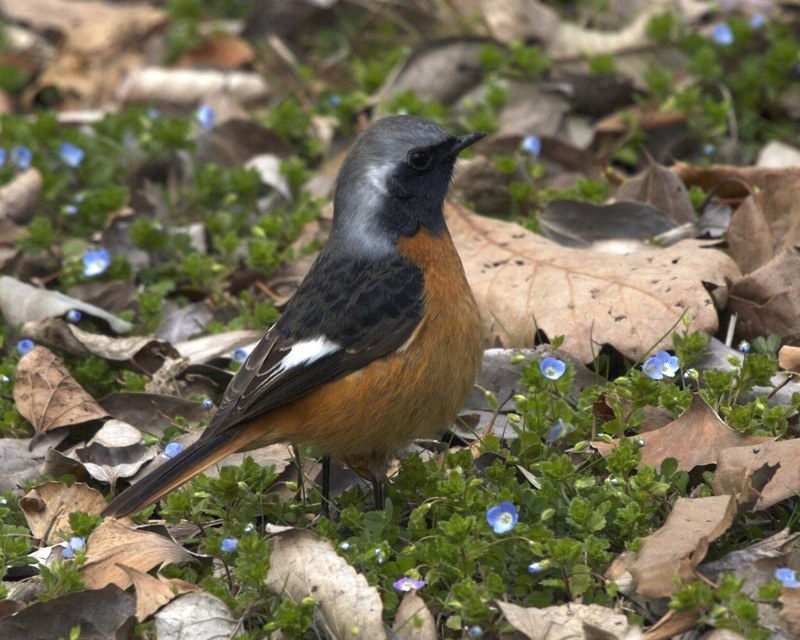
Overview
The Daurian Redstart (Phoenicurus auroreus) is a small, colorful thrush relative (Old World flycatcher family) that breeds in eastern Asia and winters commonly in parks, gardens, and farmland across China, Korea, and Japan, where it's a familiar cold-season visitor.
Key Field Marks
- Size & shape: About 14–15 cm (5.5–6 in), a small, plump-bodied songbird with a fairly long tail that it often quivers or shivers.
- Male: Silvery-gray crown and nape, black face, throat, and upper breast, and rich orange-rufous underparts, rump, and tail — a striking, high-contrast combination. A bold white patch on the closed wing (formed by white bases to the secondaries) is diagnostic and visible even in flight.
- Female: Much duller grayish-brown overall, with warm orange-buff tones on the rump and tail similar to the male but without the black face/silver crown; retains a small white wing patch, though less prominent than the male's.
- Tail: Orange-rufous tail with a darker center, frequently quivered/shivered while perched — a habitual behavior shared with other redstarts.
- Bill and legs: Small black bill; black legs.
Similar Species
- Common Redstart (mostly separate range, western Palearctic): Male has a white forehead patch and lacks the bold white wing patch of Daurian Redstart; ranges barely overlap.
- Black Redstart (western/central Asia, limited range overlap): Male is sootier overall, generally lacking the clean silvery crown and bold wing patch combination, though some races show a small white wing patch too — check face/crown pattern and range.
- Female Daurian vs. female Common Redstart: Female Daurian typically shows a paler wing patch and warmer tail tone; range is the most reliable separator given limited overlap.
Habitat & Range
Breeds in shrubby and open forest edge, mountains, and taiga margins across Siberia, Mongolia, Korea, Japan, and northern/central China. Winters more widely across lowland China, Korea, Japan, and northern Southeast Asia, favoring gardens, parks, farmland hedgerows, and scrubby edges — often the most visible small songbird in East Asian city parks in winter.
Behavior
Perches conspicuously on low branches, fences, or wires, frequently quivering its tail and giving a soft bobbing motion. Feeds on insects and, especially in winter, berries and small fruits, often sallying out briefly to catch prey before returning to a perch (typical redstart flycatching behavior). Usually solitary or in pairs, defending winter feeding territories.
Voice
Song is a thin, high, scratchy warble. The common call is a sharp "hweet" or "tik-tik" ticking sound, often given while the tail is quivered — useful for locating a bird perched in dense cover.
Best Viewing Tips
Check park hedgerows, garden shrubs, and forest edges in East Asia during autumn through spring; look for a small bird quivering its bright orange tail on a low perch, and check for the male's bold white wing patch and black-and-silver head pattern.
Frequently asked questions
What is the most reliable field mark for a male Daurian Redstart?
A silvery-gray crown, black face and throat, orange-rufous underparts and tail, and a bold white wing patch together are diagnostic.
How can I identify a female Daurian Redstart?
Females are dull grayish-brown with an orange-toned tail and rump like the male, plus a smaller white wing patch, but lack the male's black face and silvery crown.
Where does the Daurian Redstart spend the winter?
It winters widely across lowland China, Korea, Japan, and parts of northern Southeast Asia, commonly in parks, gardens, and farmland.
Why does the Daurian Redstart quiver its tail?
Like other redstarts, it frequently shivers or quivers its tail while perched, a behavior thought to be linked to signaling and foraging alertness, and it's a useful identification cue.