
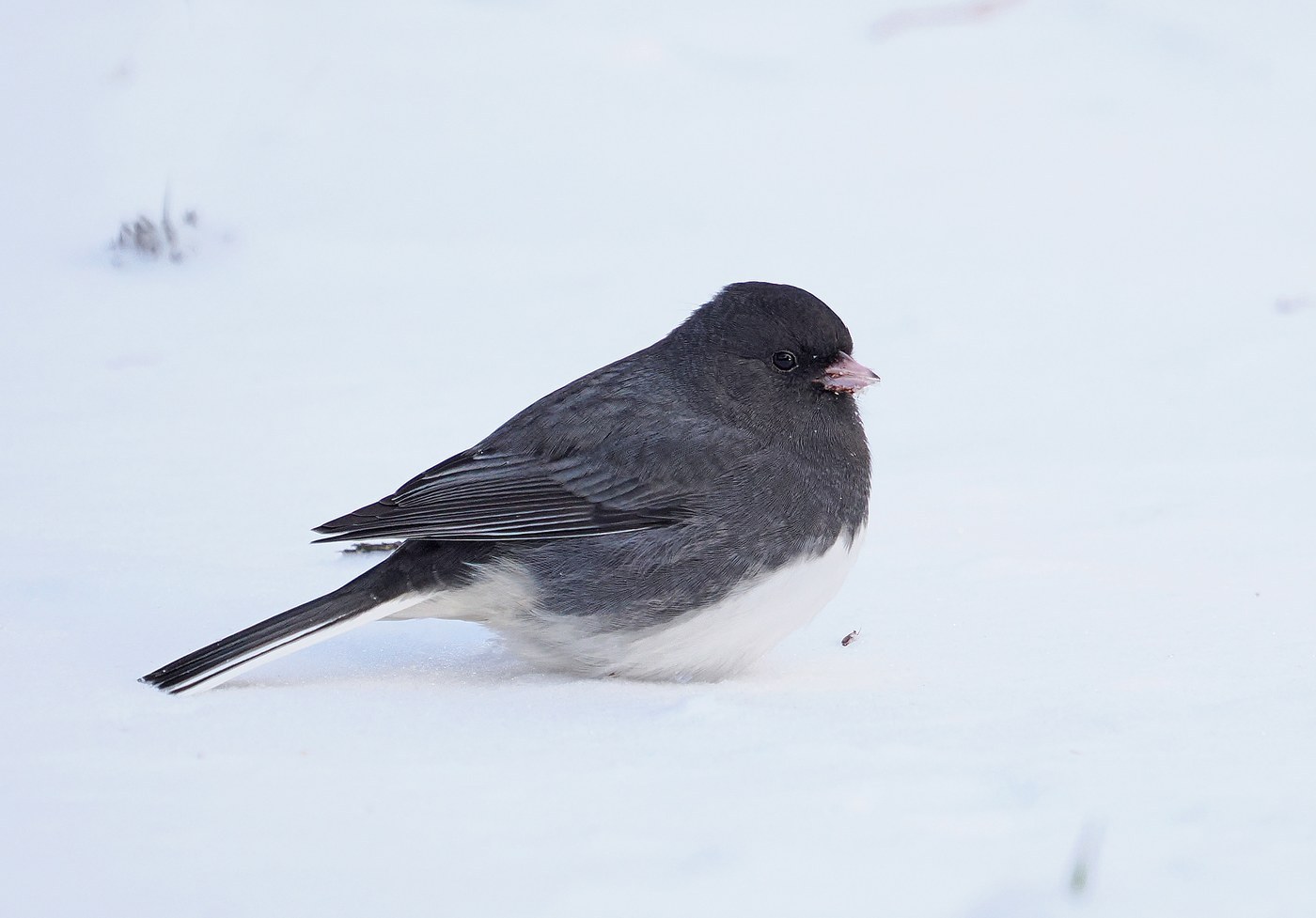
Dark-eyed Junco
Junco hyemalis
A small, highly variable sparrow-relative often called a "snowbird," typically dark gray or brown above with a contrasting white belly and pink bill.
- Size
- 13-17.5 cm (5-6.5 in) long, 18-25 cm (7-9.5 in) wingspan
- Habitat
- coniferous and mixed forests, forest edges, and, in winter, gardens and open fields
- Type
- songbird
Spotted a bird like this?
Identify any bird from a photo, free.
Overview
The Dark-eyed Junco is a small, common sparrow relative found throughout North America, often nicknamed the "snowbird" for its habit of appearing at feeders in winter alongside the first snows. It is highly variable across its range, with several distinct regional forms once considered separate species and still sometimes recognized by plumage type, including the widespread "Slate-colored" form (uniform dark gray above, white belly) and the western "Oregon" form (blackish hood, brown back and flanks, white belly).
Despite the plumage variation, all forms share a small, pale pinkish bill, dark eyes, and white outer tail feathers that flash conspicuously in flight, along with a generally plain white belly contrasting with darker upperparts.
How to identify it
Key Field Marks
- Small pale pink conical bill
- White outer tail feathers, flashing in flight
- Contrasting white belly against darker (gray, brown, or blackish-hooded) upperparts, depending on regional form
- Often forages on the ground, hopping and flicking its tail
Similar Species
- Chipping Sparrow: has a rufous cap and streaked back, unlike the junco's plain gray or brown upperparts, and lacks white outer tail feathers.
- Eastern Towhee: much larger, with a longer tail, red eyes, and rufous flanks, unlike the junco's small size and white belly.
- Other junco forms: within the species, Slate-colored, Oregon, Pink-sided, Gray-headed, and White-winged forms differ in the extent and color of the hood, back, and flanks, but all share the core junco shape and pink bill.
Habitat & range
Habitat
Juncos breed in coniferous and mixed forests, often near clearings or edges, and in winter become common in a much broader range of habitats including gardens, parks, fields, and roadsides.
Range
They breed across most of Canada, Alaska, and mountainous or northern parts of the United States, and winter throughout most of the continental United States and northern Mexico.
Migration
Many populations are medium-distance migrants, moving from higher elevation or northern breeding areas to lower elevations and more southerly wintering grounds, arriving in much of the U.S. in fall and departing by spring.
Behavior & voice
Behavior
Juncos are typically seen foraging on the ground in flocks, hopping and scratching through leaf litter or snow, and flashing their white outer tail feathers, possibly as a signal to flockmates or to startle predators.
Voice
The song is a simple, musical trill on one pitch, similar to a Chipping Sparrow's trill but usually more musical; calls include a smacking "tick" note and twittering flight calls.
Feeding
They primarily eat seeds, especially in fall and winter, supplemented by insects during the breeding season; they commonly forage on the ground beneath feeders for spilled seed.
Nesting & Breeding
Females build a cup nest usually on or near the ground, often in a natural depression, root tangle, or under vegetation, laying 3-5 eggs. Juncos are a well-studied model species for research on winter flocking, dominance hierarchies, and hormonal regulation of behavior.
Frequently asked questions
Why is the Dark-eyed Junco called a 'snowbird'?
Juncos become much more visible and abundant at feeders across much of the U.S. in winter, often arriving with the first cold weather and snow, which led to the folk name "snowbird."
Why do Dark-eyed Juncos look so different in different regions?
The species has several distinct regional forms (such as Slate-colored, Oregon, Pink-sided, and Gray-headed) that were formerly considered separate species and still differ noticeably in plumage color pattern, though they are now classified as one species due to interbreeding.
What do Dark-eyed Juncos eat in winter?
They feed mainly on seeds in winter, foraging on the ground, and readily eat millet and other small seeds scattered beneath bird feeders.
Do Dark-eyed Juncos migrate?
Many populations migrate to lower elevations or more southerly regions for winter, though some populations, especially in parts of the West, are largely resident.
How can you identify a Dark-eyed Junco in flight?
Look for flashing white outer tail feathers against darker central tail feathers, a useful field mark visible as the bird flies away.
Dark-eyed Junco guides
In-depth guides for identifying, finding, and understanding Dark-eyed Junco.
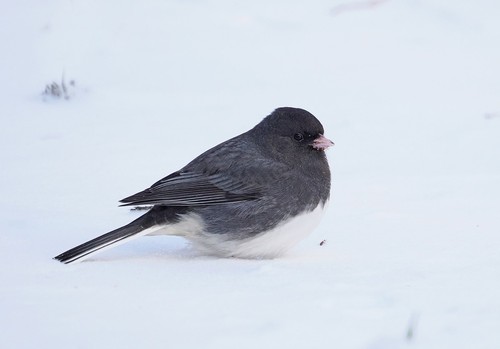
Other birds you may enjoy

Black Redstart
13-14.5 cm (5.1-5.7 in) long, 23-26 cm wingspan

Black-throated Sparrow
12-14 cm (4.7-5.5 in) long, about 19-20 cm (7.5-8 in) wingspan

Greater Bird-of-paradise
Body about 43 cm; males with additional flank plumes up to 50 cm and long tail wires

Blue Tit
11-12 cm (4.3-4.7 in) long, 17-20 cm wingspan

Red-billed Quelea
11.5–13 cm long, wingspan about 20–22 cm
White-plumed Antbird
13-14 cm (5-5.5 in) long

Pyrrhuloxia
19-22 cm (7.5-8.7 in) long, 30 cm wingspan

Blue-gray Tanager
16-18 cm (6-7 in) long

Blackburnian Warbler
11-13 cm (4.3-5.1 in) long, 20-22 cm wingspan

Bluethroat
13-14 cm (5.1-5.5 in) long, 20-22 cm wingspan

Eurasian Nuthatch
12-14.5 cm (4.7-5.7 in) long, 22.5-27 cm wingspan

Wood Thrush
19-21 cm (7.5-8.3 in) long, about 33 cm (13 in) wingspan