
Dark-eyed Junco Identification Guide
A common North American sparrow relative, often called the "snowbird," recognized by its dark hood, white belly, pink bill, and flashing white outer tail feathers.
Read the full Dark-eyed Junco encyclopedia entry →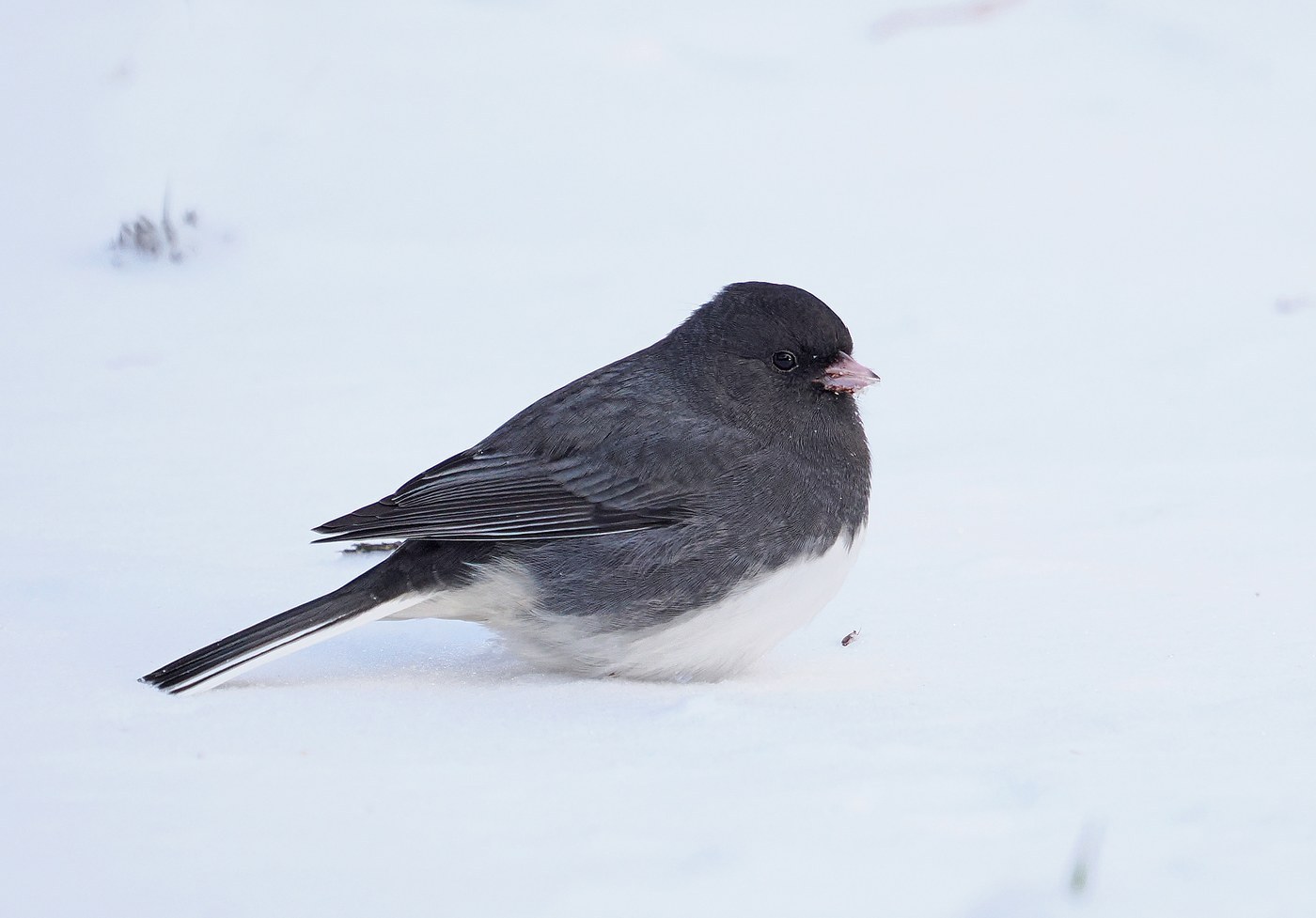
Overview
The Dark-eyed Junco (Junco hyemalis) is one of the most familiar and widespread sparrows in North America, breeding across boreal and montane forests and wintering commonly at feeders throughout much of the continent. It is highly variable geographically, with several distinct-looking forms once considered separate species.
Key Field Marks
- Size & shape: About 13–17.5 cm (5–6.75 in), a small, round-bodied sparrow with a fairly long tail and a conical bill.
- Bill: Pale pink to whitish, contrasting with the darker head — visible at a distance.
- General pattern: Dark hood or upperparts (varying by form from slate-gray to brown/black) sharply demarcated from a clean white belly — the classic "dark above, white below" junco look.
- Tail: Blackish tail with white outer tail feathers that flash conspicuously in flight and when the bird hops, a key identification feature across all forms.
- Eye: Dark eye (hence "dark-eyed"), distinguishing it from the Yellow-eyed Junco of the southwestern mountains.
- Regional forms: "Slate-colored" (uniform gray hood and back, widespread in the east and north), "Oregon" (blackish hood, contrasting rufous-brown back and flanks, western), "Pink-sided" (blue-gray hood, broad pinkish-cinnamon flanks, Rockies), "Gray-headed" (pale gray overall with a rufous back patch, southern Rockies), and "White-winged" (pale gray with white wing bars, Black Hills) — all are the same species but look quite different.
Similar Species
- Spotted Towhee/Eastern Towhee: Much larger with red eyes (in most populations) and bold white spotting/wing markings, not just a plain dark hood.
- Yellow-eyed Junco (southwestern mountains, limited overlap): Pale yellow eye instead of dark, otherwise similar gray-and-white pattern.
- Regional junco forms can look like different species, but the white outer tail feathers, pink bill, and overall shape unify them as Dark-eyed Junco.
Habitat & Range
Breeds in coniferous and mixed forests across Canada, Alaska, and mountainous parts of the western and northeastern U.S. In winter, found in open woodlands, brushy edges, parks, and especially at backyard bird feeders across most of the continental U.S. and northern Mexico, often in flocks.
Behavior
Forages mostly on the ground, hopping and scratching through leaf litter and snow for seeds and insects, flicking white tail feathers as it moves. Often in loose flocks in winter, sometimes with other sparrow species, with a fairly steady flock hierarchy.
Voice
Song is a simple, dry, musical trill on one pitch, similar to a Chipping Sparrow's but usually more musical and ringing. Common call is a sharp "smack" or twittering note given in flight and while foraging.
Best Viewing Tips
Check feeders and brushy field edges in winter across most of North America; watch for the flash of white outer tail feathers as birds hop and fly, and note bill color (pink) and the clean division between the dark hood/back and white belly.
Frequently asked questions
Why are Dark-eyed Juncos called "snowbirds"?
They are called snowbirds because they become much more visible at feeders and in yards across much of North America in winter, often coinciding with snowy weather, even though they breed farther north or at higher elevations.
How many types of Dark-eyed Junco are there?
There are several distinctly plumaged regional forms (such as Slate-colored, Oregon, Pink-sided, Gray-headed, and White-winged), all considered the same species despite looking quite different.
What is the easiest way to identify a Dark-eyed Junco?
Look for a small sparrow with a dark hood, contrasting white belly, pink bill, and white outer tail feathers that flash when it flies or hops.
Do Dark-eyed Juncos migrate?
Many populations are migratory, breeding in northern or mountain forests and moving to lower elevations and more southern latitudes in winter, though some populations are largely resident.