
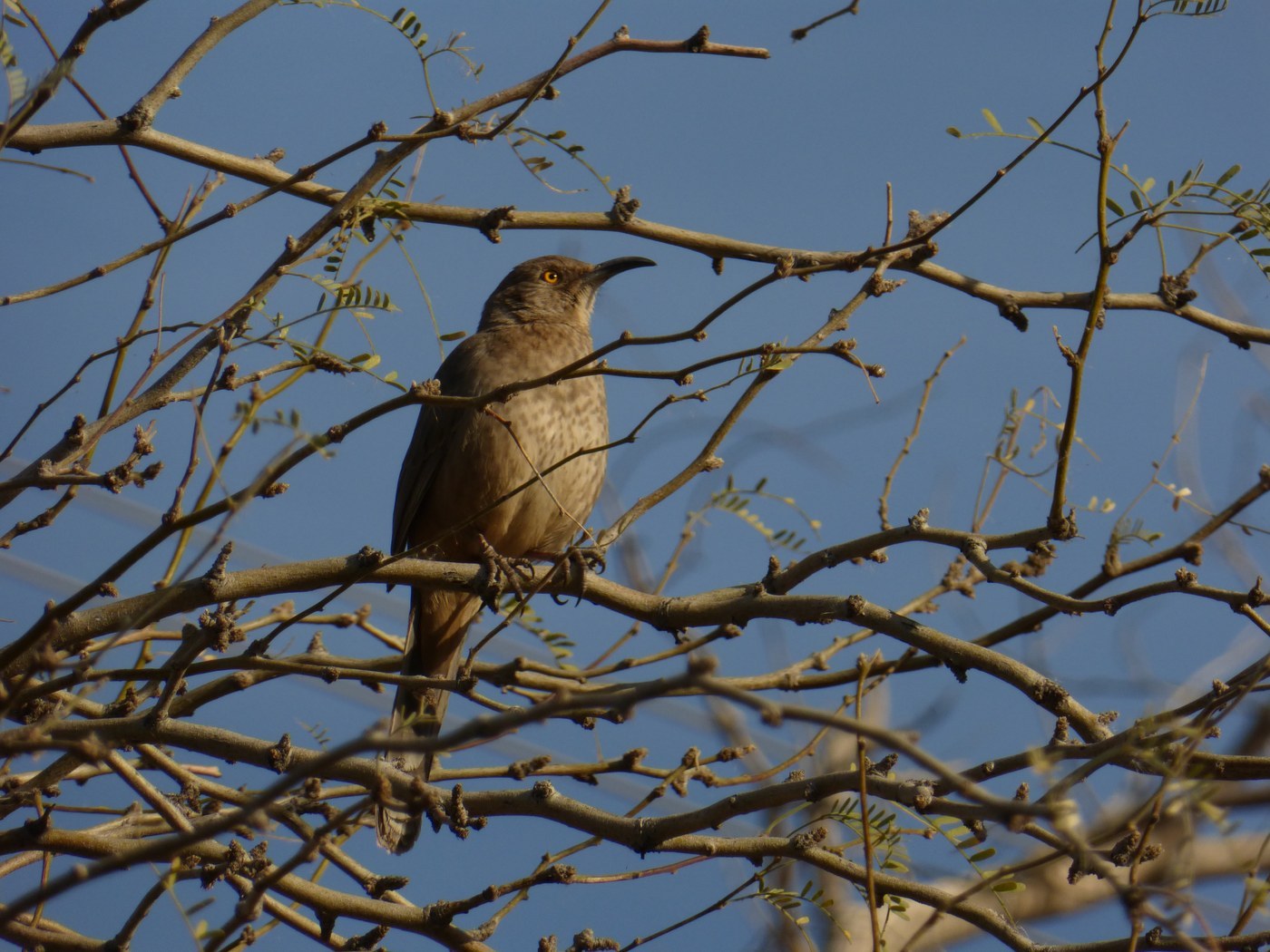
Curve-billed Thrasher
Toxostoma curvirostre
A common, noisy desert thrasher with a long downcurved bill and orange-red eyes, often seen atop cactus in the Southwest.
- Size
- 25-28 cm (10-11 in) long
- Habitat
- desert scrub and cactus habitat, especially cholla
- Type
- songbird
Spotted a bird like this?
Identify any bird from a photo, free.
Overview
The Curve-billed Thrasher is one of the most familiar and conspicuous birds of the desert Southwest, a bold, noisy resident that thrives in the cactus-studded landscapes of Arizona, New Mexico, and Texas. Grayish-brown overall with only faint breast spotting, its most distinctive feature is a long, strongly downcurved bill used for probing soil and cactus for food.
The species is a common, year-round backyard bird across much of its range, readily nesting in cholla and other spiny cacti, and it is often heard before it is seen thanks to its loud, whistled call notes.
How to identify it
Key field marks
- Grayish-brown overall plumage
- Long, strongly downcurved black bill
- Bright orange-red eyes
- Faint, diffuse breast spotting
- White wing bars and white tips on the outer tail feathers
Similar species
Bendire's Thrasher is very similar but has a shorter, straighter bill, paler yellowish eyes, and more distinct, arrowhead-shaped breast spots. Crissal Thrasher lacks breast streaking entirely and shows a chestnut undertail patch. Curve-billed's combination of orange-red eyes and long curved bill with faint spotting is diagnostic in most of its range.
Habitat & range
Habitat
Curve-billed Thrashers favor desert scrub, especially areas with abundant cholla and other cacti, as well as suburban yards and parks with cactus landscaping within their range.
Range
The species is a year-round resident across the Sonoran and Chihuahuan Desert regions of the southwestern United States, including Arizona, New Mexico, and Texas, and ranges south through much of Mexico.
Migration
Curve-billed Thrashers are non-migratory, remaining on their desert territories throughout the year.
Behavior & voice
Behavior
Curve-billed Thrashers forage mainly on the ground, using their curved bills to dig and flip through soil and leaf litter for insects, and also eat cactus fruit and other berries; they are bold and often approach human dwellings and feeders.
Voice
The call is a loud, sharp, whistled "whit-wheet," often the first clue to the bird's presence; the song is a long, varied series of warbled phrases, richer and more musical than the call.
Nesting
Nests are built within the protective spines of cholla or other cactus, constructed as a bulky cup of twigs. Females lay 2-4 pale blue-green eggs, and the species may raise multiple broods in a season.
Frequently asked questions
How do you identify a Curve-billed Thrasher?
Look for a grayish-brown bird with a long, strongly downcurved black bill, bright orange-red eyes, and faint breast spotting, often seen perched on cactus in the desert Southwest.
What does a Curve-billed Thrasher sound like?
Its call is a loud, sharp, whistled "whit-wheet," and its song is a long, varied series of warbled phrases.
Where do Curve-billed Thrashers nest?
They typically nest within the protective spines of cholla or other cactus.
How do you tell Curve-billed from Bendire's Thrasher?
Curve-billed has a longer, more strongly curved bill and orange-red eyes with faint spotting, while Bendire's has a shorter, straighter bill, paler yellowish eyes, and more distinct breast spots.
Curve-billed Thrasher guides
In-depth guides for identifying, finding, and understanding Curve-billed Thrasher.
Other birds you may enjoy

Black Redstart
13-14.5 cm (5.1-5.7 in) long, 23-26 cm wingspan

Black-throated Sparrow
12-14 cm (4.7-5.5 in) long, about 19-20 cm (7.5-8 in) wingspan

Greater Bird-of-paradise
Body about 43 cm; males with additional flank plumes up to 50 cm and long tail wires

Blue Tit
11-12 cm (4.3-4.7 in) long, 17-20 cm wingspan

Red-billed Quelea
11.5–13 cm long, wingspan about 20–22 cm
White-plumed Antbird
13-14 cm (5-5.5 in) long

Pyrrhuloxia
19-22 cm (7.5-8.7 in) long, 30 cm wingspan

Blue-gray Tanager
16-18 cm (6-7 in) long

Blackburnian Warbler
11-13 cm (4.3-5.1 in) long, 20-22 cm wingspan

Bluethroat
13-14 cm (5.1-5.5 in) long, 20-22 cm wingspan

Eurasian Nuthatch
12-14.5 cm (4.7-5.7 in) long, 22.5-27 cm wingspan

Wood Thrush
19-21 cm (7.5-8.3 in) long, about 33 cm (13 in) wingspan