
Curve-billed Thrasher Identification Guide
A common desert songbird of the American Southwest and Mexico, gray-brown overall with a long downcurved bill, orange eyes, and a loud whit-wheet call.
Read the full Curve-billed Thrasher encyclopedia entry →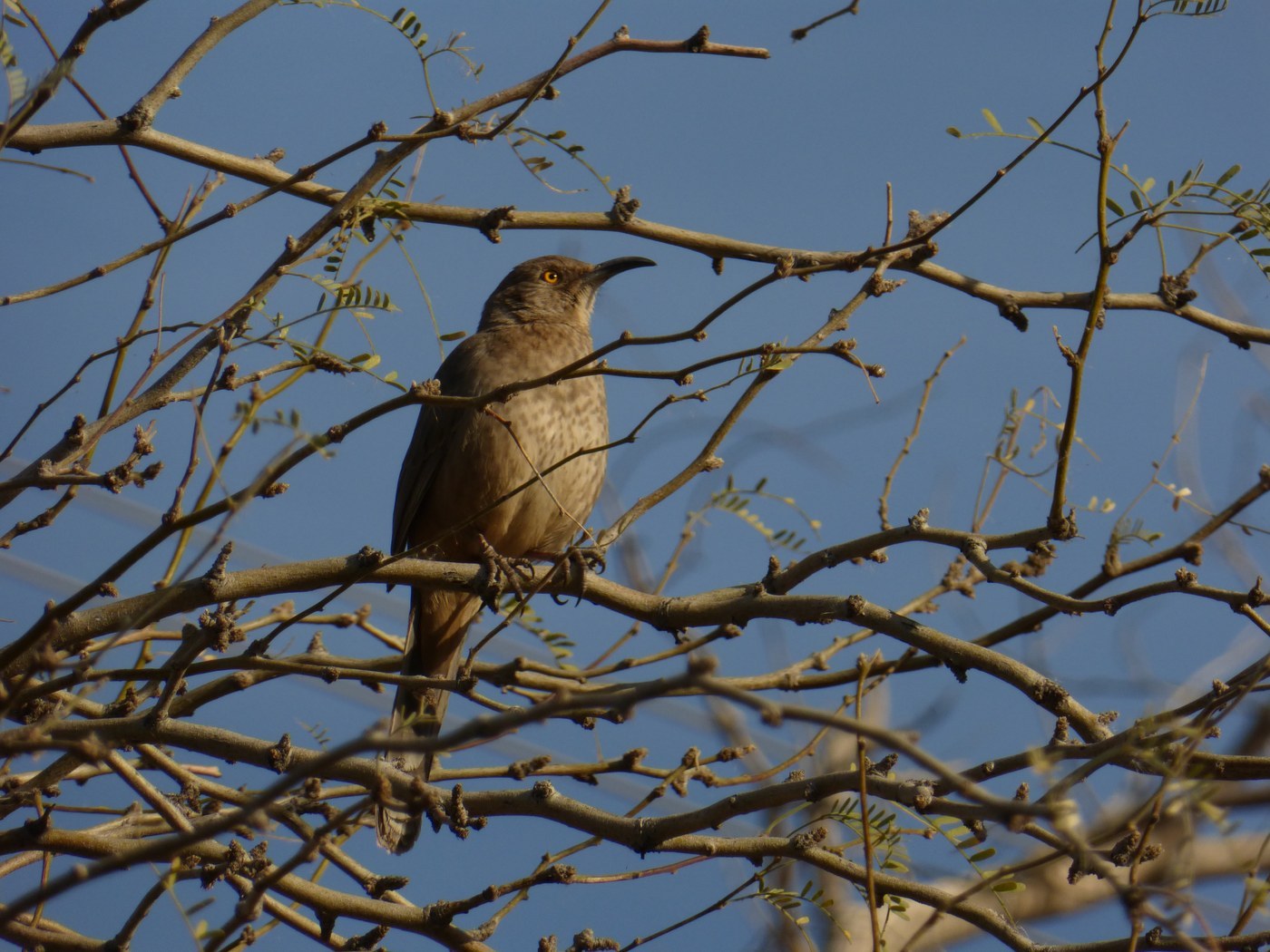
Overview
The Curve-billed Thrasher (Toxostoma curvirostre) is the default large gray-brown thrasher of desert scrub and cactus country across the southwestern United States and much of Mexico. It's a bold, vocal bird often seen perched atop cactus or shrubs.
Key Field Marks
- Size & shape: About 25–28 cm (10–11 in), a long-tailed, long-legged songbird with a fairly slim body and an obviously decurved bill.
- Bill: Moderately long and curved downward, blackish, and thicker-based than in some other thrashers.
- Plumage: Grayish-brown overall above, slightly paler grayish-buff below, with faint, blurry breast spotting that is more diffuse than crisp (unlike the bold spotting of Brown Thrasher).
- Eye: Bright orange to orange-red iris, obvious at close range and a good distinguishing feature from similar species with yellow eyes.
- Wing bars: Two narrow, pale wing bars, subtle rather than bold.
- Tail: Long, dark tail with whitish corners/tips visible from below, especially in flight.
Similar Species
- Bendire's Thrasher: Shorter, straighter, and paler bill (often looking almost straight rather than strongly curved), pale yellowish eye rather than orange, and crisper, more defined breast spotting arranged in a necklace — ranges overlap in parts of Arizona and New Mexico, so bill shape and eye color are key.
- Brown Thrasher (mostly separate range in the east): Bright rufous upperparts and bold, crisp black breast streaking with yellow eyes, quite different in color tone.
- California/LeConte's Thrashers: Much paler (LeConte's) or differently patterned and largely allopatric.
Habitat & Range
Resident in desert scrub, thornscrub, and suburban areas with cactus (especially cholla) from central Arizona and New Mexico east to central Texas, and south through much of Mexico. Highly associated with cholla and other cacti for nesting.
Behavior
Forages mostly on the ground, using its curved bill to sweep aside leaf litter and dig for insects and other invertebrates. Often perches conspicuously atop cacti or shrubs to sing or scold. Bold and often approaches yards and feeders in its range, sometimes seen using bird baths.
Voice
Song is a long series of rich, varied musical phrases, often doubled or repeated, reminiscent of a mockingbird but lower and richer. The most distinctive vocalization is a sharp, whistled "whit-WHEET" call, often given repeatedly and diagnostic of the species even without a visual.
Best Viewing Tips
Listen for the sharp whit-wheet call from desert scrub or a backyard with cholla cactus in the Southwest; look for the bird perched on top of a cactus, and check the eye color (orange) and bill curvature to rule out Bendire's Thrasher where ranges overlap.
Frequently asked questions
How can I tell a Curve-billed Thrasher from a Bendire's Thrasher?
Curve-billed has a longer, more strongly downcurved black bill and an orange eye, while Bendire's has a shorter, straighter, paler-based bill and a pale yellowish eye.
What is the distinctive call of the Curve-billed Thrasher?
A sharp, whistled "whit-WHEET" call, often repeated, is highly diagnostic and frequently heard before the bird is seen.
Where does the Curve-billed Thrasher live?
It's a year-round resident of desert scrub and cactus habitats from Arizona, New Mexico, and Texas south through much of Mexico.
Does the Curve-billed Thrasher migrate?
No, it is a non-migratory resident throughout its range, staying in the same desert habitats year-round.