
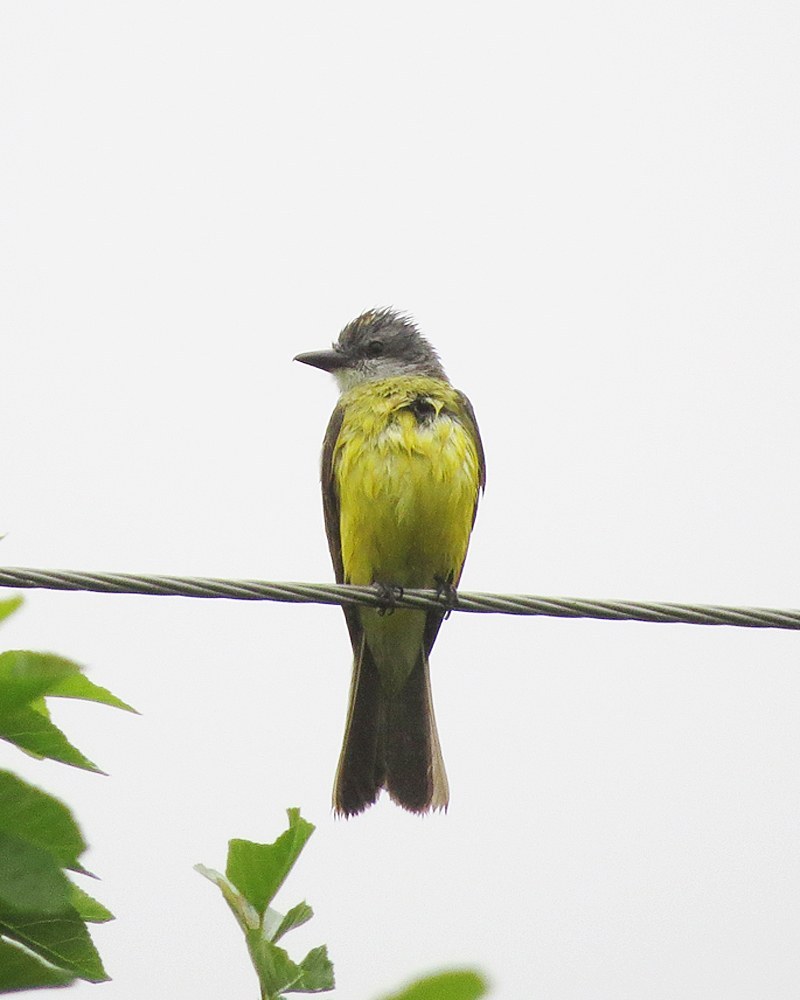
Couch's Kingbird
Tyrannus couchii
A south Texas specialty nearly indistinguishable from Tropical Kingbird in plumage, but recognized by its distinctive burry 'breeer' call.
- Size
- 22-24 cm (9 in) long, 38-40 cm wingspan
- Habitat
- woodland edges, resacas, and brushy areas of the lower Rio Grande Valley, Mexico, and Central America
- Type
- songbird
Spotted a bird like this?
Identify any bird from a photo, free.
Overview
Couch's Kingbird is a large tropical flycatcher found in the United States only in the lower Rio Grande Valley of south Texas, where it replaces the very similar Tropical Kingbird. It shares the same gray head, olive back, notched blackish tail, and bright yellow belly, making the two species essentially impossible to separate by sight alone.
Named for naturalist Darius Nash Couch, this kingbird favors semi-open woodland edges, resacas (oxbow lakes), and scrubby thickets, where it perches prominently while hunting insects.
How to identify it
Key field marks
- Gray head, olive-green back, bright yellow belly
- Notched blackish tail
- Large flycatcher with a fairly heavy bill
Similar species
- Tropical Kingbird: essentially identical in plumage; distinguished chiefly by voice (Tropical gives a rapid even trill, Couch's gives a sharp "kip" and burry "breeer") and by slightly different bill proportions.
- Western Kingbird: square, white-edged tail rather than notched blackish tail.
- Cassin's Kingbird: grayer overall with a less deeply notched tail.
Habitat & range
Range and habitat
Couch's Kingbird occurs from south Texas south through eastern Mexico to Belize and Guatemala. In the US it is largely confined to the lower Rio Grande Valley, where it uses woodland edges, resacas, ranchland with scattered trees, and increasingly, suburban areas with tall trees.
Migration
Mostly resident, though some individuals wander north or east outside the breeding season, occasionally turning up well outside the core range in fall and winter.
Behavior & voice
Behavior
Like other kingbirds, Couch's perches conspicuously and sallies out after flying insects, returning to the same or a nearby perch.
Voice
The most reliable way to separate this species from Tropical Kingbird: a sharp "kip" note and a distinctive rolling, burry "breeer" or "kip-kip-kididear."
Feeding
Primarily flying insects taken by flycatching; also eats berries and small fruit.
Nesting and breeding
Builds a bulky twig-and-grass cup nest on a horizontal branch, often well concealed in foliage. The female incubates 3-5 eggs, and both adults defend the nest aggressively.
Frequently asked questions
How is Couch's Kingbird different from Tropical Kingbird?
The two look almost identical; the best way to tell them apart is voice—Couch's gives a sharp 'kip' and a burry rolling 'breeer,' while Tropical Kingbird gives an even, rapid twittering trill.
Where can you find Couch's Kingbird in the US?
It occurs in the United States mainly in the lower Rio Grande Valley of south Texas.
What does Couch's Kingbird eat?
Mainly flying insects caught in mid-air, plus some berries and fruit.
Is Couch's Kingbird migratory?
Most individuals are year-round residents, though some wander outside the breeding range after the nesting season.
Couch's Kingbird guides
In-depth guides for identifying, finding, and understanding Couch's Kingbird.
Other birds you may enjoy

Black Redstart
13-14.5 cm (5.1-5.7 in) long, 23-26 cm wingspan

Black-throated Sparrow
12-14 cm (4.7-5.5 in) long, about 19-20 cm (7.5-8 in) wingspan

Greater Bird-of-paradise
Body about 43 cm; males with additional flank plumes up to 50 cm and long tail wires

Blue Tit
11-12 cm (4.3-4.7 in) long, 17-20 cm wingspan

Red-billed Quelea
11.5–13 cm long, wingspan about 20–22 cm
White-plumed Antbird
13-14 cm (5-5.5 in) long

Pyrrhuloxia
19-22 cm (7.5-8.7 in) long, 30 cm wingspan

Blue-gray Tanager
16-18 cm (6-7 in) long

Blackburnian Warbler
11-13 cm (4.3-5.1 in) long, 20-22 cm wingspan

Bluethroat
13-14 cm (5.1-5.5 in) long, 20-22 cm wingspan

Eurasian Nuthatch
12-14.5 cm (4.7-5.7 in) long, 22.5-27 cm wingspan

Wood Thrush
19-21 cm (7.5-8.3 in) long, about 33 cm (13 in) wingspan