
Couch's Kingbird Identification Guide
A gray-headed, yellow-bellied kingbird of the Lower Rio Grande Valley, virtually identical to Tropical Kingbird in plumage and best told apart by its distinctive rolling "breeer" call.
Read the full Couch's Kingbird encyclopedia entry →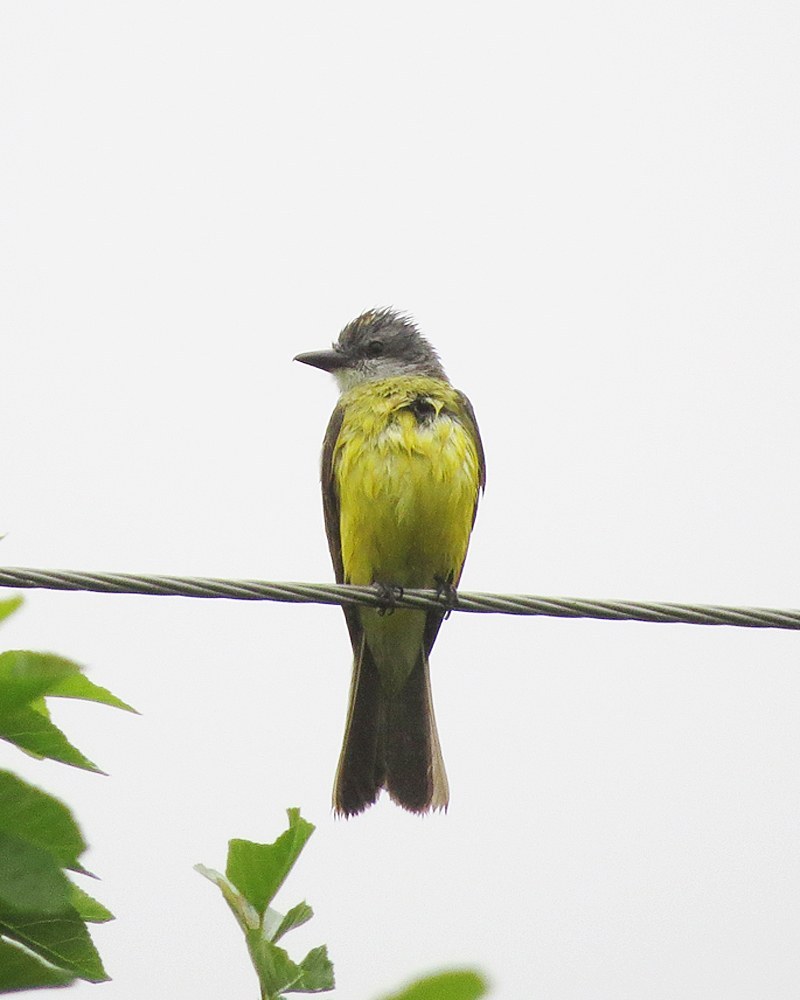
Key Field Marks
- Size & shape: A medium-large tyrant flycatcher, about 22 cm, with a fairly large head and a relatively short, thick-based bill compared to some other kingbirds.
- Plumage: Gray head, olive-gray back, and bright yellow belly; tail is brownish-black and only shallowly notched, not deeply forked.
- Behavior: Perches conspicuously on wires, fence lines, and treetops in open or semi-open country, sallying out to catch flying insects.
Separating It From Similar Species
- Tropical Kingbird: Nearly identical in plumage; Tropical Kingbird tends to have a slightly longer, more deeply notched tail and a proportionally longer bill, but the most reliable distinction is voice — Tropical gives a rapid, twittering trill, while Couch's gives a rolling, buzzy "breeer" or "kip-kip-kideer."
- Western Kingbird: Shows white edges on the outer tail feathers and a darker gray head contrasting more strongly with a paler, less yellow throat — Couch's and Tropical both lack white tail edges.
- Cassin's Kingbird: Has a darker gray chest with a whiter chin that contrasts more sharply, and pale (not white) tips to the tail feathers rather than Western's crisp white edges.
Where & When to See It
- Habitat: Woodland edges, riparian corridors, brushy semi-open country, and areas with scattered large trees.
- Range: Resident from the Lower Rio Grande Valley of south Texas south through eastern Mexico into Central America, with some post-breeding wandering north and east along the Gulf coast, occasionally reaching farther-flung states in fall and winter.
- Season: Largely resident within its core range, making it possible to find year-round in south Texas.
Voice
- Call: A distinctive, rolled, buzzy "breeer" or a rolling "kip-kip-kideer," the single most reliable way to separate this species from the nearly identical-looking Tropical Kingbird.
Frequently asked questions
How do I tell Couch's Kingbird from Tropical Kingbird?
The two look nearly identical in plumage; the best way to distinguish them is by voice — Couch's gives a rolling, buzzy "breeer" or "kip-kip-kideer," while Tropical Kingbird gives a rapid twittering trill.
What distinguishes Couch's Kingbird from Western Kingbird?
Western Kingbird has crisp white edges on its outer tail feathers, which Couch's Kingbird lacks, along with a paler throat contrasting against a darker gray head.
Where is the best place in the U.S. to find Couch's Kingbird?
The Lower Rio Grande Valley of south Texas is the most reliable U.S. location, where it is resident year-round.
Is Couch's Kingbird migratory?
It is largely resident within its core range in south Texas and eastern Mexico, though some individuals wander north and east along the Gulf coast after breeding.
Can plumage alone confirm a Couch's Kingbird identification?
Rarely with full confidence — because it is so similar to Tropical Kingbird in plumage, most confident identifications rely on hearing the bird's distinctive rolling call.