
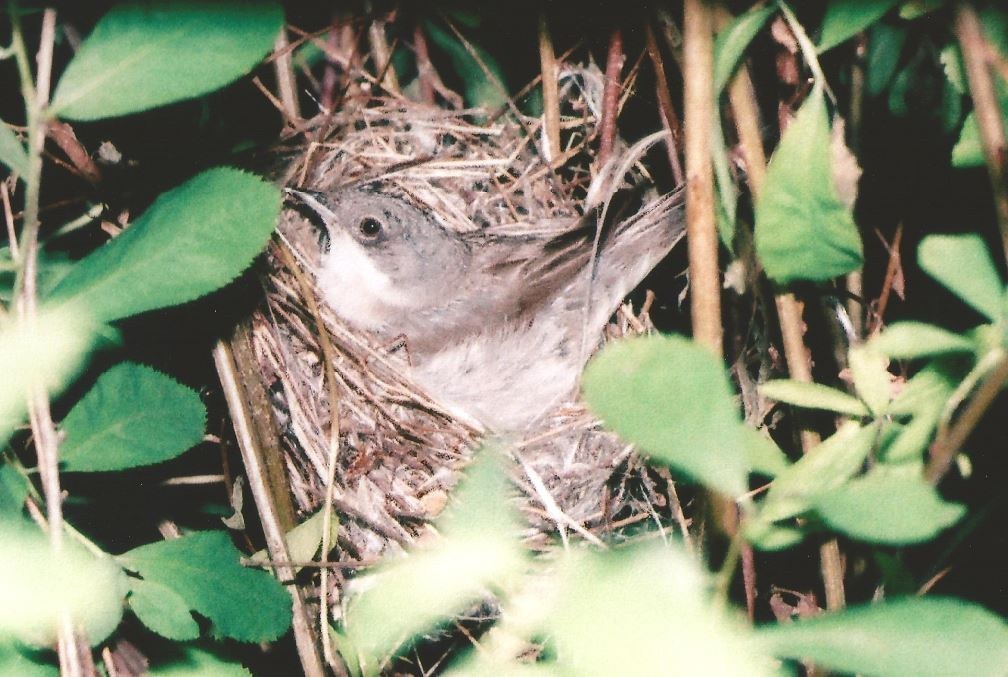
Common Whitethroat
Curruca communis
An animated scrubland warbler with a grey head, bright white throat, and chestnut-fringed wings, often seen bursting into a brief song-flight above the hedgerow.
- Size
- 13-15 cm (5-6 in) long, 18-23 cm wingspan
- Habitat
- scrub, hedgerows, bramble patches, and farmland edges
- Type
- songbird
Spotted a bird like this?
Identify any bird from a photo, free.
Overview
The Common Whitethroat is a lively, restless warbler of scrubby countryside, named for the bright white throat patch that contrasts with its grey head and warm brown body. Males show a clean, pale grey head, while females and juveniles are duller and browner overall.
The wings show a distinctive rufous-chestnut fringing to the flight feathers, giving a warm, bright panel that helps separate it from similar species. The tail is fairly long and often flicked or cocked, adding to the bird's restless, energetic character.
It is best known for its scratchy song delivered from deep in a hedge or, more conspicuously, during a brief bounding song-flight in which the male rises a short distance into the air before dropping back into cover.
How to identify it
Key field marks
- Grey head (male) or brownish head (female/juvenile)
- Bright white throat contrasting with the rest of the body
- Warm chestnut fringing on the wing feathers
- Fairly long tail, often cocked or flicked
- Pale eye-ring and pinkish-brown legs
Similar species
- Lesser Whitethroat: greyer overall, lacks the chestnut wing panel, has a darker mask through the eye, and gives a distinctive one-note rattling song rather than a scratchy warble.
- Garden Warbler: lacks the white throat contrast and chestnut wing panel, and is uniformly plain brown.
- Dartford Warbler: much darker and wine-red below, with a longer tail relative to body size and no white throat contrast.
Habitat & range
Common Whitethroats breed across most of Europe and temperate Asia, favouring open scrub, bramble-choked hedgerows, farmland margins, and other areas of dense low vegetation with scattered taller perches.
They are long-distance migrants, wintering in the Sahel zone south of the Sahara, and populations have historically shown dramatic year-to-year fluctuations linked to drought conditions on the African wintering grounds.
The species returns to breeding areas in April and quickly becomes conspicuous through its song-flight display.
Behavior & voice
Voice
The song is a fast, scratchy, chattering warble, often delivered from cover but also given during a distinctive short song-flight in which the male flutters up a few metres before parachuting back down into the hedge. The call is a harsh "tacc" or a soft "wheet."
Feeding
Insects and spiders gleaned from foliage and picked off the ground make up the bulk of the summer diet, with berries becoming more important before autumn migration.
Nesting and breeding
The nest is a flimsy cup of grass built low in dense scrub or brambles, often close to the ground. Clutches typically number four to five eggs, and males may build several "cock nests" before the female selects one to line and use.
Frequently asked questions
How do you identify a Common Whitethroat?
Look for a grey-headed warbler with a bright white throat, chestnut-fringed wings, and a long tail often cocked, frequently seen making short bounding flights above hedgerows.
What is the difference between Common and Lesser Whitethroat?
Common Whitethroat has a warmer brown body with rufous wing fringes and a scratchy warbling song, while Lesser Whitethroat is greyer, lacks chestnut in the wing, and gives a distinctive single-note rattle.
What does a Common Whitethroat's song-flight look like?
The male flutters a short distance up from cover, sings briefly, and then drops back down into the hedge or scrub, a display often seen in spring and early summer.
Where do Common Whitethroats winter?
They migrate to the Sahel region south of the Sahara Desert, and their numbers have historically fluctuated with drought conditions there.
What habitat do Common Whitethroats prefer?
They favour scrubby farmland, hedgerows, and bramble patches with dense low cover and a few taller song perches.
Common Whitethroat guides
In-depth guides for identifying, finding, and understanding Common Whitethroat.
Other birds you may enjoy

Black Redstart
13-14.5 cm (5.1-5.7 in) long, 23-26 cm wingspan

Black-throated Sparrow
12-14 cm (4.7-5.5 in) long, about 19-20 cm (7.5-8 in) wingspan

Greater Bird-of-paradise
Body about 43 cm; males with additional flank plumes up to 50 cm and long tail wires

Blue Tit
11-12 cm (4.3-4.7 in) long, 17-20 cm wingspan

Red-billed Quelea
11.5–13 cm long, wingspan about 20–22 cm
White-plumed Antbird
13-14 cm (5-5.5 in) long

Pyrrhuloxia
19-22 cm (7.5-8.7 in) long, 30 cm wingspan

Blue-gray Tanager
16-18 cm (6-7 in) long

Blackburnian Warbler
11-13 cm (4.3-5.1 in) long, 20-22 cm wingspan

Bluethroat
13-14 cm (5.1-5.5 in) long, 20-22 cm wingspan

Eurasian Nuthatch
12-14.5 cm (4.7-5.7 in) long, 22.5-27 cm wingspan

Wood Thrush
19-21 cm (7.5-8.3 in) long, about 33 cm (13 in) wingspan