
Common Whitethroat Identification Guide
A slim, skulking Old World warbler told by its bright white throat, rusty wing panel, and scratchy chattering song delivered from scrub or a jerky song-flight.
Read the full Common Whitethroat encyclopedia entry →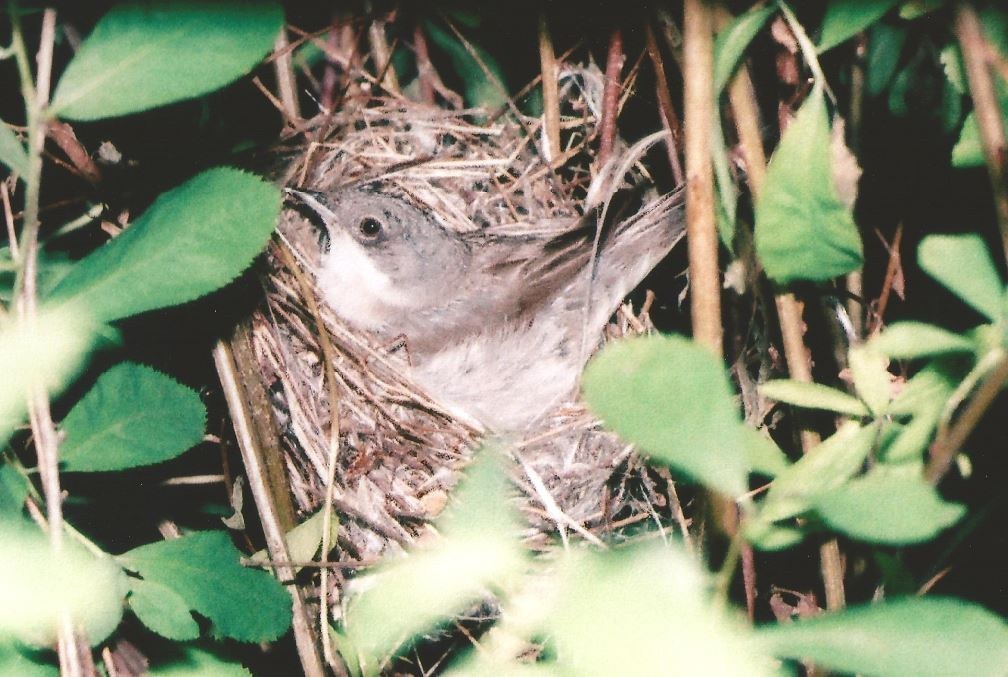
Key Field Marks
- Size & shape: A small, slender warbler (about 13–15 cm) with a fairly long tail and a small, peaked head that it often raises, giving an alert, long-necked look.
- Throat: The namesake feature — a clean, bright white throat that puffs out and contrasts sharply with the rest of the plumage, especially when the bird sings.
- Upperparts: Grey-brown back with a distinctive rufous/chestnut panel across the folded wing (edges of the secondaries and tertials), which is one of the best year-round field marks.
- Head: Males show a cleaner grey head and pale eye-ring; females and immatures have a browner, less contrasting head but retain the white throat and rusty wing panel.
- Underparts: Pale pinkish-buff breast fading to whitish belly.
- Bill & legs: Fine, dark bill typical of Sylviid warblers; legs pale pinkish-brown.
- Behavior: Often skulks low in brambles and hedgerows, but males regularly pop up to sing from an exposed twig or perform a short, jerky, bouncing song-flight before dropping back into cover. Frequently flicks and cocks its tail.
Separating It From Similar Species
- Lesser Whitethroat: Greyer overall, with a darker mask through the eye, no rufous wing panel, and white outer tail feathers that flash in flight; song is a flat rattle rather than a scratchy chatter.
- Garden Warbler: Plain, featureless face and wings with no white throat contrast and no rusty wing panel; much less vocal in short bursts.
- Subalpine/Sardinian Warbler (where ranges overlap): Both show more saturated pink underparts and a red eye-ring/orbital ring, lacking the Common Whitethroat's rufous wing panel.
Where & When to See It
- Habitat: Scrubby field edges, hedgerows, bramble patches, young plantations, heathland with gorse, and overgrown wasteland — anywhere with dense low cover and song perches.
- Range: Breeds across almost all of Europe and western/central Asia.
- Season: A long-distance migrant; present on breeding grounds roughly April to September, wintering in sub-Saharan Africa (the Sahel belt).
Voice
- Song: A fast, scratchy, chattering warble, often described as hurried and slightly grating, delivered either from a perch or during the bouncing display flight.
- Call: A harsh, scolding "tacc-tacc" or churring note given when agitated near the nest or a perceived threat.
Frequently asked questions
What is the single best field mark for Common Whitethroat?
The combination of a bright white throat and a rufous-chestnut panel across the closed wing is diagnostic; no similarly patterned Sylvia/Curruca warbler shows both features together.
How do I tell Common Whitethroat from Lesser Whitethroat?
Common Whitethroat has a rusty wing panel and a scratchy chattering song; Lesser Whitethroat lacks the rusty wing panel, has a darker face mask, white outer tail feathers, and a distinctive flat rattling song.
Where is the best place to look for Common Whitethroat?
Scan low scrub, hedgerows, and bramble edges of farmland or heathland — males often perch up on the tallest available twig to sing or make short song-flights above the cover.
Do male and female Common Whitethroats look different?
Yes — males have a cleaner grey head that contrasts with the white throat, while females and immatures have a duller, browner head, though both sexes show the rusty wing panel.
When is Common Whitethroat present in Europe?
It's a summer visitor, typically arriving in April and departing by September, wintering south of the Sahara in Africa.