
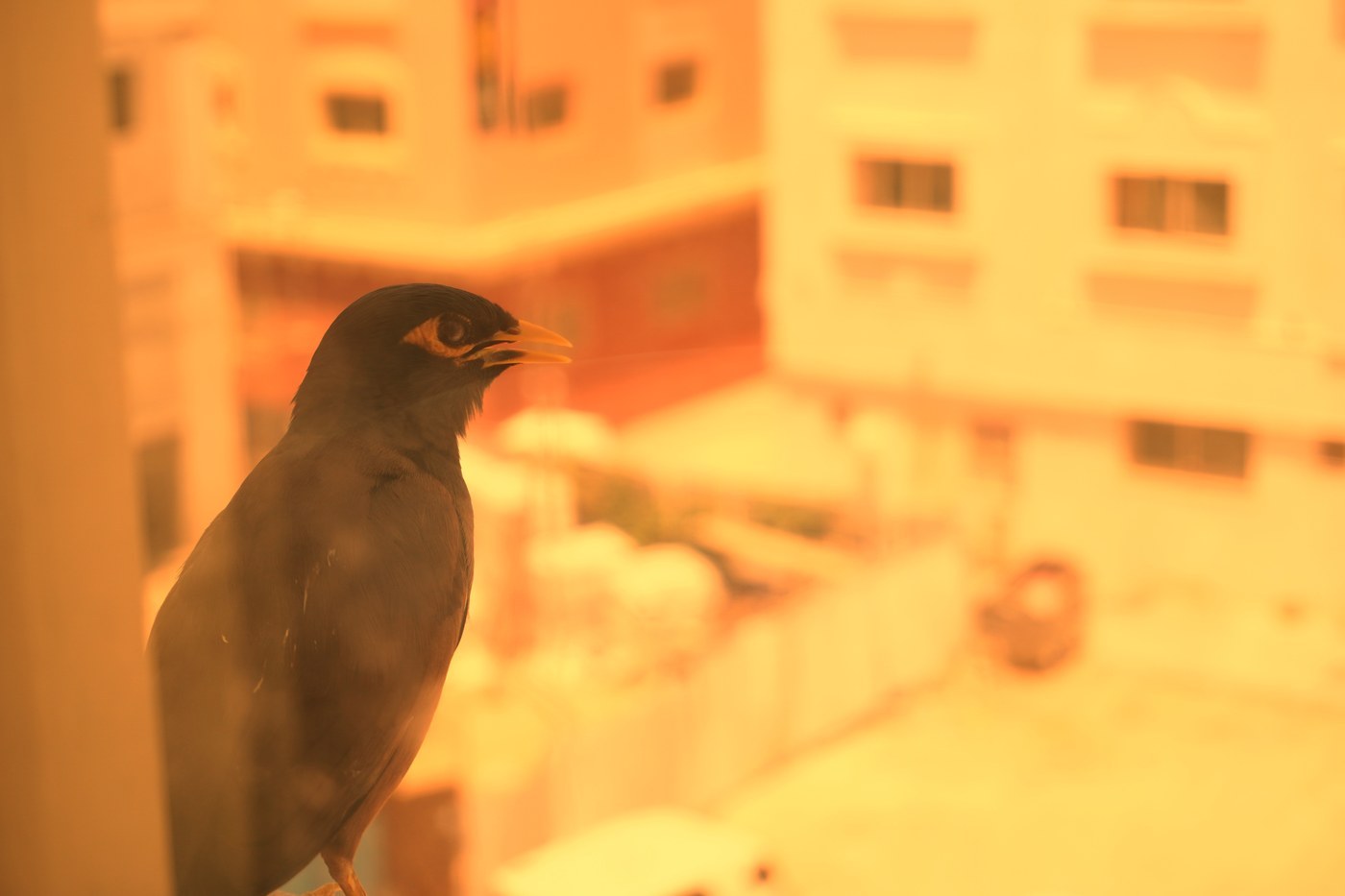
Common Myna
Acridotheres tristis
A brown-bodied, black-headed myna with bright yellow bill, legs, and bare eye patch, one of the world's most successful urban-adapted birds.
- Size
- 23-26 cm (9-10 in) long, 35-42 cm wingspan
- Habitat
- cities, towns, farmland, and open country
- Type
- songbird
Spotted a bird like this?
Identify any bird from a photo, free.
Overview
The Common Myna is a familiar, highly adaptable songbird native to South and Southeast Asia but now established as one of the world's most widespread introduced birds. It has a chocolate-brown body, a glossy black head and throat, and bright yellow bare skin around the eye, matched by a yellow bill and yellow legs.
In flight it reveals large white wing patches and a white-tipped tail, features that make it easy to identify even at a distance. Confident and conspicuous, it thrives in close association with people, often seen strutting on lawns, roadsides, and outdoor dining areas.
How to identify it
Key field marks
- Chocolate-brown body, glossy black head and throat
- Bright yellow bill, legs, and bare skin patch around the eye
- Bold white wing patches visible in flight, white-tipped tail
- Confident, upright walk on the ground
Similar species
The Jungle Myna is greyer with a tuft of feathers on the forehead and a blue-white eye. The Bank Myna is paler grey-brown with an orange (not yellow) eye patch. The Common Myna's brown body and yellow eye patch combination is distinctive.
Habitat & range
Range
Native to South Asia, Afghanistan, and parts of Southeast Asia; widely introduced and now established across Australia, South Africa, the Middle East, and many Pacific and Indian Ocean islands.
Habitat
Highly adaptable, thriving in cities, towns, agricultural land, and open country; strongly associated with human settlement and often uncommon in undisturbed natural habitats.
Migration
Largely resident, with local movements related to food availability rather than long-distance migration.
Behavior & voice
Behavior
Bold, confident, and highly social, often seen in pairs or small groups foraging on the ground; forms large communal roosts, sometimes numbering thousands of birds, especially in urban trees.
Voice
A varied range of chattering, gurgling, and squawking notes, along with some mimicry; often noisy, especially at communal roosts.
Feeding
An opportunistic omnivore, eating insects, fruit, seeds, small reptiles, and scraps of human food, contributing to its success in urban environments.
Nesting and breeding
Nests in cavities, including tree holes, building crevices, and roof spaces, often competing aggressively with native cavity-nesting species. Lays 4-6 eggs, with both parents caring for the young.
Frequently asked questions
Why is the Common Myna considered a problem in some countries?
As an introduced species outside its native range, it can outcompete native cavity-nesting birds for nest sites and adapts aggressively to urban and agricultural habitats.
How do you identify a Common Myna?
Look for a brown body, glossy black head, bright yellow bill and legs, a yellow bare-skin eye patch, and white wing patches visible in flight.
Where is the Common Myna originally from?
It is native to South and Southeast Asia but has been introduced and become established in many other parts of the world.
What does the Common Myna eat?
It is an opportunistic omnivore that eats insects, fruit, seeds, small vertebrates, and scavenged food scraps.
Common Myna guides
In-depth guides for identifying, finding, and understanding Common Myna.
Other birds you may enjoy

Black Redstart
13-14.5 cm (5.1-5.7 in) long, 23-26 cm wingspan

Black-throated Sparrow
12-14 cm (4.7-5.5 in) long, about 19-20 cm (7.5-8 in) wingspan

Greater Bird-of-paradise
Body about 43 cm; males with additional flank plumes up to 50 cm and long tail wires

Blue Tit
11-12 cm (4.3-4.7 in) long, 17-20 cm wingspan

Red-billed Quelea
11.5–13 cm long, wingspan about 20–22 cm
White-plumed Antbird
13-14 cm (5-5.5 in) long

Pyrrhuloxia
19-22 cm (7.5-8.7 in) long, 30 cm wingspan

Blue-gray Tanager
16-18 cm (6-7 in) long

Blackburnian Warbler
11-13 cm (4.3-5.1 in) long, 20-22 cm wingspan

Bluethroat
13-14 cm (5.1-5.5 in) long, 20-22 cm wingspan

Eurasian Nuthatch
12-14.5 cm (4.7-5.7 in) long, 22.5-27 cm wingspan

Wood Thrush
19-21 cm (7.5-8.3 in) long, about 33 cm (13 in) wingspan