
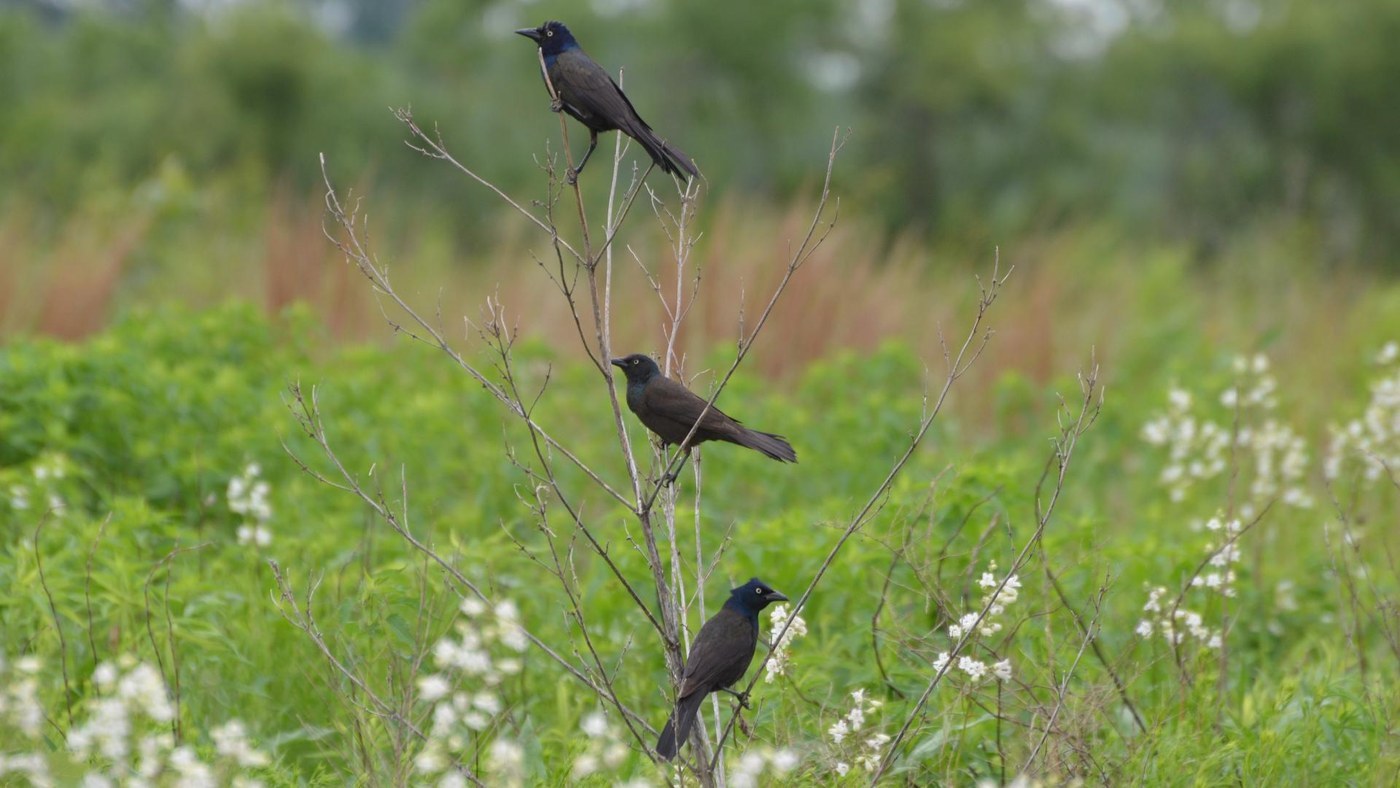
Common Grackle
Quiscalus quiscula
A large, iridescent blackbird with a long keel-shaped tail and pale yellow eyes, common across eastern and central North America.
- Size
- 28-34 cm (11-13.4 in) long, 36-46 cm wingspan
- Habitat
- open woodlands, agricultural fields, urban parks, and suburban lawns
- Type
- songbird
Spotted a bird like this?
Identify any bird from a photo, free.
Overview
The Common Grackle is a large, lanky member of the blackbird family, instantly recognizable by its long, wedge-shaped tail that it often holds in a distinctive V- or keel-shape while flying. At a distance it looks all black, but in good light the plumage shimmers with iridescent purple, bronze, or blue-green depending on the subspecies and angle of light.
Both sexes share the glossy plumage, though females are slightly smaller and duller. The piercing pale yellow eye stands out against the dark head and is a useful mark at any distance. Common Grackles are bold, gregarious birds often seen striding confidently across lawns and parking lots.
How to identify it
Key field marks
- Long, keel-shaped tail, often held in a deep V during flight
- Glossy black plumage with purple, bronze, or blue-green iridescence
- Pale yellow eyes
- Long, heavy, slightly downcurved bill
Similar species
- Brewer's Blackbird and Rusty Blackbird are smaller with shorter, more normal-shaped tails and lack the strong keeled tail shape.
- Boat-tailed and Great-tailed Grackle are larger still, with even longer tails and are largely restricted to coastal or southwestern/south-central regions, with limited range overlap.
- Female Common Grackles are duller and browner but retain the same tail shape and pale eye.
Habitat & range
Common Grackles are widespread and abundant across the eastern two-thirds of North America, from the Gulf Coast north into central Canada, and west to the Rocky Mountains. They favor open and semi-open habitats: agricultural fields, city parks, lawns, marsh edges, and open woodlands, and readily nest in conifers, city trees, and near water.
Most northern populations migrate south for the winter, forming enormous mixed-species roosts with other blackbirds and starlings, sometimes numbering in the millions of birds, while southern populations are largely resident year-round.
Behavior & voice
Common Grackles are gregarious and often forage in large, noisy flocks on the ground, walking with a purposeful strut rather than hopping. They are opportunistic omnivores, eating insects, seeds, grain, and fruit, but also raid other birds' nests for eggs and nestlings, catch small fish or amphibians, and readily scavenge at picnic areas and feeders.
The voice is a harsh, rasping, mechanical-sounding "readle-eak," often likened to a rusty gate hinge, along with various clucks and chattering notes. Nests are bulky cups of twigs, grass, and mud built in trees or shrubs, often in loose colonies, with females typically laying four to five eggs and incubating alone, though both parents feed the young.
Frequently asked questions
How do you identify a Common Grackle?
Look for an all-dark, iridescent blackbird with a long tail held in a distinctive keel or V-shape in flight, pale yellow eyes, and a long, slightly downcurved bill.
What is the difference between a Common Grackle and a crow?
Grackles are much smaller and slimmer than crows, with iridescent (not flat black) plumage, pale yellow eyes instead of dark eyes, and a long keeled tail rather than a crow's fan-shaped tail.
What does a Common Grackle sound like?
A harsh, squeaky, mechanical call often compared to a rusty gate hinge, rendered as 'readle-eak,' along with assorted clucks and chatters.
Where do Common Grackles live?
Across the eastern two-thirds of North America in open woodlands, farmland, parks, and suburban lawns; northern populations migrate south in winter.
Are Common Grackles harmful to other birds?
They are opportunistic and will raid the nests of other birds for eggs and nestlings, and can dominate feeders, but this is normal foraging behavior within their native range.
Common Grackle guides
In-depth guides for identifying, finding, and understanding Common Grackle.
Other birds you may enjoy

Black Redstart
13-14.5 cm (5.1-5.7 in) long, 23-26 cm wingspan

Black-throated Sparrow
12-14 cm (4.7-5.5 in) long, about 19-20 cm (7.5-8 in) wingspan

Greater Bird-of-paradise
Body about 43 cm; males with additional flank plumes up to 50 cm and long tail wires

Blue Tit
11-12 cm (4.3-4.7 in) long, 17-20 cm wingspan

Red-billed Quelea
11.5–13 cm long, wingspan about 20–22 cm
White-plumed Antbird
13-14 cm (5-5.5 in) long

Pyrrhuloxia
19-22 cm (7.5-8.7 in) long, 30 cm wingspan

Blue-gray Tanager
16-18 cm (6-7 in) long

Blackburnian Warbler
11-13 cm (4.3-5.1 in) long, 20-22 cm wingspan

Bluethroat
13-14 cm (5.1-5.5 in) long, 20-22 cm wingspan

Eurasian Nuthatch
12-14.5 cm (4.7-5.7 in) long, 22.5-27 cm wingspan

Wood Thrush
19-21 cm (7.5-8.3 in) long, about 33 cm (13 in) wingspan