
Common Grackle Identification Guide
A large, long-tailed North American blackbird with iridescent bronze or purple-blue plumage and pale yellow eyes.
Read the full Common Grackle encyclopedia entry →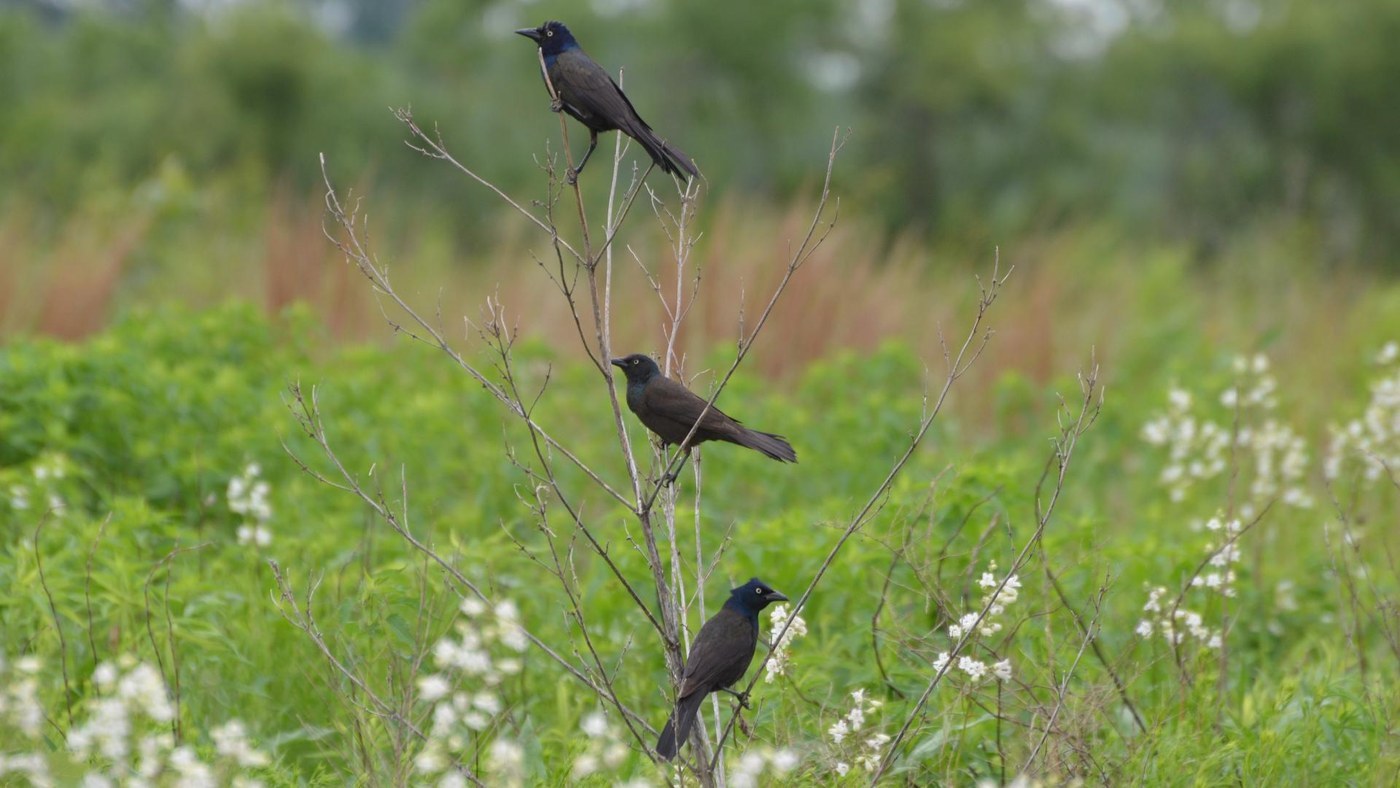
Key Field Marks
- Size & shape: A large blackbird, noticeably bigger and longer-tailed than a red-winged blackbird, with a long, keel-shaped tail that it often folds into a deep V-shape (like an open book) in flight.
- Plumage: Males are glossy black overall with iridescent sheen that flashes bronze, purple, or blue-green on the head and back depending on light and subspecies (bronzed vs. purple grackle forms). Females are similar but duller and slightly smaller.
- Eyes: Bright pale yellow eyes stand out against the dark head at close range — a good confirming mark.
- Bill & legs: Long, heavy, slightly downcurved black bill; long black legs suited to walking confidently on the ground.
- Behavior: Walks with a purposeful strut rather than hopping; forages on lawns, parking lots, and fields; highly social, forming large noisy flocks, especially at winter roosts.
Separating from Similar Species
- Boat-tailed and Great-tailed Grackles: Both are larger with proportionally even longer, more dramatically keeled tails and are largely restricted to coastal marshes (Boat-tailed) or the south-central/western U.S. (Great-tailed); Common Grackle has a comparatively shorter tail and much wider range.
- Rusty Blackbird: Smaller, with a shorter tail, pale eye also present in some plumages, but Rusty Blackbird shows rusty-edged feathers in fall/winter and a thinner bill; lacks the grackle's iridescent gloss and long wedge tail.
- Brewer's Blackbird: Smaller, shorter-tailed, with a shorter bill; male Brewer's has a purplish head and greenish body gloss but never the long keeled tail.
- European Starling: Much shorter tail, speckled in fresh plumage, short pointed bill — easily eliminated by shape alone.
Where & When to See It
Common Grackles are widespread and common across eastern and central North America, from the Rockies to the Atlantic. They breed in open and semi-open habitats — farmland, suburban lawns, parks, woodland edges, and marshes — and are frequent visitors to bird feeders. Northern populations migrate south in winter, often forming immense mixed roosts with other blackbirds and starlings, while southern populations are largely resident year-round.
Voice & Song Cues
The song is a short, unmusical, rising rusty-hinge creak — "readle-eak" — often described as sounding like a squeaky gate. Calls include a loud, sharp "chack" or "chak" given year-round, especially in flight and flocks.
Frequently asked questions
How do I tell a Common Grackle from a crow?
Grackles are much smaller than crows, with a slender build, long keeled tail, pale yellow eye, and iridescent sheen, whereas crows are larger, stockier, all-black including the eye, and have a fan-shaped (not keeled) tail.
What makes the grackle's tail distinctive?
In flight, Common Grackles fold their long tail into a deep V or keel shape, especially males; this trough-like tail profile is a quick way to identify the species at a distance.
Do male and female Common Grackles look different?
Yes, males are larger and more strongly iridescent (bronze or purple-blue depending on the subspecies), while females are smaller, duller, and browner but share the same pale eye.
Where do Common Grackles nest?
They nest in loose colonies in conifers, dense shrubs, or cavities near open ground, often close to human development, including parks and suburban yards.
Are Common Grackles seen in winter?
In the northern part of their range they migrate south, but across much of the central and southern U.S. they are present year-round, often in enormous mixed-species winter roosts.