
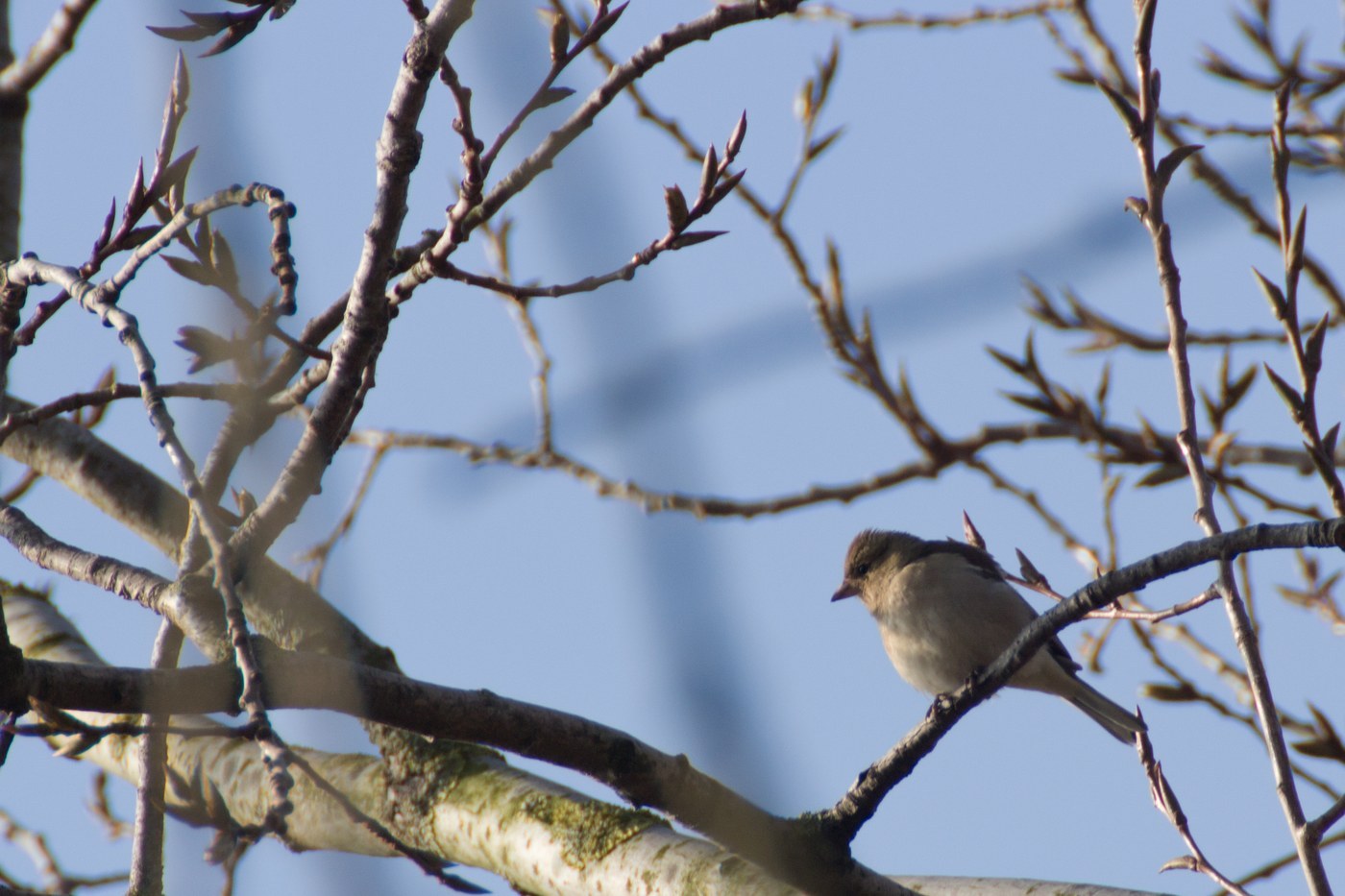
Common Chaffinch
Fringilla coelebs
One of Europe's most abundant finches, the male sporting a blue-gray crown and pink-buff breast, both sexes showing bold white wing bars.
- Size
- 14.5-16 cm (5.7-6.3 in) long, 24-28 cm wingspan
- Habitat
- woodlands, hedgerows, farmland, parks, and gardens
- Type
- songbird
Spotted a bird like this?
Identify any bird from a photo, free.
Overview
The Common Chaffinch is one of the most widespread and numerous songbirds in Europe. The male is brightly patterned with a blue-gray crown and nape, chestnut-brown back, and warm pinkish-buff underparts, while the more subdued female is olive-brown with grayish underparts. Both sexes show two bold white wing bars and white outer tail feathers that flash conspicuously in flight.
Chaffinches are common in almost any wooded or semi-open habitat and are frequent visitors to garden feeders, especially in winter when flocks form.
How to identify it
Key field marks
- Male: blue-gray crown, chestnut back, pink-buff underparts
- Female: olive-brown overall, duller than male
- Both sexes: two bold white wing bars, white outer tail feathers
- Undulating flight pattern typical of finches
Similar species
- European Greenfinch is more uniformly olive-green with yellow in the wings and tail, lacking the double white wing bar.
- Brambling (a winter visitor in parts of the range) shows orange shoulder patches and a white rump, distinguishing it from the Chaffinch's white wing bars.
Habitat & range
Habitat
Found in woodlands, hedgerows, farmland, orchards, parks, and gardens, favoring areas with trees or shrubs for cover.
Range
Widespread across Europe, North Africa, and western Asia.
Migration
Partially migratory; northern and eastern populations move south in winter, while western European birds are often resident, with migrants sometimes forming large flocks.
Behavior & voice
Behavior
Forages on the ground and in trees, often in loose flocks outside the breeding season; males are strongly territorial and vocal in spring.
Voice
A loud, cheerful, descending song ending in a flourish, often rendered as "chip-chip-chip-cherry-erry-tissi-cheweeoo"; call is a distinctive "pink pink" or "chwink."
Feeding
Eats seeds, insects, and berries, foraging mainly on the ground; feeds insects to nestlings during the breeding season.
Nesting
Builds a neat, well-camouflaged cup nest of moss, lichen, and spider webs in a tree fork or shrub; lays 4-5 pale bluish-green eggs with darker markings.
Frequently asked questions
What does a male Chaffinch look like compared to a female?
The male has a blue-gray crown, chestnut back, and pink-buff underparts, while the female is much plainer olive-brown; both share bold white wing bars.
What is the Chaffinch's song like?
A cheerful, cascading song that speeds up and ends with a distinctive flourish, often described as sounding like a bowler's run-up and delivery.
Are Chaffinches common?
Yes, they are among the most abundant and widespread songbirds in Europe, found in almost any wooded or semi-open habitat.
Do Chaffinches migrate?
Some populations, especially in northern and eastern Europe, migrate south for winter, while many western European birds remain resident year-round.
Common Chaffinch guides
In-depth guides for identifying, finding, and understanding Common Chaffinch.
Other birds you may enjoy

Black Redstart
13-14.5 cm (5.1-5.7 in) long, 23-26 cm wingspan

Black-throated Sparrow
12-14 cm (4.7-5.5 in) long, about 19-20 cm (7.5-8 in) wingspan

Greater Bird-of-paradise
Body about 43 cm; males with additional flank plumes up to 50 cm and long tail wires

Blue Tit
11-12 cm (4.3-4.7 in) long, 17-20 cm wingspan

Red-billed Quelea
11.5–13 cm long, wingspan about 20–22 cm
White-plumed Antbird
13-14 cm (5-5.5 in) long

Pyrrhuloxia
19-22 cm (7.5-8.7 in) long, 30 cm wingspan

Blue-gray Tanager
16-18 cm (6-7 in) long

Blackburnian Warbler
11-13 cm (4.3-5.1 in) long, 20-22 cm wingspan

Bluethroat
13-14 cm (5.1-5.5 in) long, 20-22 cm wingspan

Eurasian Nuthatch
12-14.5 cm (4.7-5.7 in) long, 22.5-27 cm wingspan

Wood Thrush
19-21 cm (7.5-8.3 in) long, about 33 cm (13 in) wingspan