
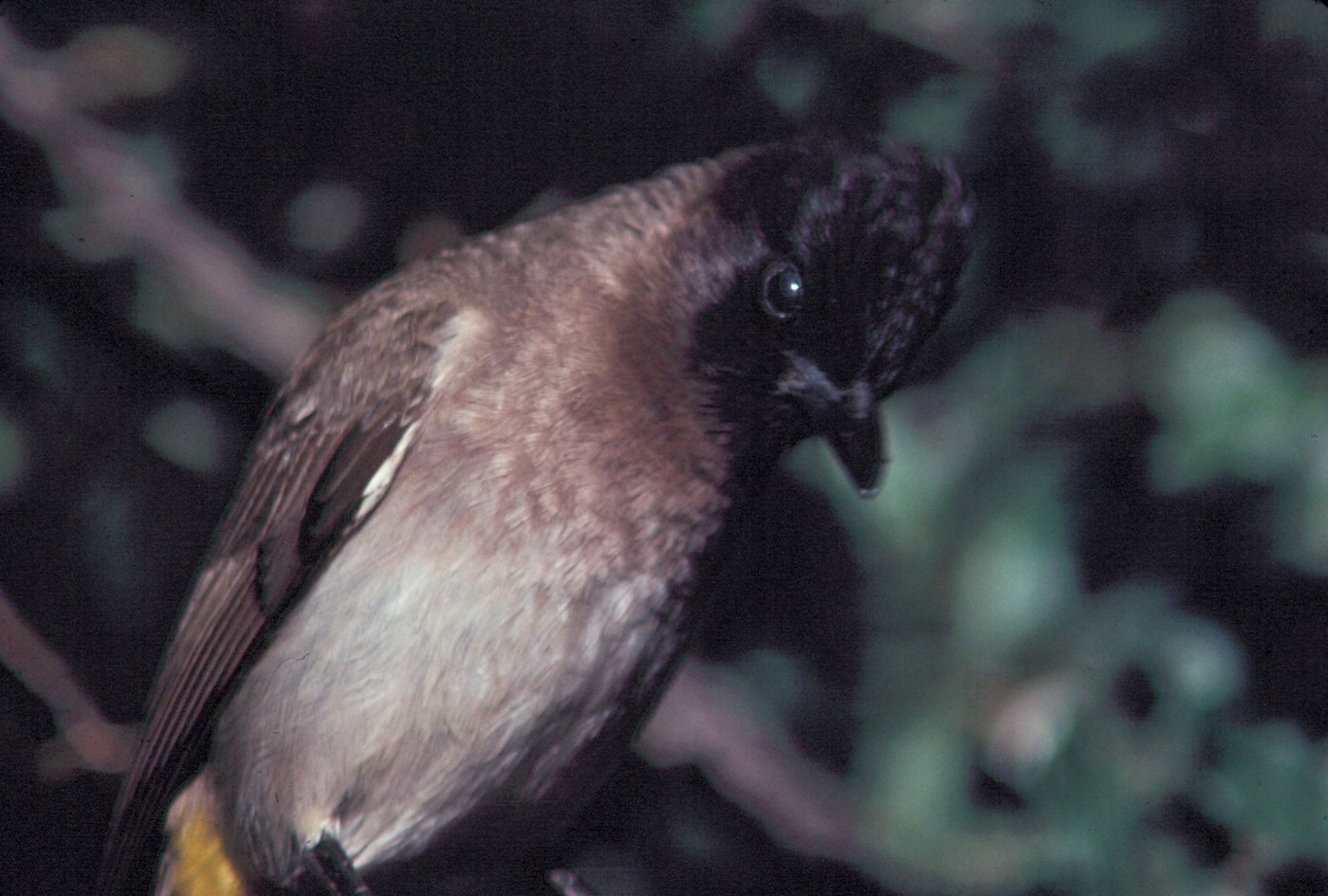
Common Bulbul
Pycnonotus barbatus
A plain brown, noisy, and highly social African songbird known for its cheerful bubbling call and bright yellow undertail.
- Size
- About 18 cm long
- Habitat
- Savanna, woodland edge, farmland, and gardens across sub-Saharan Africa and parts of the Middle East
- Type
- songbird
Spotted a bird like this?
Identify any bird from a photo, free.
Overview
The Common Bulbul is one of the most widespread and familiar birds across sub-Saharan Africa, thriving in a huge range of habitats from wild bush to busy suburban gardens. It is closely related to, and sometimes considered conspecific with, the Dark-capped Bulbul of southern and eastern Africa.
Appearance
- Overall dull brown plumage, darker and browner on the head with no obvious crest
- Off-white to pale grey underparts
- Bright yellow undertail coverts (vent), the bird's most distinctive feature
- Dark eye, bill, and legs
- Sexes look alike
How to identify it
Key field marks
- Plain brown bird with a darker, uncrested head
- Bright yellow vent visible especially in flight or when the tail is raised
- Loud, cheerful, bubbling calls given from perches
Similar species
- Dark-capped Bulbul (often treated as a separate species in southern/eastern Africa) looks almost identical and shares the yellow vent; range generally separates the two
- Garden Bulbul and other regional bulbuls can be similar but the combination of overall plainness plus a yellow vent is a reliable clue across most of its range
- Told from robin-chats and thrushes by its plainer, less patterned plumage and constant chattering calls
Habitat & range
Range
Widespread from West Africa across the Sahel and into parts of the Middle East, and through much of sub-Saharan Africa.
Habitat
Extremely adaptable, found in savanna, woodland edge, farmland, scrub, and gardens; one of the most commonly encountered birds around towns and villages.
Migration
Generally resident and sedentary, though some local movements can occur in response to fruiting seasons.
Behavior & voice
Voice
A cheerful, bubbly, whistled series of notes, often described as sounding like "quick-pick-a-mixed-pickle"; highly vocal and social, frequently calling in groups.
Feeding
Omnivorous and opportunistic, eating a wide variety of fruit, berries, nectar, and insects; often forages in noisy small flocks.
Nesting and breeding
Builds a neat cup nest of twigs, grass, and leaves in a shrub or low tree; typically lays 2–3 eggs, and is territorial and vocal in defense of the nest.
Frequently asked questions
How do you identify a Common Bulbul?
Look for a plain brown bird with a darker, uncrested head and bright yellow undertail coverts, often heard giving cheerful bubbling calls.
What does a Common Bulbul eat?
A wide variety of fruit, nectar, and insects, foraged opportunistically, often in small noisy groups.
Is the Common Bulbul the same as the Dark-capped Bulbul?
They are very closely related and look nearly identical; some authorities treat them as separate species occupying different parts of Africa, others as one widespread species.
Where does the Common Bulbul live?
Across a huge range of sub-Saharan Africa and into parts of the Middle East, in savanna, woodland edge, farmland, and gardens.
Common Bulbul guides
In-depth guides for identifying, finding, and understanding Common Bulbul.
Other birds you may enjoy

Black Redstart
13-14.5 cm (5.1-5.7 in) long, 23-26 cm wingspan

Black-throated Sparrow
12-14 cm (4.7-5.5 in) long, about 19-20 cm (7.5-8 in) wingspan

Greater Bird-of-paradise
Body about 43 cm; males with additional flank plumes up to 50 cm and long tail wires

Blue Tit
11-12 cm (4.3-4.7 in) long, 17-20 cm wingspan

Red-billed Quelea
11.5–13 cm long, wingspan about 20–22 cm
White-plumed Antbird
13-14 cm (5-5.5 in) long

Pyrrhuloxia
19-22 cm (7.5-8.7 in) long, 30 cm wingspan

Blue-gray Tanager
16-18 cm (6-7 in) long

Blackburnian Warbler
11-13 cm (4.3-5.1 in) long, 20-22 cm wingspan

Bluethroat
13-14 cm (5.1-5.5 in) long, 20-22 cm wingspan

Eurasian Nuthatch
12-14.5 cm (4.7-5.7 in) long, 22.5-27 cm wingspan

Wood Thrush
19-21 cm (7.5-8.3 in) long, about 33 cm (13 in) wingspan