
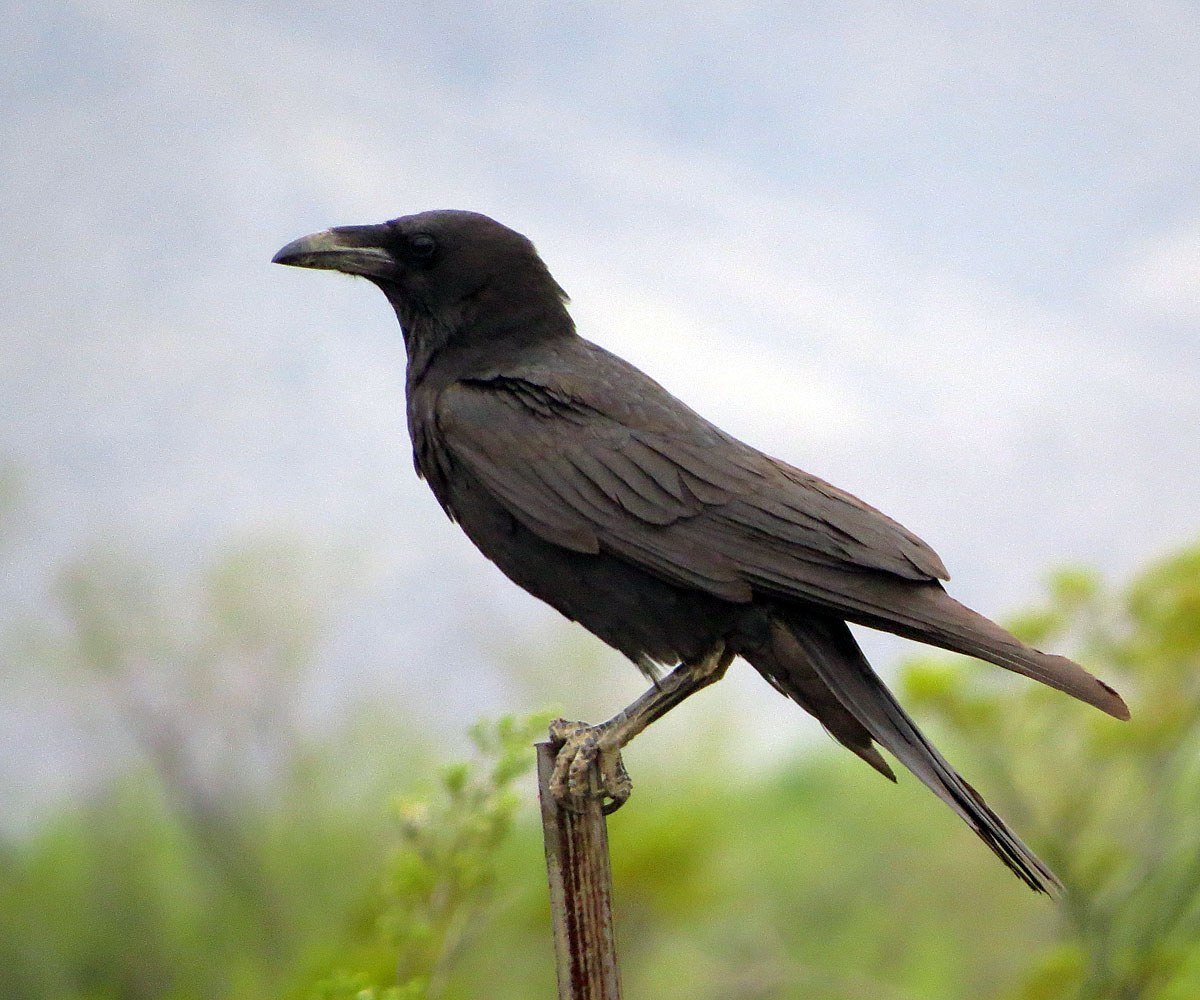
Chihuahuan Raven
Corvus cryptoleucus
A desert grassland raven, smaller than the Common Raven, with white-based neck feathers normally hidden beneath black plumage.
- Size
- 46-53 cm (18-21 in) long, 100-112 cm wingspan
- Habitat
- arid grassland, desert scrub, and agricultural land of the southwestern United States and northern Mexico
- Type
- songbird
Spotted a bird like this?
Identify any bird from a photo, free.
Overview
The Chihuahuan Raven is a medium-large corvid of arid grasslands and deserts, entirely glossy black and closely resembling the Common Raven, but smaller with a somewhat shorter, less massive bill. Its most distinctive feature, visible only when wind ruffles the plumage or the bird is examined closely, is that the feathers of the neck and breast are white at the base rather than solid black to the skin, as in the Common Raven.
This species is well adapted to hot, arid environments and is often seen in loose flocks foraging in open grassland, agricultural fields, and along roadsides in the desert Southwest.
How to identify it
Key Field Marks
- Entirely glossy black plumage
- Smaller size and shorter, less deep bill than Common Raven
- White feather bases on the neck and breast, visible when feathers are ruffled by wind (diagnostic but often not visible)
- Wedge-shaped tail, similar to Common Raven
Similar Species
- Common Raven is larger with a heavier bill and shaggier throat hackles, and its neck feathers are black to the base rather than white.
- American Crow is smaller still with a fan-shaped tail and higher-pitched caw, and generally prefers less arid habitat.
Habitat & range
Habitat
Chihuahuan Ravens favor open desert grassland, mesquite scrub, agricultural fields, and arid rangeland, generally avoiding forested or mountainous terrain.
Range
Found across the desert Southwest, including west Texas, southern New Mexico, southeastern Arizona, and northern Mexico, within the Chihuahuan Desert region for which it is named.
Migration
Most populations are resident, though some birds move locally or short distances in response to food availability and drought conditions.
Behavior & voice
Behavior
Chihuahuan Ravens are social, often forming loose flocks, especially outside the breeding season, and forage extensively on the ground in open country.
Voice
Calls include a flatter, more nasal croak than the Common Raven, though the two species can be difficult to distinguish by voice alone.
Feeding
Diet is broadly omnivorous, including insects, small reptiles and mammals, carrion, grain, and seeds, often foraging in agricultural fields.
Nesting
Pairs build a stick nest in a tree, yucca, utility pole, or other elevated structure in open country; the female incubates 5-7 pale green, spotted eggs.
Frequently asked questions
How do you tell a Chihuahuan Raven from a Common Raven?
Chihuahuan Ravens are smaller with a shorter bill, and their neck feathers are white at the base rather than black, though this is only visible when the feathers are ruffled.
Where does the Chihuahuan Raven live?
It lives in arid grassland and desert scrub of the southwestern United States and northern Mexico, within the Chihuahuan Desert region.
What does a Chihuahuan Raven eat?
It eats a wide variety of foods including insects, small vertebrates, carrion, grain, and seeds.
Why is it called the White-necked Raven?
An alternate name refers to the white feather bases on its neck, which are hidden beneath the black outer plumage and only visible when wind ruffles the feathers.
Chihuahuan Raven guides
In-depth guides for identifying, finding, and understanding Chihuahuan Raven.
Other birds you may enjoy

Black Redstart
13-14.5 cm (5.1-5.7 in) long, 23-26 cm wingspan

Black-throated Sparrow
12-14 cm (4.7-5.5 in) long, about 19-20 cm (7.5-8 in) wingspan

Greater Bird-of-paradise
Body about 43 cm; males with additional flank plumes up to 50 cm and long tail wires

Blue Tit
11-12 cm (4.3-4.7 in) long, 17-20 cm wingspan

Red-billed Quelea
11.5–13 cm long, wingspan about 20–22 cm
White-plumed Antbird
13-14 cm (5-5.5 in) long

Pyrrhuloxia
19-22 cm (7.5-8.7 in) long, 30 cm wingspan

Blue-gray Tanager
16-18 cm (6-7 in) long

Blackburnian Warbler
11-13 cm (4.3-5.1 in) long, 20-22 cm wingspan

Bluethroat
13-14 cm (5.1-5.5 in) long, 20-22 cm wingspan

Eurasian Nuthatch
12-14.5 cm (4.7-5.7 in) long, 22.5-27 cm wingspan

Wood Thrush
19-21 cm (7.5-8.3 in) long, about 33 cm (13 in) wingspan