
Chihuahuan Raven Identification Guide
A desert-grassland raven of the southwestern U.S. and northern Mexico, smaller-billed than Common Raven and best told apart by range, voice, and habitat.
Read the full Chihuahuan Raven encyclopedia entry →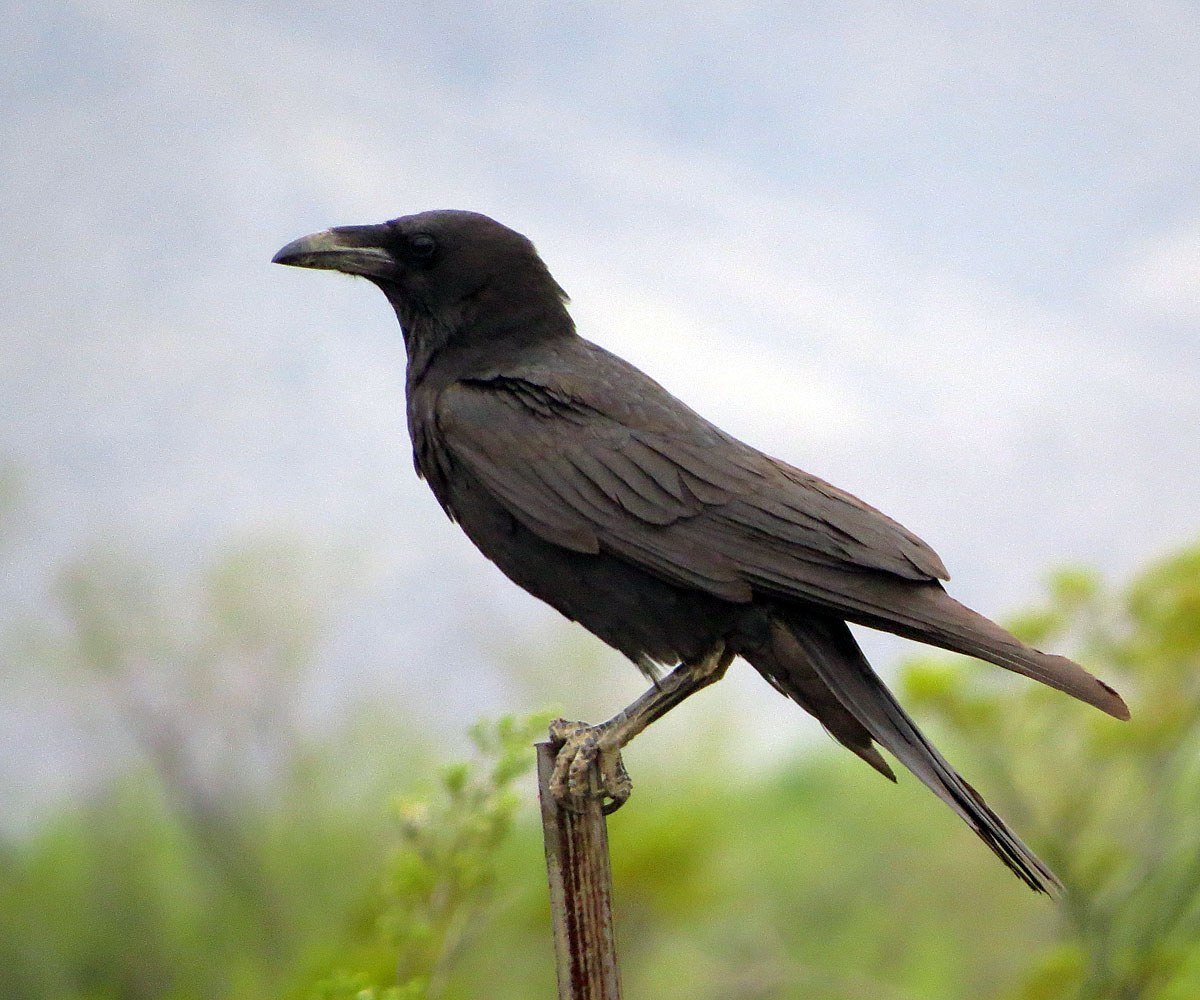
Key Field Marks
- All-black corvid, intermediate in size between American Crow and Common Raven, roughly 19–21 inches long.
- Heavier, slightly arched bill than a crow, with nasal bristles that extend farther out along the bill than on Common Raven.
- Shaggy throat (hackle) feathers, visible especially when calling or in wind.
- Wedge-shaped tail visible in flight, though less pronounced than in Common Raven.
- Neck feather bases are white rather than gray, but this is only visible when feathers are ruffled by wind and is not a reliable field mark at a distance.
Separating It From Similar Species
- Common Raven: larger overall, heavier bill, deeper and more resonant croaking call, and prefers more varied terrain including mountains and coastline; Chihuahuan Raven is smaller-billed and restricted to arid lowlands.
- American Crow: smaller, thinner bill, squared (not wedge-shaped) tail, and a distinctive nasal "caw" rather than a croak; crows are also far less likely in open desert grassland.
- Range and habitat are often the most reliable clues: Chihuahuan Raven favors flat desert grassland and agricultural land, while Common Raven favors rugged, more topographically varied terrain.
- Voice is diagnostic with practice: Chihuahuan Raven gives a flatter, higher-pitched, more nasal croak than the deep, resonant croak of Common Raven.
Habitat, Range & Season
- Resident of arid grasslands, desert scrub, and agricultural fields of the southwestern United States (Arizona, New Mexico, west Texas) south through the Chihuahuan Desert of northern and central Mexico.
- Often forms large, loose flocks, especially outside the breeding season, sometimes numbering in the hundreds.
- Builds bulky stick nests on utility poles, yuccas, or scattered trees in open country.
Voice
- A dry, flat, somewhat higher-pitched croak compared with the deep, rolling croak of Common Raven.
- Often gives repeated short calls in flight, especially when in flocks.
Frequently asked questions
What is the easiest way to separate Chihuahuan Raven from Common Raven?
Range and habitat are the most practical clues — Chihuahuan Raven sticks to flat desert grassland of the southwestern U.S. and Mexico, while Common Raven favors more varied, often higher-elevation terrain. Voice (a flatter, higher croak) and a slightly smaller bill also help.
Are the white feather bases on the neck a reliable field mark?
Not usually — they are only visible when wind or preening exposes the feather bases, so they're a fun confirming detail but not something to rely on for identification at a distance.
Do Chihuahuan Ravens flock together?
Yes, especially in the nonbreeding season, when they can form large, conspicuous flocks feeding in agricultural fields, unlike the more solitary or paired habits typical of Common Raven.
How does a Chihuahuan Raven differ from an American Crow?
Chihuahuan Raven is larger with a heavier bill, a wedge-shaped tail, and shaggy throat feathers, plus a croaking call rather than the crow's nasal caw.