
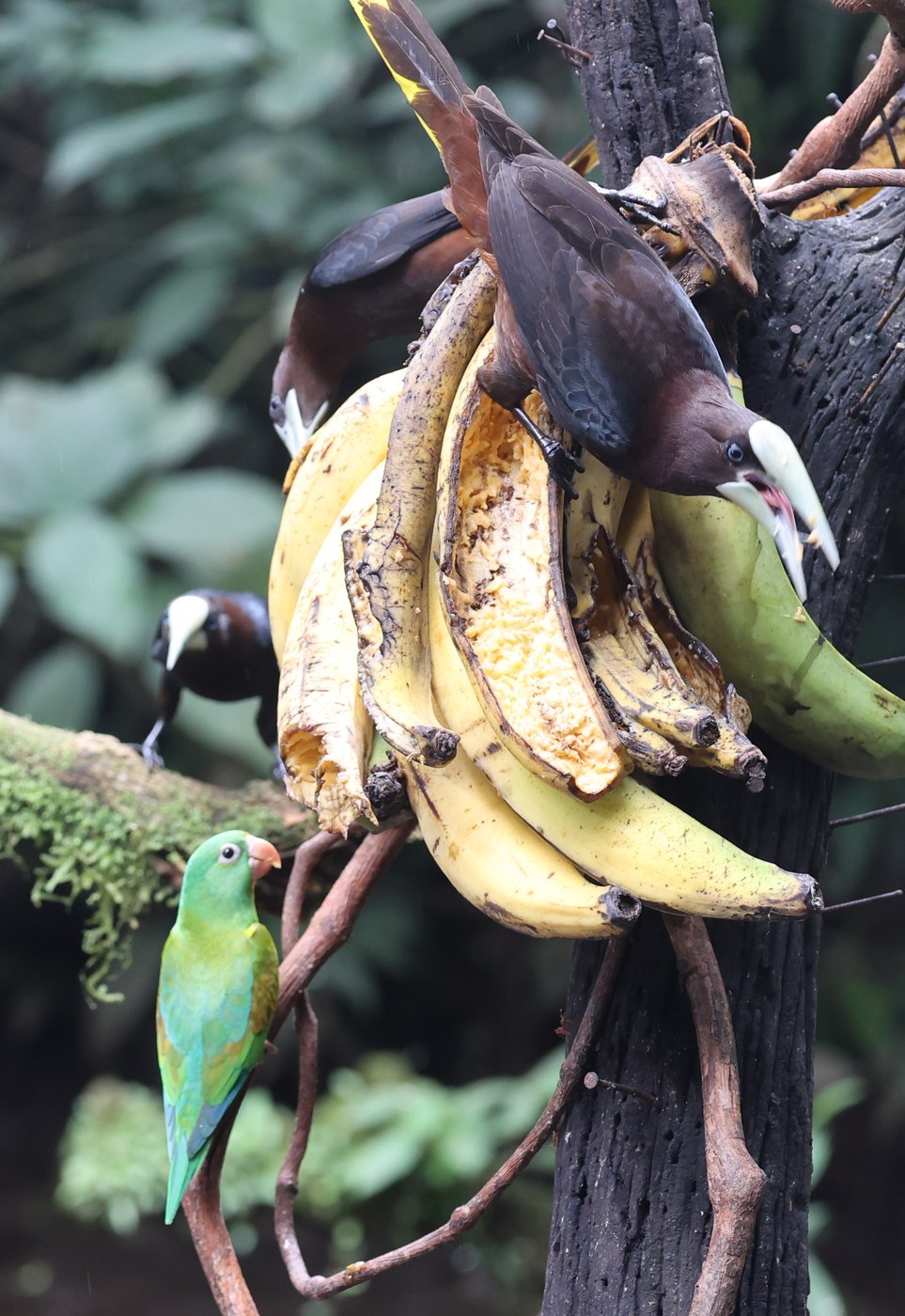
Chestnut-headed Oropendola
Psarocolius wagleri
A colonial-nesting blackbird relative with a rich chestnut head and pale-tipped bill, famous for its long, hanging, woven nests dangling from tall trees.
- Size
- 23-28 cm (9-11 in) long
- Habitat
- humid forest, forest edge, and plantations from Central America to northwestern South America
- Type
- songbird
Spotted a bird like this?
Identify any bird from a photo, free.
Overview
The Chestnut-headed Oropendola is a medium-sized member of the blackbird family (Icteridae), best known for its glossy black body plumage set off by a rich chestnut-brown head, and a pale, bluish-tipped bill. Males are notably larger than females, a common pattern in oropendolas driven by strong sexual selection within colonies.
The tail shows the typical oropendola pattern of black central feathers and bright yellow outer feathers, most visible in flight or when the bird calls. Its overall shape is fairly long and slim compared to many blackbirds, with a long, pointed bill suited to a varied fruit-and-insect diet.
This species is highly social and colonial, nesting in loose to dense colonies where dozens of long, woven, sock-like nests hang from the outer branches of tall emergent trees, often a dramatic and conspicuous feature of forest edges within its range.
How to identify it
Key field marks
- Chestnut-brown head contrasting with glossy black body
- Pale, bluish-tipped bill
- Black tail with bright yellow outer feathers
- Colonial nester with distinctive long, hanging woven nests
Similar species
Russet-backed Oropendola and Russet-backed Oropendola differ in overall color, with the Chestnut-headed being most easily identified by the sharply defined chestnut head against a black body; Montezuma Oropendola is much larger with an entirely different, more extensively pale bill and bicolored body pattern.
Habitat & range
Habitat
Chestnut-headed Oropendolas inhabit humid forest, forest edge, and plantations, often nesting in isolated tall trees near forest edges or clearings.
Range
The species ranges from Honduras and Nicaragua through Costa Rica and Panama into Colombia and Ecuador, occupying lowland and foothill regions on both slopes in Central America.
Migration
It is largely a non-migratory resident, with colonies often returning to the same nesting trees over multiple years.
Behavior & voice
Behavior
This oropendola is highly social, nesting and foraging in colonies, and males perform an elaborate bowing display accompanied by a gurgling call to attract females and defend status within the colony hierarchy.
Voice
The voice includes a distinctive liquid, gurgling, bubbling song given during the male's bowing display, along with various chattering and clucking calls.
Feeding
It feeds on fruit, insects, and nectar, foraging in the canopy and sometimes in mixed flocks with other oropendolas or caciques.
Nesting and breeding
Colonies build numerous long, pendulous, woven nests that hang like socks from the tips of outer branches in tall emergent trees, an adaptation thought to deter predators and parasitic botflies; the species is also a frequent host to parasitic cowbirds.
Frequently asked questions
How do you identify a Chestnut-headed Oropendola?
Look for a rich chestnut-brown head contrasting with a glossy black body, a pale bluish-tipped bill, and yellow outer tail feathers.
Why does the Chestnut-headed Oropendola build hanging nests?
It nests colonially, weaving long, sock-like nests that hang from the tips of tall tree branches, likely to reduce predation and nest parasite access.
Where does the Chestnut-headed Oropendola live?
From Honduras and Nicaragua south through Costa Rica and Panama into Colombia and Ecuador.
What does the Chestnut-headed Oropendola eat?
Fruit, insects, and nectar.
What does the male Chestnut-headed Oropendola do to attract a mate?
It performs a bowing display accompanied by a liquid, gurgling call to attract females and assert status in the colony.
Chestnut-headed Oropendola guides
In-depth guides for identifying, finding, and understanding Chestnut-headed Oropendola.
Other birds you may enjoy

Black Redstart
13-14.5 cm (5.1-5.7 in) long, 23-26 cm wingspan

Black-throated Sparrow
12-14 cm (4.7-5.5 in) long, about 19-20 cm (7.5-8 in) wingspan

Greater Bird-of-paradise
Body about 43 cm; males with additional flank plumes up to 50 cm and long tail wires

Blue Tit
11-12 cm (4.3-4.7 in) long, 17-20 cm wingspan

Red-billed Quelea
11.5–13 cm long, wingspan about 20–22 cm
White-plumed Antbird
13-14 cm (5-5.5 in) long

Pyrrhuloxia
19-22 cm (7.5-8.7 in) long, 30 cm wingspan

Blue-gray Tanager
16-18 cm (6-7 in) long

Blackburnian Warbler
11-13 cm (4.3-5.1 in) long, 20-22 cm wingspan

Bluethroat
13-14 cm (5.1-5.5 in) long, 20-22 cm wingspan

Eurasian Nuthatch
12-14.5 cm (4.7-5.7 in) long, 22.5-27 cm wingspan

Wood Thrush
19-21 cm (7.5-8.3 in) long, about 33 cm (13 in) wingspan