
Chestnut-headed Oropendola Identification Guide
A blackbird relative of Neotropical forests with a chestnut head and mantle contrasting sharply against a black body, pale blue eyes, and a bicolored bill.
Read the full Chestnut-headed Oropendola encyclopedia entry →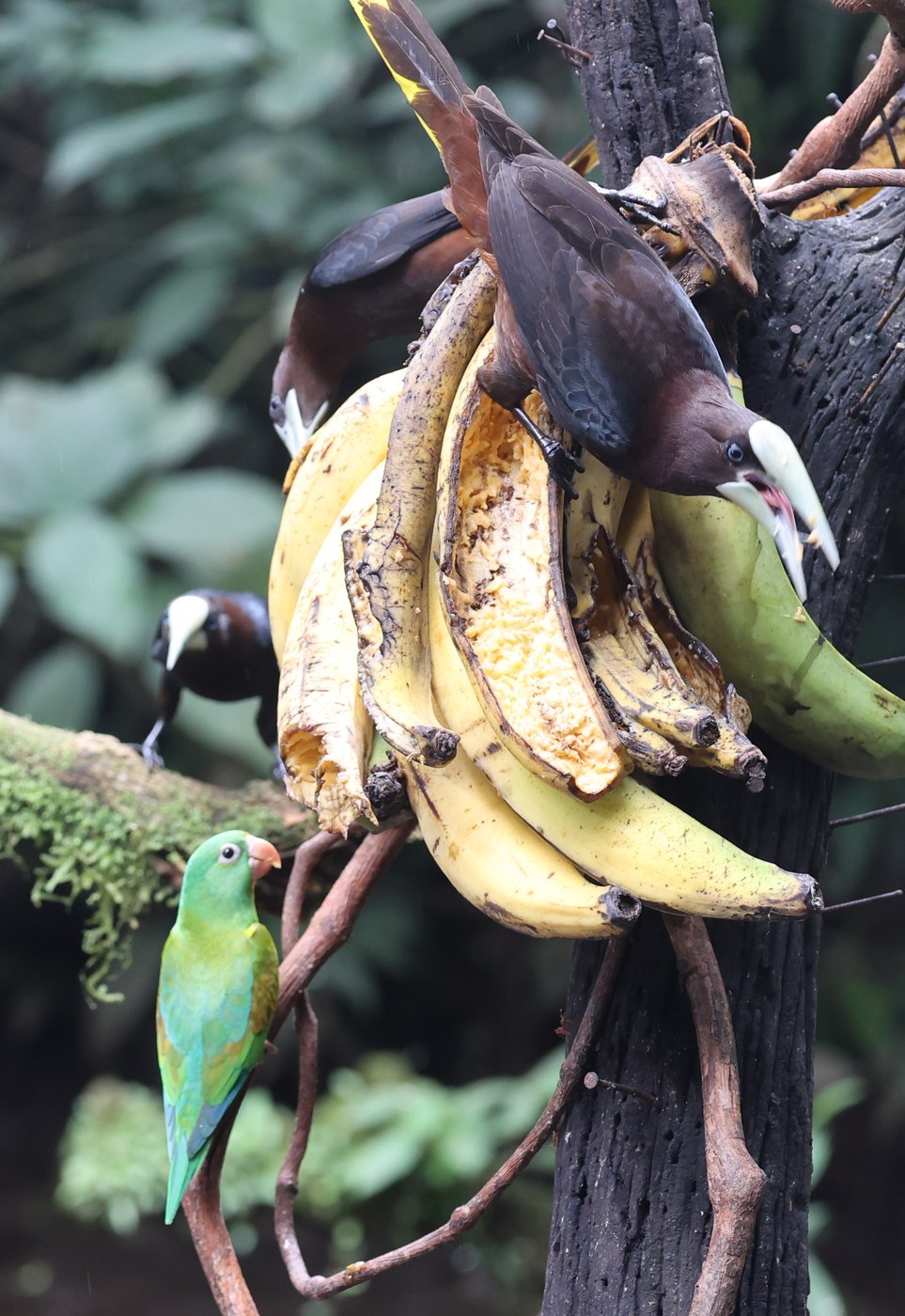
Key Field Marks
- Medium-large icterid (blackbird family member) with glossy black overall body plumage.
- Rich chestnut head, neck, and mantle contrasting sharply against the black wings, back, and underparts.
- Pale, whitish-blue eyes, noticeable at close range.
- Bicolored bill: black at the base, pale orange-yellow at the tip.
- Bright yellow outer tail feathers, with the central feathers black — visible as flashes of yellow when the tail is spread or in flight.
- Males are considerably larger than females, a typical oropendola trait.
Similar Species
- Montezuma Oropendola: Larger overall, with a black (not chestnut) head, more extensive orange bill tip, and bare bluish and pink facial skin patches that Chestnut-headed Oropendola lacks.
- Crested Oropendola and other icterids: Differ in head/body color pattern and lack the sharp chestnut-versus-black contrast; bill and eye color combination help confirm Chestnut-headed.
Habitat & Range
- Found in humid lowland and foothill forest, forest edge, and clearings from southern Mexico through Central America into western Colombia, Ecuador, and Bolivia.
- Nests colonially, building long, hanging woven pouch nests clustered in isolated tall trees, often over open areas or near forest edges.
Behavior
- Highly social and colonial, with multiple females nesting in the same tree, often defended by a dominant male.
- Polygynous mating system; males perform an elaborate bowing display accompanied by song while clinging to a branch, wings and tail spread.
- Feeds on fruit, large insects, and nectar, foraging in the canopy and subcanopy.
Voice
- Males give a distinctive gurgling, liquid song that builds and culminates in a burst of sound, accompanied by the bowing display.
- Also gives loud, harsh "cheorrr" or similar calls.
Frequently asked questions
How do I tell Chestnut-headed Oropendola from Montezuma Oropendola?
Chestnut-headed Oropendola has a chestnut (not black) head and lacks the bare blue-and-pink facial skin patches shown by the larger Montezuma Oropendola.
What does the Chestnut-headed Oropendola's nest look like?
A long, hanging, woven pouch nest, built colonially with many nests often clustered together in a single isolated tall tree.
Where is the Chestnut-headed Oropendola found?
In humid lowland and foothill forest and forest edge from southern Mexico through Central America to western Colombia, Ecuador, and Bolivia.
What is the male's display like?
Males perform an elaborate bowing display on a branch, spreading the wings and tail while giving a gurgling, liquid song, often at communal nesting trees.