
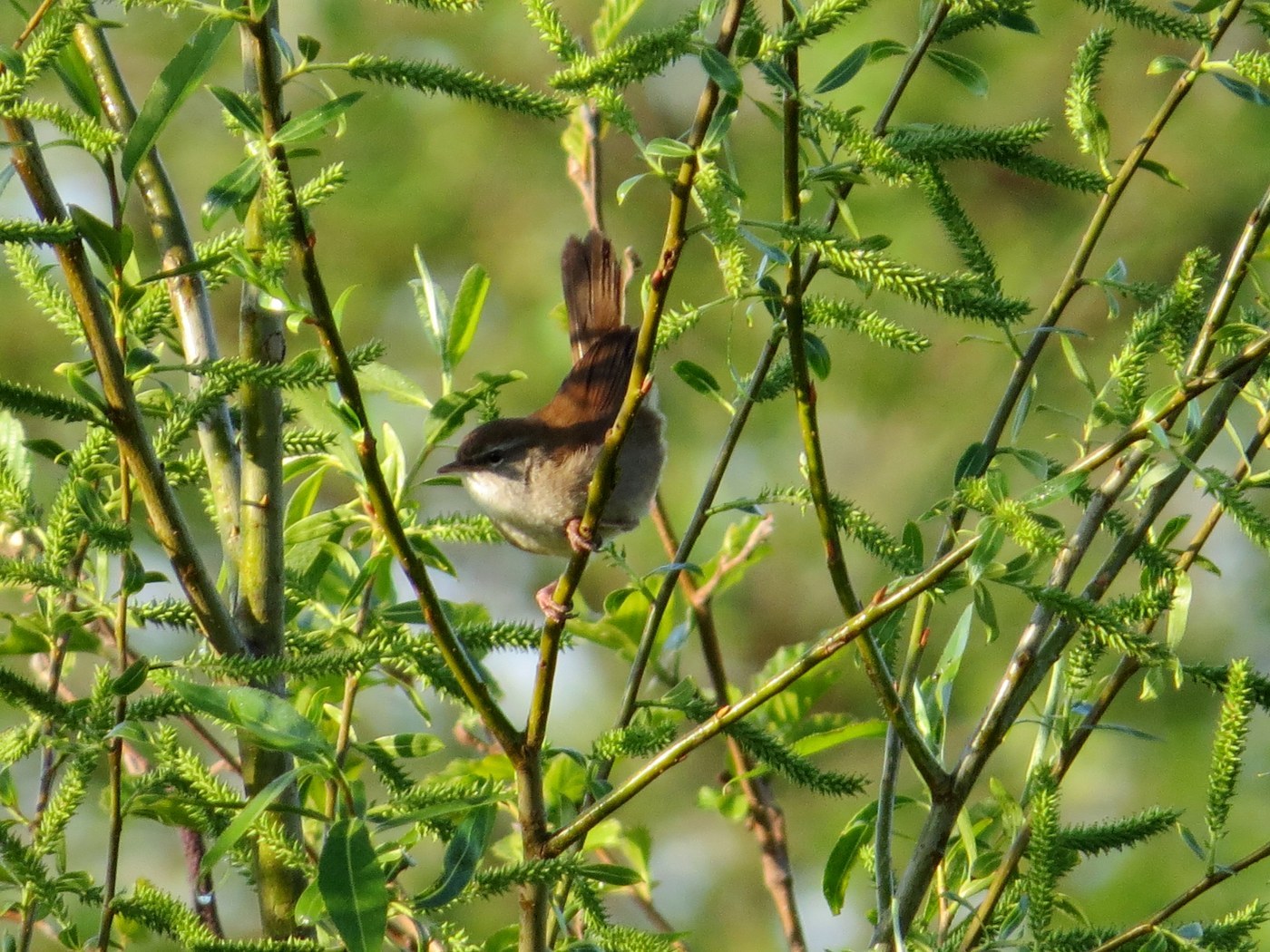
Cetti's Warbler
Cettia cetti
A dark, skulking, non-migratory warbler famous for its sudden, explosively loud burst of song erupting from deep within streamside cover.
- Size
- 13.5-14 cm (5.3-5.5 in) long, 15-19 cm wingspan
- Habitat
- dense waterside scrub, reedbeds with bushes, and damp thickets
- Type
- songbird
Spotted a bird like this?
Identify any bird from a photo, free.
Overview
Cetti's Warbler is a dark, rich reddish-brown warbler with plain, unmarked plumage, greyish underparts, and a rounded tail that is frequently held cocked upward. It is a notoriously skulking species, spending nearly all of its time deep within dense waterside vegetation and rarely venturing into the open.
Unlike most European warblers, Cetti's Warbler is a year-round resident rather than a migrant, remaining on territory throughout the winter, which makes it one of the few warblers that can be heard singing in every month of the year in parts of its range.
Its presence is usually revealed not by sight but by its astonishingly loud and sudden burst of song, which erupts unexpectedly from thick cover and can startle unsuspecting observers with its volume relative to the bird's small size.
How to identify it
Key field marks
- Dark, rich reddish-brown upperparts
- Plain greyish-white underparts with no streaking
- Rounded, often cocked tail
- Rounded wings and a stocky build for a warbler
- Short, indistinct pale eyebrow stripe
Similar species
- Cetti's Warbler is best distinguished by voice and behaviour rather than plumage, since it is rarely seen well: no other common European warbler gives such an explosively loud, sudden burst of song from dense cover.
- Wren: also skulking and loud-voiced, but much smaller, more rotund, with a proportionately shorter tail and a completely different rapid trilling song.
- Nightingale: richer song with more varied phrases and whistles; Nightingale also favours drier scrub rather than the wet habitats favoured by Cetti's Warbler.
Habitat & range
Cetti's Warblers are found across southern and western Europe, favouring dense, tangled vegetation along watercourses, ditches, and wetland edges, including bramble and willow scrub bordering reedbeds, damp thickets, and overgrown ditches.
As a non-migratory resident, the species has been expanding its range northward in recent decades, likely aided by a run of milder winters, colonising new areas including parts of Britain where it was previously absent.
Because it does not migrate, severe cold winters can cause significant local population declines, followed by gradual recovery and range expansion during milder periods.
Behavior & voice
Voice
The song is famous for its sudden, explosive volume: a short burst typically rendered as "chee, chee-chippy-chippy-chippy-chew," erupting abruptly and loudly from deep cover, often catching listeners by surprise.
Feeding
Cetti's Warblers glean insects and spiders from dense waterside vegetation, foraging low and largely out of sight within scrub and bramble tangles.
Nesting and breeding
The nest is a deep cup built low in dense bramble or scrub near water. Clutches typically contain three to five eggs, and the male may be polygynous, mating with more than one female within his territory.
Frequently asked questions
Why is Cetti's Warbler so hard to see?
It is an extremely skulking bird that spends nearly all its time deep within dense waterside scrub and is usually detected by its loud, sudden song rather than by sight.
What does Cetti's Warbler sound like?
It gives a short, explosively loud burst of song, often rendered as 'chee, chee-chippy-chippy-chippy-chew,' erupting suddenly from thick cover.
Does Cetti's Warbler migrate?
No, unlike most European warblers, it is a year-round resident, remaining on territory through the winter, which makes it vulnerable to cold snaps.
Where does Cetti's Warbler live?
It favours dense, tangled vegetation along watercourses and wetland edges, including bramble and willow scrub bordering reedbeds and ditches.
Is Cetti's Warbler expanding its range?
Yes, aided by a run of milder winters, it has been expanding northward in recent decades, colonising new areas including parts of Britain.
Cetti's Warbler guides
In-depth guides for identifying, finding, and understanding Cetti's Warbler.
Other birds you may enjoy

Black Redstart
13-14.5 cm (5.1-5.7 in) long, 23-26 cm wingspan

Black-throated Sparrow
12-14 cm (4.7-5.5 in) long, about 19-20 cm (7.5-8 in) wingspan

Greater Bird-of-paradise
Body about 43 cm; males with additional flank plumes up to 50 cm and long tail wires

Blue Tit
11-12 cm (4.3-4.7 in) long, 17-20 cm wingspan

Red-billed Quelea
11.5–13 cm long, wingspan about 20–22 cm
White-plumed Antbird
13-14 cm (5-5.5 in) long

Pyrrhuloxia
19-22 cm (7.5-8.7 in) long, 30 cm wingspan

Blue-gray Tanager
16-18 cm (6-7 in) long

Blackburnian Warbler
11-13 cm (4.3-5.1 in) long, 20-22 cm wingspan

Bluethroat
13-14 cm (5.1-5.5 in) long, 20-22 cm wingspan

Eurasian Nuthatch
12-14.5 cm (4.7-5.7 in) long, 22.5-27 cm wingspan

Wood Thrush
19-21 cm (7.5-8.3 in) long, about 33 cm (13 in) wingspan