
Cetti's Warbler Identification Guide
A chunky, skulking, plain rufous-brown warbler of dense waterside vegetation, far more often heard than seen thanks to its explosively loud song.
Read the full Cetti's Warbler encyclopedia entry →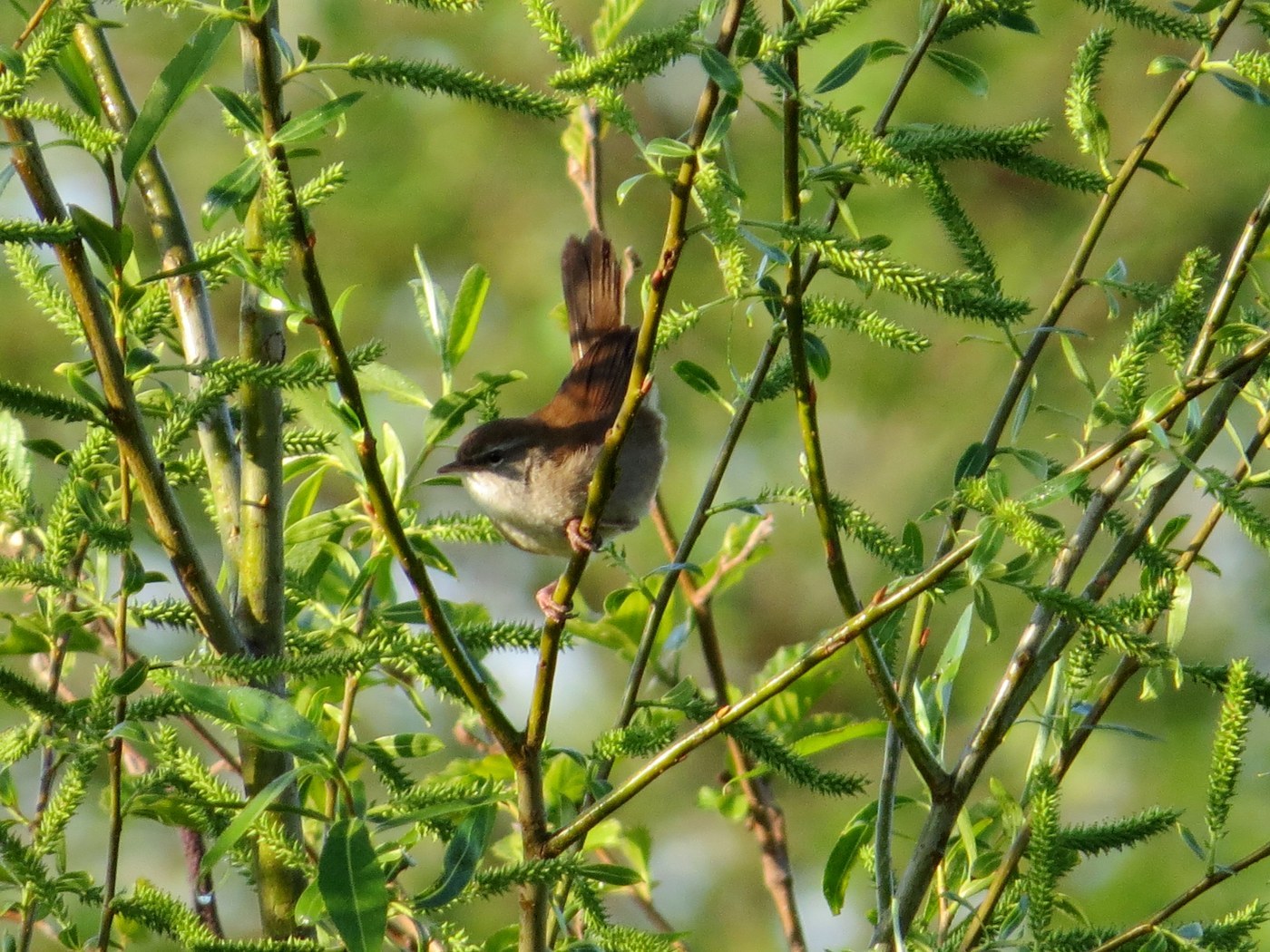
Key Field Marks
- Stocky, rounded warbler, larger and bulkier than most Old World "leaf" warblers, with a broad, often slightly cocked rounded tail.
- Plain warm rufous-brown upperparts with no wingbars or obvious patterning.
- Dull grayish-white underparts, with a faint, indistinct pale eyebrow (supercilium) that does not extend far behind the eye.
- Fairly stout, dark bill and pinkish legs.
- Generally appears dark, plain, and nondescript compared to more patterned reed and bush warblers.
Similar Species
- Reed and Sedge Warblers (Acrocephalus): Slimmer, more evenly proportioned, with flatter foreheads and less rounded tails; most show more streaking or a warmer, more uniform tone without Cetti's chunky, cocked-tail shape.
- Nightingale: Larger still, with a longer tail and more rufous overall tone, but lacks Cetti's skulking, low, dense-cover behavior and explosive short song.
- Best distinguished from most confusion species by voice and habitat rather than plumage, since it is rarely seen well.
Habitat & Range
- Found across southern and western Europe, North Africa, and parts of the Middle East and Central Asia.
- Favors dense, tangled waterside vegetation — reedbeds with scrub, brambles, and thickets along rivers, lakes, marshes, and wet ditches.
- Largely non-migratory (resident) across most of its range, though northern-edge populations can be vulnerable to hard winters.
- Range has been expanding northward in parts of Europe (including the UK) in recent decades, likely linked to milder winters.
Behavior
- Extremely skulking; spends almost all its time deep within dense cover, rarely emerging into the open.
- Often detected only by its sudden, startling burst of song from an unseen bird just a few meters away.
Voice
- An abrupt, very loud, explosive song for such a small bird: a sharp introductory note followed by a rapid stuttering phrase, often rendered as "chee, chip-chip-chip-chip-chip" — the volume and suddenness are the best clue to the species' identity.
Frequently asked questions
Why is Cetti's Warbler so hard to see?
It is an extreme skulker that spends nearly all its time deep inside dense waterside scrub and reed cover, rarely venturing into the open, so most identifications rely on its loud, distinctive song.
What does Cetti's Warbler sound like?
A sudden, very loud, explosive song — a sharp opening note followed by a rapid stuttering burst, often written as "chee, chip-chip-chip-chip-chip" — startlingly loud for the bird's small size.
Is Cetti's Warbler migratory?
Most populations are resident year-round, though the species has been gradually expanding its range northward in Europe as winters have grown milder.
What habitat should I search for Cetti's Warbler in?
Look and listen in dense, tangled vegetation next to water — reedbeds mixed with bramble and scrub along rivers, lakes, and marshes are classic habitat.