
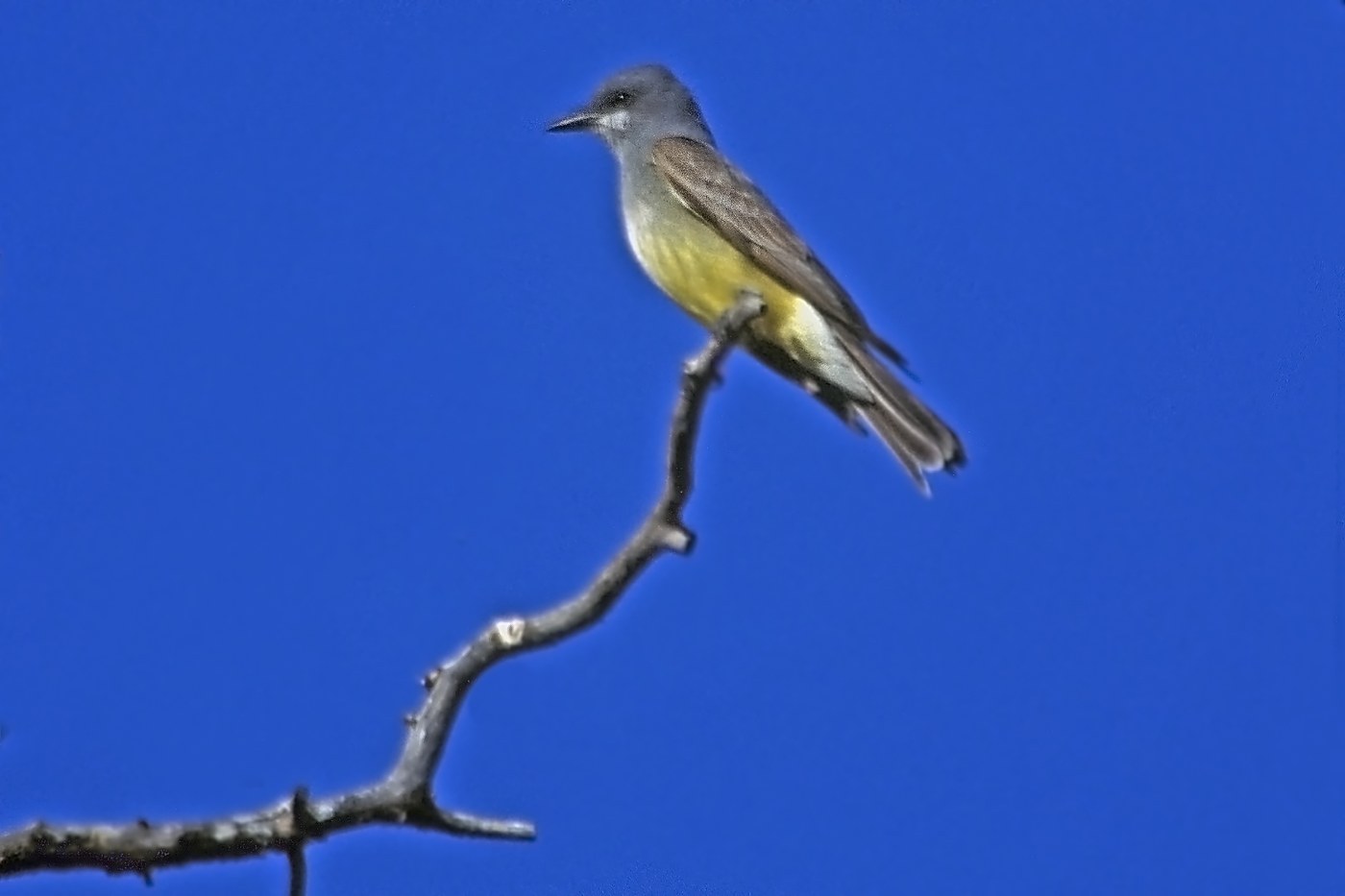
Cassin's Kingbird
Tyrannus vociferans
A chunky gray-headed flycatcher of southwestern oak country, best told from the similar Western Kingbird by its darker chest and raspy voice.
- Size
- 20-23 cm (8-9 in) long, 38-41 cm wingspan
- Habitat
- open woodlands, oak savanna, ranchland, and riparian areas in the southwestern US and Mexico
- Type
- songbird
Spotted a bird like this?
Identify any bird from a photo, free.
Overview
The Cassin's Kingbird is a robust, big-headed flycatcher of the arid and semi-arid Southwest, often seen perched conspicuously on wires, fence posts, or the tops of trees while scanning for insects. It has a gray head and chest, an olive-tinged gray-brown back, and a bright yellow belly. The tail is blackish with only a faint, narrow pale tip, giving the bird a darker, less contrasty look than its close relative the Western Kingbird.
A neat white chin patch stands out against the otherwise gray throat and chest, and a dusky mask runs through the eye. Sexes look alike. Cassin's Kingbirds are bold and pugnacious, frequently chasing off crows, hawks, and other kingbirds that venture too close to a nest site.
How to identify it
Key field marks
- Gray head and chest with a crisp white chin patch
- Olive-gray back, bright yellow belly
- Blackish tail with only a thin, indistinct pale terminal band
- Dark mask through the eye
- Stocky build with a fairly heavy bill
Similar species
- Western Kingbird: paler gray head, thinner bill, and a tail with white outer edges (not just a pale tip); voice is a sharper, higher-pitched twitter.
- Tropical Kingbird and Couch's Kingbird: more deeply notched tail, more olive (less gray) head, and a very different, high-pitched twittering voice; ranges barely overlap with Cassin's.
- Western Wood-Pewee: much smaller, lacks the yellow belly and white chin patch.
Habitat & range
Range and habitat
Cassin's Kingbird breeds across the southwestern United States—from California, Arizona, and New Mexico east to Texas and north into the Great Basin—and south through the Mexican highlands. It favors open country with scattered trees: oak savanna, pinyon-juniper woodland, ranchland, and riparian corridors, usually at higher elevations than Western Kingbird.
Migration
Most populations are migratory, wintering from Mexico south to Guatemala, though some birds in the milder parts of the range (such as southern California and southern Arizona) remain year-round.
Behavior & voice
Behavior
Cassin's Kingbirds perch prominently and sally out to snatch flying insects, often returning to the same perch. They are highly territorial and aggressively mob larger birds, including hawks and ravens, that approach their nesting area.
Voice
The call is a harsh, raspy "ch-bear" or "chi-queer," along with sharp chattering notes—coarser and lower-pitched than the twittery calls of Western Kingbird.
Feeding
They hunt mainly by flycatching—darting out from an exposed perch to grab a flying insect and returning to the same or a nearby perch. In fall and winter they also eat berries and other small fruit.
Nesting and breeding
Nests are bulky cups of twigs, grass, and plant fibers built on a horizontal tree limb or utility pole crossbar, often 5-15 m up. The female incubates 3-4 eggs for about 2 weeks, and both parents feed the young.
Frequently asked questions
How do you tell a Cassin's Kingbird from a Western Kingbird?
Cassin's Kingbird has a darker gray chest, a thicker bill, a blackish tail with only a faint pale tip, and a raspy 'ch-bear' call, while Western Kingbird is paler with white edges on the tail sides and a thinner, higher-pitched voice.
Where do Cassin's Kingbirds live?
They breed in open, tree-dotted country across the southwestern United States and the Mexican highlands, favoring oak savanna, ranchland, and riparian edges.
What do Cassin's Kingbirds eat?
Mostly flying insects caught in mid-air from an exposed perch, supplemented by berries and small fruit outside the breeding season.
Are Cassin's Kingbirds aggressive?
Yes, they are notably bold and will chase and mob crows, hawks, and other large birds that come near their nest.
Do Cassin's Kingbirds migrate?
Most populations migrate to Mexico and Central America for winter, though some birds in the mildest parts of the range stay year-round.
Cassin's Kingbird guides
In-depth guides for identifying, finding, and understanding Cassin's Kingbird.
Other birds you may enjoy

Black Redstart
13-14.5 cm (5.1-5.7 in) long, 23-26 cm wingspan

Black-throated Sparrow
12-14 cm (4.7-5.5 in) long, about 19-20 cm (7.5-8 in) wingspan

Greater Bird-of-paradise
Body about 43 cm; males with additional flank plumes up to 50 cm and long tail wires

Blue Tit
11-12 cm (4.3-4.7 in) long, 17-20 cm wingspan

Red-billed Quelea
11.5–13 cm long, wingspan about 20–22 cm
White-plumed Antbird
13-14 cm (5-5.5 in) long

Pyrrhuloxia
19-22 cm (7.5-8.7 in) long, 30 cm wingspan

Blue-gray Tanager
16-18 cm (6-7 in) long

Blackburnian Warbler
11-13 cm (4.3-5.1 in) long, 20-22 cm wingspan

Bluethroat
13-14 cm (5.1-5.5 in) long, 20-22 cm wingspan

Eurasian Nuthatch
12-14.5 cm (4.7-5.7 in) long, 22.5-27 cm wingspan

Wood Thrush
19-21 cm (7.5-8.3 in) long, about 33 cm (13 in) wingspan