
Cassin's Kingbird Identification Guide
A large, dark-headed kingbird of the southwestern U.S., separated from similar kingbirds by its blackish tail with a white terminal band rather than white edges.
Read the full Cassin's Kingbird encyclopedia entry →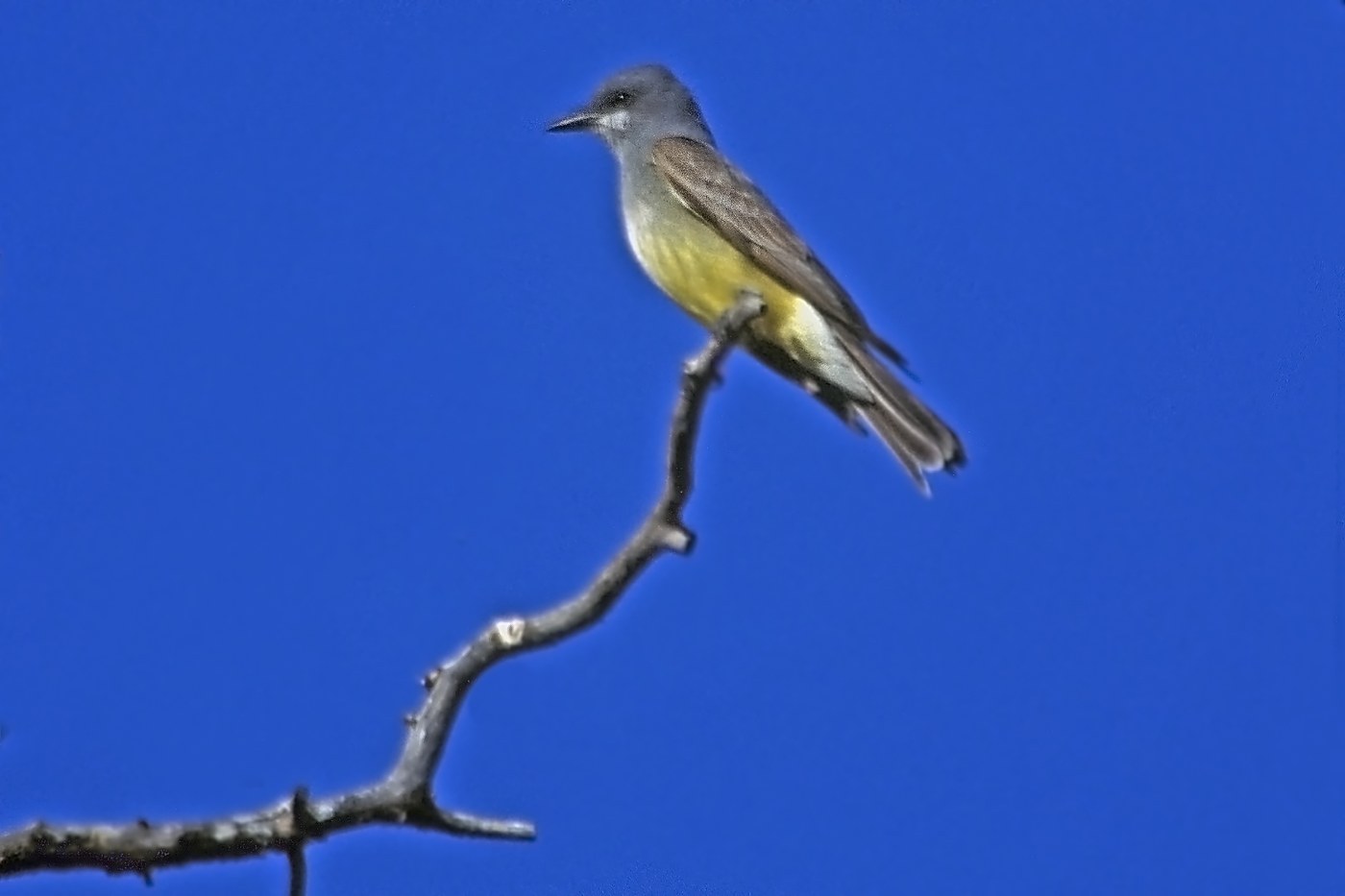
Key Field Marks
- Size & shape: A large, robust kingbird with a big head and heavy bill, one of the bulkier members of the Tyrannus genus.
- Plumage: Dark gray head and upper chest contrasting with a whitish chin/throat, olive-gray back, and pale yellow belly and undertail coverts.
- Tail: Blackish tail with a narrow white band across the tip (not along the edges), a key distinguishing feature from the very similar Western Kingbird.
- Behavior: Perches conspicuously on wires, fence posts, and treetops in open country, sallying out to catch flying insects; often noisy and aggressive toward other birds near its territory.
Separating It From Similar Species
- Western Kingbird shows a paler, more contrastingly gray head, a pale gray throat blending more smoothly into the chest, and critically has white outer tail edges running the length of the tail rather than a terminal white band.
- Tropical Kingbird and Couch's Kingbird have brighter olive-green backs, more deeply notched tails without white, and different, more twittering calls; ranges overlap only in limited areas of the extreme southwestern U.S. and Mexico.
- Overall, Cassin's Kingbird looks darker-headed and "dirtier" gray on the chest compared to the cleaner pale gray of Western Kingbird, and the white chin patch stands out more sharply against the darker chest.
Where & When to See It
- Habitat: Open oak woodland, savanna, ranchland, and scattered trees in arid and semi-arid country; also found around agricultural areas and rural development with scattered perches.
- Range: Breeds across the southwestern United States including California, Arizona, New Mexico, Texas, and north into parts of the Great Basin, extending south through Mexico's highlands.
- Season: A migratory breeder in most of its U.S. range, arriving in spring and departing in fall for wintering areas in Mexico and Central America; some populations in the southern part of the range are resident year-round.
Voice & Song Cues
- Gives a sharp, harsh "ka-brick" or "chi-bew" call, more abrupt and emphatic than the higher, thinner calls of Western Kingbird.
- Also produces an excited chattering series during territorial and courtship displays, often delivered from an exposed perch or in flight.
Frequently asked questions
What is the best field mark to separate Cassin's Kingbird from Western Kingbird?
Check the tail: Cassin's Kingbird has a blackish tail with a narrow white band at the very tip, while Western Kingbird has white running along the outer edges of the tail.
Does Cassin's Kingbird look darker than Western Kingbird?
Yes, Cassin's Kingbird has a darker gray head and chest with a sharply contrasting white chin patch, giving it a more hooded appearance than the paler, more uniformly gray Western Kingbird.
What habitat does Cassin's Kingbird prefer?
It favors open oak woodland, savanna, and ranchland with scattered trees and perches across the southwestern United States and Mexican highlands.
Is Cassin's Kingbird migratory?
Most populations migrate, breeding in the southwestern U.S. in summer and wintering in Mexico and Central America, though some southern populations remain resident year-round.