
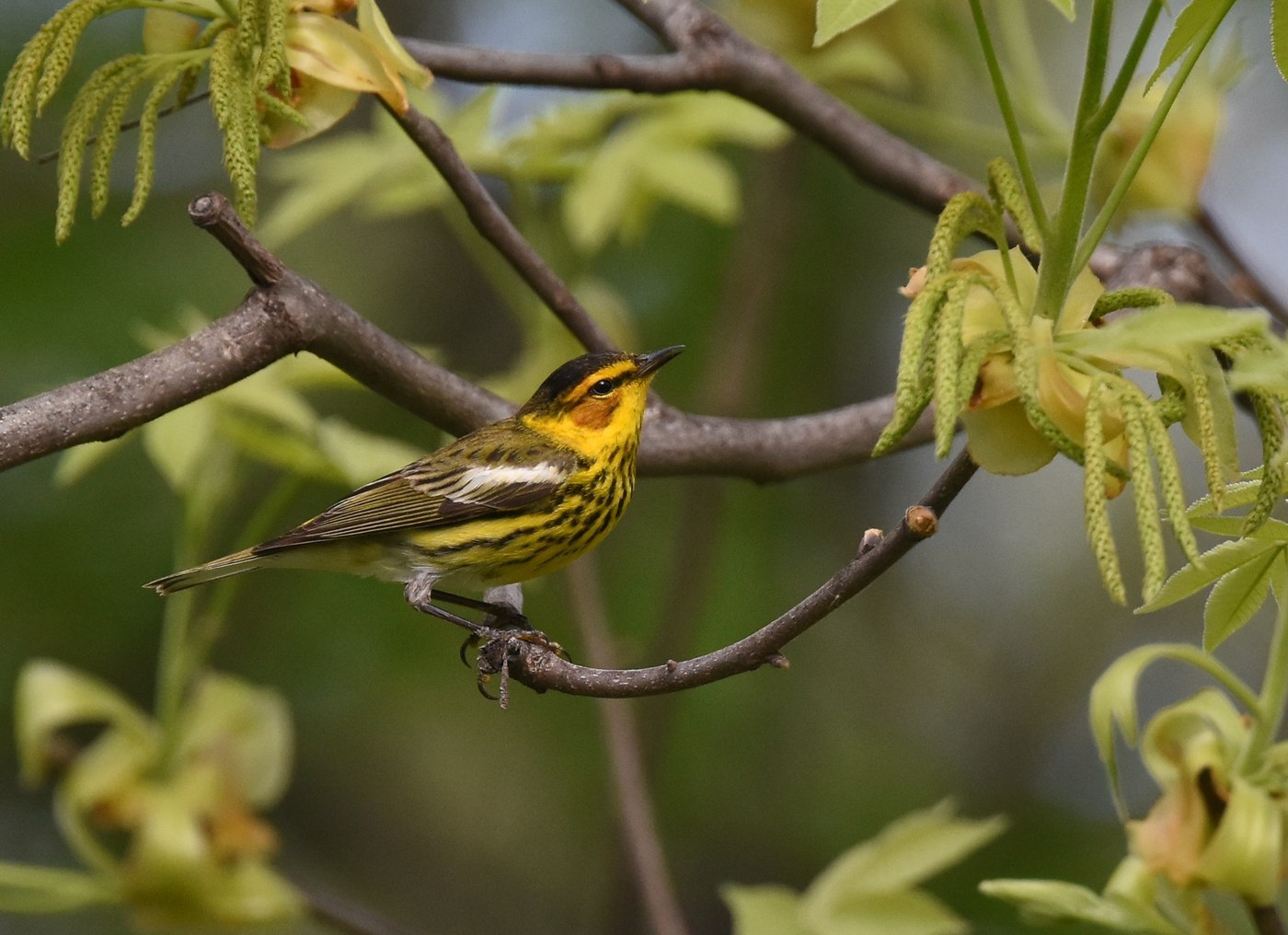
Cape May Warbler
Setophaga tigrina
A boldly patterned boreal warbler with a chestnut cheek patch and tiger-striped breast, whose populations boom and bust with spruce budworm outbreaks.
- Size
- 11-14 cm (4.3-5.5 in) long, 20-22 cm wingspan
- Habitat
- boreal spruce forest for breeding, closely tied to spruce budworm outbreaks; a variety of wooded and shrubby habitats in migration and winter
- Type
- songbird
Spotted a bird like this?
Identify any bird from a photo, free.
Overview
The Cape May Warbler is a striking, boldly marked warbler whose numbers are tightly linked to outbreaks of spruce budworm in the northern boreal forest. Breeding males show a rich chestnut cheek patch bordered by a dark crown and a bright yellow neck collar, with heavy black streaking (often called 'tiger stripes') across a yellow breast.
A distinctive thin, sharply pointed bill, slightly downcurved, is an adaptation shared with a few other nectar-feeding warblers, allowing this species to sip nectar and fruit juice on its wintering grounds. Females and immatures are much duller, grayish-olive with faint streaking and reduced or absent cheek patch coloring, making them considerably harder to identify than the vividly patterned males.
How to identify it
Key Field Marks
- Breeding male: chestnut cheek patch, dark crown, bright yellow neck collar
- Heavy black 'tiger stripe' streaking across a yellow breast
- Yellowish-green rump patch
- Thin, sharply pointed, slightly downcurved bill
- Female/immature: dull grayish-olive with faint streaking and little or no cheek patch color
Similar Species
Yellow-rumped Warbler also shows a yellow rump but lacks the chestnut cheek patch and has a bolder white wingbar pattern and different face pattern. Magnolia Warbler shows heavy breast streaking too but has a distinctive white-banded tail and gray crown rather than the Cape May's chestnut cheek. The thin, pointed bill is a useful mark separating Cape May from other streaked yellow warblers.
Habitat & range
Habitat
Cape May Warblers breed in boreal spruce forest, with breeding density and success closely tied to outbreaks of spruce budworm, a favored food source. In migration and winter, they use a wider variety of wooded and shrubby habitats, including gardens with flowering or fruiting plants.
Range
This species breeds across the boreal forest of Canada and a small portion of the northeastern United States. It winters mainly in the Caribbean, especially the Greater Antilles, with some birds reaching Central America.
Migration
Cape May Warblers are medium- to long-distance Neotropical migrants; breeding population size can fluctuate dramatically from year to year in response to spruce budworm outbreak cycles in the boreal forest.
Behavior & voice
Behavior
During the breeding season, Cape May Warblers forage high in spruce canopy, often specializing heavily on spruce budworm caterpillars when outbreaks occur. On its wintering grounds, it becomes notably more flexible, sipping nectar and fruit juice.
Voice
The song is a very high-pitched, thin, repeated series of single-note phrases, 'seet-seet-seet-seet,' similar in pitch to several other high-voiced warblers. The call is a thin, high 'seet.'
Feeding
It feeds heavily on spruce budworm caterpillars during outbreak years on the breeding grounds, and uses its thin, curved bill and unique semi-tubular tongue to sip nectar and fruit juice on wintering grounds in the Caribbean, a rare trait among warblers.
Nesting & Breeding
The female builds a well-hidden cup nest high in a spruce tree, usually near the very top, making nests extremely difficult to locate. She lays 4-9 eggs, with clutch size often larger during spruce budworm outbreak years when food is abundant.
Frequently asked questions
Why do Cape May Warbler populations fluctuate so much?
Their breeding success and abundance are closely tied to outbreaks of spruce budworm, a caterpillar that provides an abundant food source in the boreal forest; population numbers rise during outbreaks and fall as budworm populations crash.
How do you identify a male Cape May Warbler?
Look for a chestnut cheek patch, dark crown, bright yellow neck collar, and heavy black 'tiger stripe' streaking across a yellow breast.
What makes the Cape May Warbler's bill unusual?
It has a thin, sharply pointed, slightly downcurved bill and a semi-tubular tongue, adaptations that let it sip nectar and fruit juice on its Caribbean wintering grounds, a trait uncommon among warblers.
Where do Cape May Warblers spend the winter?
Most winter in the Caribbean, particularly the Greater Antilles, where they feed on nectar and fruit in addition to insects.
Where do Cape May Warblers nest?
They build well-hidden cup nests high near the top of spruce trees in the boreal forest, making nests very difficult for observers to find.
Cape May Warbler guides
In-depth guides for identifying, finding, and understanding Cape May Warbler.
Other birds you may enjoy

Black Redstart
13-14.5 cm (5.1-5.7 in) long, 23-26 cm wingspan

Black-throated Sparrow
12-14 cm (4.7-5.5 in) long, about 19-20 cm (7.5-8 in) wingspan

Greater Bird-of-paradise
Body about 43 cm; males with additional flank plumes up to 50 cm and long tail wires

Blue Tit
11-12 cm (4.3-4.7 in) long, 17-20 cm wingspan

Red-billed Quelea
11.5–13 cm long, wingspan about 20–22 cm
White-plumed Antbird
13-14 cm (5-5.5 in) long

Pyrrhuloxia
19-22 cm (7.5-8.7 in) long, 30 cm wingspan

Blue-gray Tanager
16-18 cm (6-7 in) long

Blackburnian Warbler
11-13 cm (4.3-5.1 in) long, 20-22 cm wingspan

Bluethroat
13-14 cm (5.1-5.5 in) long, 20-22 cm wingspan

Eurasian Nuthatch
12-14.5 cm (4.7-5.7 in) long, 22.5-27 cm wingspan

Wood Thrush
19-21 cm (7.5-8.3 in) long, about 33 cm (13 in) wingspan