
Cape May Warbler Identification Guide
A small North American wood-warbler known for the breeding male's tiger-striped yellow underparts and rusty cheek patch.
Read the full Cape May Warbler encyclopedia entry →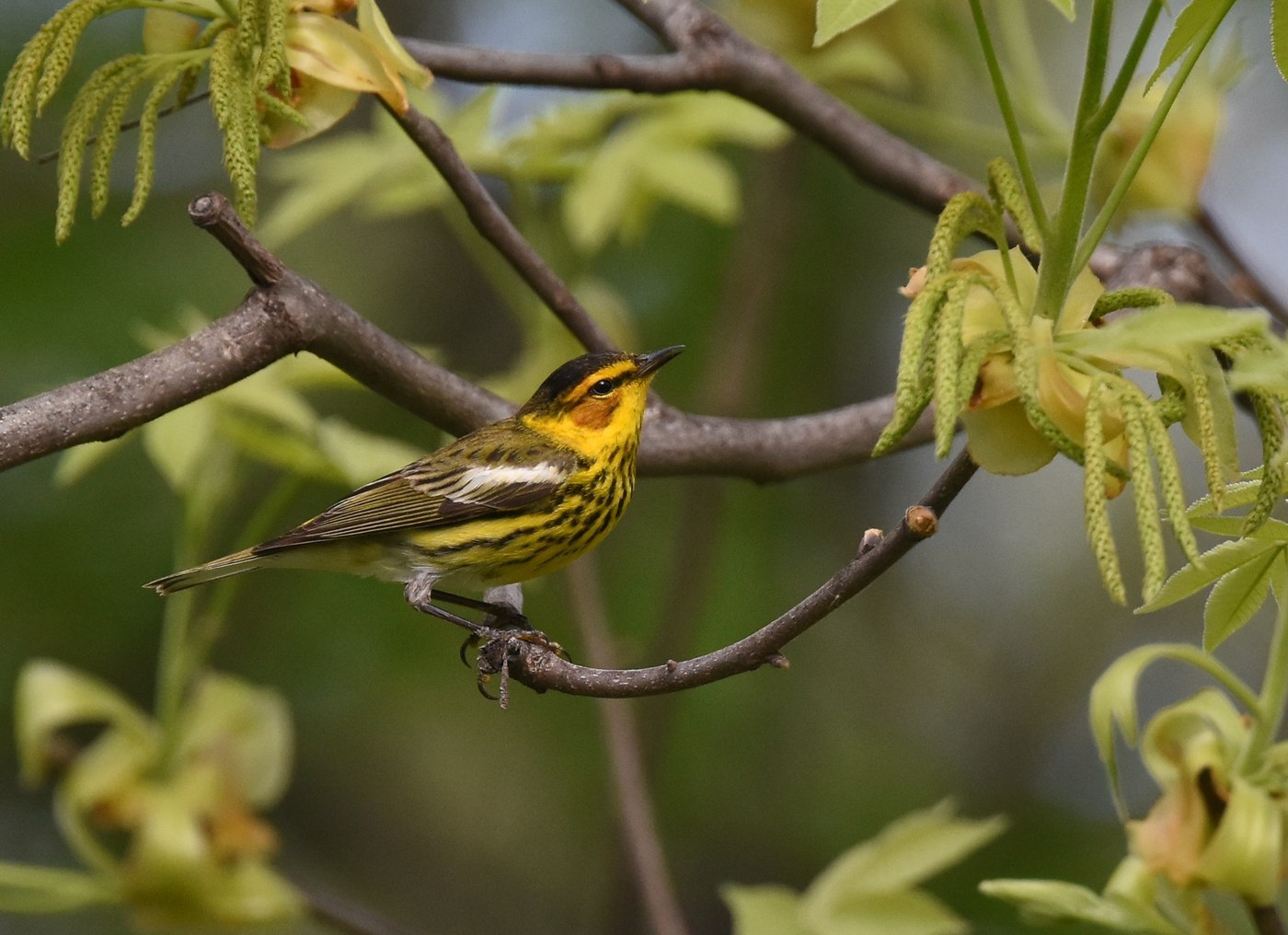
Key Field Marks
- Size & shape: A small, compact warbler with a fairly short tail and a notably thin, slightly downcurved bill, useful for its specialized nectar/insect feeding.
- Breeding male: Bright yellow underparts heavily streaked with black "tiger stripes," a distinctive chestnut-rust cheek patch bordered by yellow, an olive-yellow crown, and a bold white wing patch.
- Female and fall/immature: Much duller and grayer-olive overall, with faint streaking below, a pale yellowish neck patch, and thin white wing bars rather than a solid patch — one of the trickier fall warblers to identify.
- Behavior: Often forages high in conifers, sometimes hovering or probing flowers for nectar (aided by its unique semi-tubular tongue); joins mixed-species foraging flocks during migration.
Similar Species
- Yellow-rumped Warbler: Larger with a bright yellow rump patch, lacking Cape May's cheek patch or fine tiger-striping.
- Magnolia Warbler: Has bold black streaking and a distinctive tail pattern with white patches, plus a different face pattern without the rusty cheek.
- Palm Warbler: Constantly pumps its tail, has a rustier cap, and lacks the bold facial cheek patch of Cape May.
- Fall Cape May Warblers are best told from other dull fall warblers by the combination of a faint pale neck patch, thin streaking, and yellowish wash on the rump/underparts.
Where & When to See
Breeds in boreal spruce forest across Canada and the northern U.S., where its population closely tracks spruce budworm outbreaks. Migrates through the eastern and central U.S. in spring and fall, often stopping in flowering trees, ornamental shrubs, and gardens. Winters mainly in the Caribbean, where it frequents flowering trees for nectar. Best looked for during spring and fall migration away from the breeding range.
Voice
Song is a very high-pitched, thin, repeated "seet-seet-seet-seet," similar to several other high-pitched warbler songs and easy to overlook. Call note is a thin, sharp "tsip."
Frequently asked questions
What does a breeding male Cape May Warbler look like?
Bright yellow underparts with heavy black tiger-striping, a chestnut cheek patch, and a bold white wing patch.
How do you identify a fall or female Cape May Warbler?
Look for a duller olive-gray bird with faint streaking below, a pale yellowish patch on the side of the neck, and thin white wing bars — a challenging fall warbler best confirmed by this neck-patch combination.
Where does the Cape May Warbler breed?
In boreal spruce forests across Canada and the northern U.S., with numbers fluctuating alongside spruce budworm outbreaks, its primary food source.
Where do Cape May Warblers spend the winter?
Mainly in the Caribbean, where they feed on nectar from flowering trees using a specialized tongue.