
Canada Warbler
Cardellina canadensis
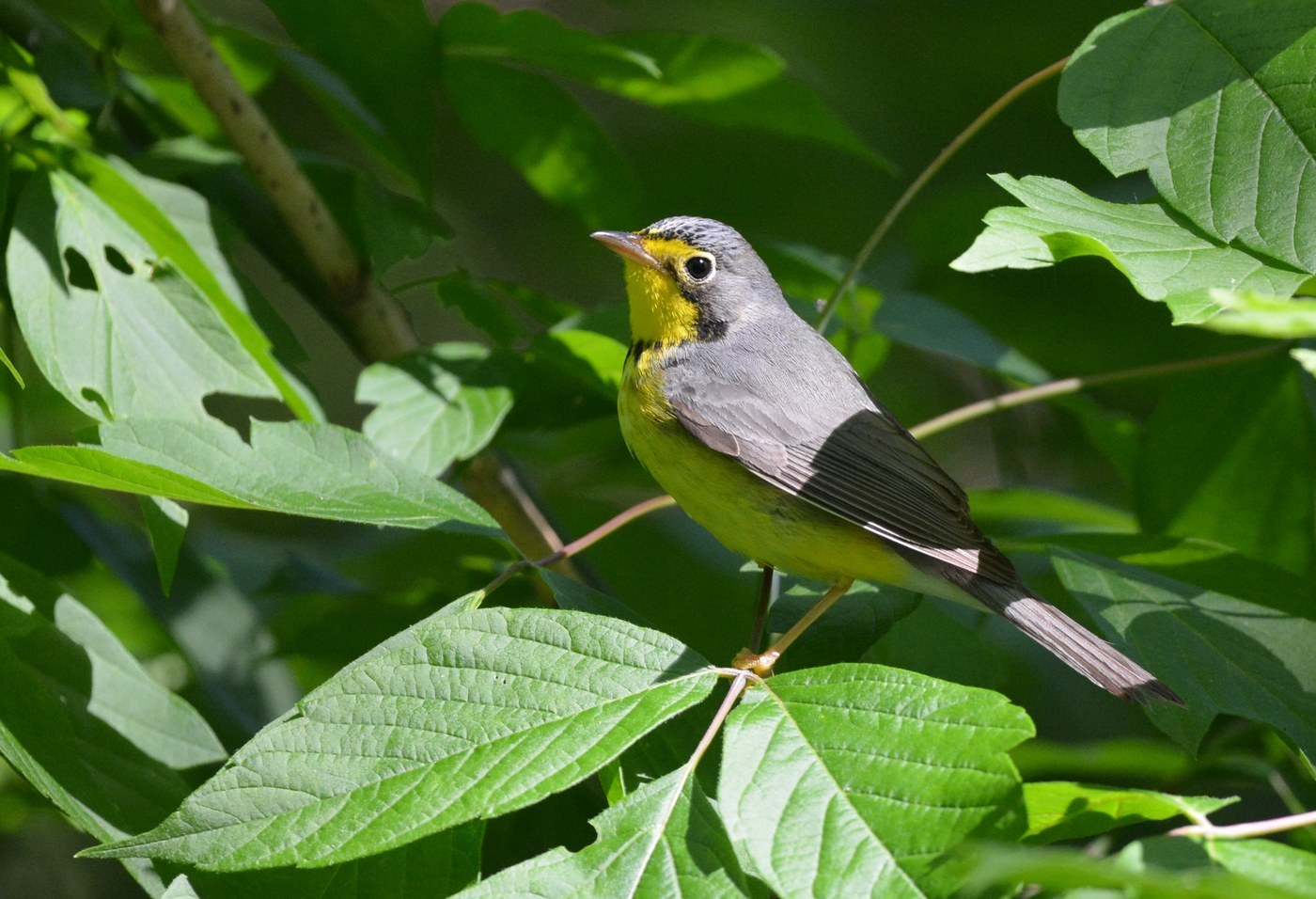
A slate-gray and yellow warbler notable for the bold necklace of black streaking across its breast and the yellow "spectacles" framing its eyes.
- Size
- 12-15 cm (4.7-5.9 in) long, 17-22 cm wingspan
- Habitat
- moist deciduous and mixed forest with dense shrub understory, boreal edges, and ravines
- Type
- songbird
Spotted a bird like this?
Identify any bird from a photo, free.
Overview
The Canada Warbler is an elegant, boldly patterned warbler that pairs blue-gray upperparts with bright yellow underparts. Its most distinctive feature is a dark "necklace" of streaks across the upper breast, bolder and more solidly black in males, finer and more diffuse in females, which gives the species one of its most memorable field marks among North American warblers.
A yellow eyering connected to yellow lores forms distinct "spectacles" around the dark eye, adding to the bird's alert, wide-eyed expression. Unlike many warblers, it shows no wingbars, relying instead on its clean color pattern and necklace for identification.
How to identify it
Key field marks
- Blue-gray, unstreaked upperparts
- Bright yellow throat and underparts
- Bold necklace of black streaking across the breast (heavier in males)
- Yellow spectacles formed by a yellow eyering and lores
- No wingbars
Similar species
No other regularly occurring warbler shows the combination of gray back, yellow underparts, and a necklace of black streaking, making adult males essentially unmistakable. Females and immatures with a faint necklace can suggest Magnolia Warbler, but Magnolia shows white in the tail, wingbars, and a different overall pattern including a white eye-arc rather than a full spectacle.
Habitat & range
Canada Warblers breed across the boreal and northern hardwood forests of Canada and the northeastern and north-central United States, extending south along the Appalachians, favoring cool, moist forest with a dense shrub layer, often near streams, seepages, bogs, or in mixed forest with a tangled understory.
They are long-distance migrants, wintering in the foothills and lower slopes of the Andes in northern South America, and are among the latest spring arrivals and earliest fall departures of any North American warbler, spending a comparatively short time on the breeding grounds.
Behavior & voice
Behavior and voice
Canada Warblers forage actively in dense understory and lower canopy, gleaning insects from foliage and frequently sallying out to catch flying insects in mid-air.
The song is loud and variable, typically beginning with a sharp, single chip note followed by a jumbled, rich, and musical burst of notes, often described as sounding excited or hurried.
Nesting
Nests are built low, often on or near the ground in a mossy hummock, upturned root, or dense shrub base, and consist of a cup of leaves, bark, and moss. Clutches typically hold 3-5 eggs. The species has experienced significant population declines linked to loss of breeding and wintering forest habitat.
Frequently asked questions
What is the black "necklace" on a Canada Warbler?
It is a band of dark streaking across the upper breast, bold and blackish in males and finer and more diffuse in females, forming a distinctive necklace pattern unique among regularly occurring warblers.
Where do Canada Warblers spend the winter?
They migrate long distances to winter in the foothill and lower montane forests of the Andes in northern South America.
Why are Canada Warblers considered a conservation concern?
Populations have declined significantly in recent decades, largely due to loss and degradation of the moist forest understory habitat they need for both breeding and wintering.
What does a Canada Warbler's song sound like?
It typically starts with a sharp chip note followed by a rich, jumbled, musical burst of notes delivered in a hurried, excited-sounding manner.
How do you identify a female Canada Warbler?
Females share the gray back, yellow underparts, and yellow spectacles of males, but their breast necklace is fainter and less distinctly streaked.
Canada Warbler guides
In-depth guides for identifying, finding, and understanding Canada Warbler.
Other birds you may enjoy

Black Redstart
13-14.5 cm (5.1-5.7 in) long, 23-26 cm wingspan

Black-throated Sparrow
12-14 cm (4.7-5.5 in) long, about 19-20 cm (7.5-8 in) wingspan

Greater Bird-of-paradise
Body about 43 cm; males with additional flank plumes up to 50 cm and long tail wires

Blue Tit
11-12 cm (4.3-4.7 in) long, 17-20 cm wingspan

Red-billed Quelea
11.5–13 cm long, wingspan about 20–22 cm
White-plumed Antbird
13-14 cm (5-5.5 in) long

Pyrrhuloxia
19-22 cm (7.5-8.7 in) long, 30 cm wingspan

Blue-gray Tanager
16-18 cm (6-7 in) long

Blackburnian Warbler
11-13 cm (4.3-5.1 in) long, 20-22 cm wingspan

Bluethroat
13-14 cm (5.1-5.5 in) long, 20-22 cm wingspan

Eurasian Nuthatch
12-14.5 cm (4.7-5.7 in) long, 22.5-27 cm wingspan

Wood Thrush
19-21 cm (7.5-8.3 in) long, about 33 cm (13 in) wingspan