
Canada Warbler Identification Guide
A boldly patterned wood warbler of northern forest understory, identified by its slate-gray back, yellow underparts, bright white eyering, and a distinctive black "necklace" of streaks across the breast.
Read the full Canada Warbler encyclopedia entry →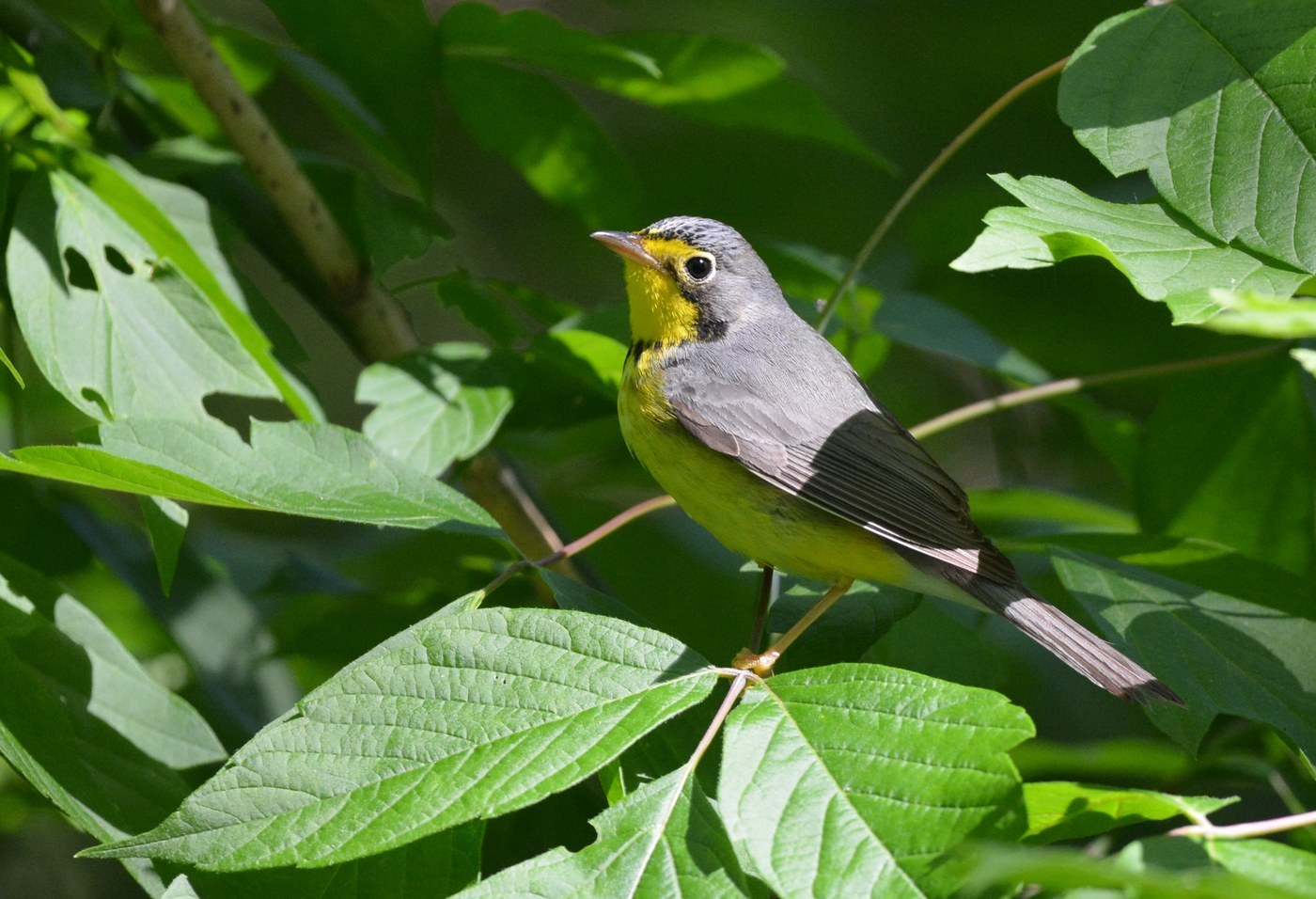
Key Field Marks
- Size & shape: Medium-sized warbler, about 5-5.5 inches, with a fairly long tail often flicked or cocked, and an active, restless foraging style low in vegetation.
- Male plumage: Clean slate-gray upperparts contrast with bright yellow underparts; the standout feature is a necklace of bold black streaks forming a broken band across the upper breast.
- Face: Bold white or yellow-white eyering ("spectacles") set against a gray face, with a yellow line from the bill to the eye, giving an alert, spectacled expression.
- Female/immature plumage: Similar pattern but duller and grayer, with a fainter, more diffuse necklace of streaking rather than bold black markings.
- Legs: Pale pinkish legs, visible as the bird hops and flits through low branches.
Separating from Similar Species
- Magnolia Warbler: Also yellow below with dark streaking, but shows bold white wing bars, a white tail band, and a different face pattern with a dark mask, lacking Canada Warbler's clean gray back and bold eyering.
- Kentucky Warbler: Yellow below with a yellow (not white) eye-ring/spectacles and black on the face rather than a necklace across the breast, plus an olive-green (not gray) back.
- Canada Warbler vs. Cape May Warbler (fall): Cape May shows yellow rump patch and streaked back, both absent in Canada Warbler's plain gray back.
- Overall: The unique combination of a plain gray back, unmarked yellow throat leading into a necklace of streaks, and a bold white eyering separates Canada Warbler from all similarly yellow-and-gray warblers.
Where & When to See It
- Habitat: Breeds in cool, moist deciduous and mixed forest with a dense shrubby understory, often near streams, bogs, or ravines; during migration uses a wider variety of woodland with good understory cover.
- Range: Breeds across the boreal and northern hardwood forest of Canada, the Great Lakes region, New England, and south through the Appalachian Mountains; winters in the understory of tropical forest in northern South America (primarily the Andean foothills).
- Season: One of the latest-arriving warblers in spring and among the earliest to depart in fall, present on breeding grounds roughly late May through August; migrates through the eastern U.S. in May and again August-September.
Voice & Song Cues
- Song is a variable, snappy, and somewhat chaotic-sounding burst of clear notes, often likened to an excited, jumbled outburst, frequently beginning with a sharp chip note.
- Call note is a sharp, distinctive chip, useful for locating birds foraging low in dense understory where they can be hard to see.
Frequently asked questions
What is the key field mark for a Canada Warbler?
Look for a slate-gray back, bright yellow underparts, a bold white eyering, and a necklace of black streaks across the upper breast - most distinct in adult males.
How do you tell a male from a female Canada Warbler?
Males show a bold, crisp black necklace of streaking on a bright yellow breast, while females and immatures show a fainter, more diffuse, grayish necklace and slightly duller overall coloring.
How is Canada Warbler different from Magnolia Warbler?
Canada Warbler has a plain gray back with no wing bars and a necklace of streaking, while Magnolia Warbler shows bold white wing bars, a white tail band, and a different, more masked face pattern.
Where does the Canada Warbler breed and winter?
It breeds in cool, shrubby forest understory across Canada, the Great Lakes, New England, and the Appalachians, and winters in tropical forest understory in the Andean foothills of northern South America.
What does a Canada Warbler sound like?
Its song is a lively, somewhat jumbled burst of clear, snappy notes, often starting with a sharp chip, quite different from the more measured, repetitive songs of many other warblers.