
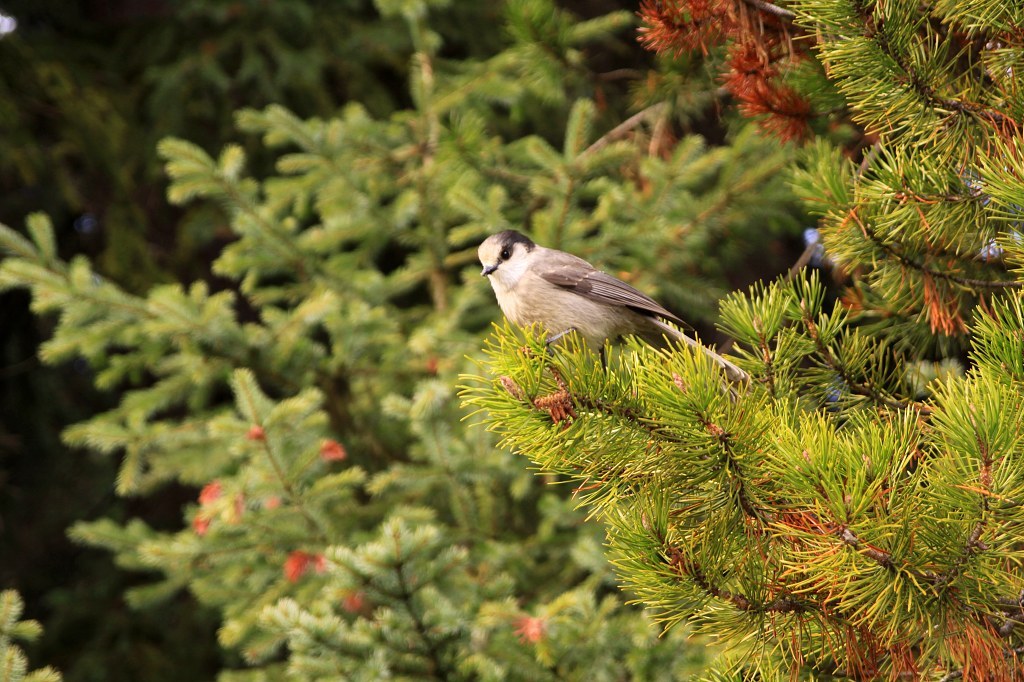
Canada Jay
Perisoreus canadensis
The official current name for the Gray Jay, a fluffy, remarkably tame boreal-forest corvid famous for hoarding food and visiting campsites.
- Size
- 25-33 cm (10-13 in) long, 45 cm wingspan
- Habitat
- boreal and subalpine coniferous forests of Canada, Alaska, and the northern United States
- Type
- songbird
Spotted a bird like this?
Identify any bird from a photo, free.
Overview
The Canada Jay, formerly and still sometimes called the Gray Jay, is a soft-plumaged corvid of Canada's boreal forest and adjoining high-elevation and northern woodlands in the United States. It has pale gray underparts, darker gray upperparts, a whitish face and forehead, and a dark gray-black cap across the nape, with no crest or bright colors.
In 2018 the American Ornithological Society officially adopted 'Canada Jay' as the standard English name, both restoring an older historical name and reflecting the species' status as an unofficial national bird candidate for Canada, given its resident presence across nearly every Canadian province and territory.
How to identify it
Key Field Marks
- Soft, fluffy pale gray plumage overall
- Whitish forehead and face
- Dark gray-blackish patch across the nape and back of the crown
- No crest, no blue coloring
- Short, stout bill
Similar Species
- Clark's Nutcracker is larger with a longer, sharper bill and a bold black-and-white wing and tail pattern.
- Northern Shrike shows a black facial mask and hooked bill, unlike the plain-faced Canada Jay.
Habitat & range
Habitat
Canada Jays inhabit boreal coniferous forest, especially spruce and fir stands, as well as subalpine forest at higher elevations in the southern portions of their range.
Range
Found across the boreal forest of essentially all of Canada and Alaska, extending south into the mountains of the western United States, the upper Great Lakes region, and northern New England.
Migration
This species is entirely non-migratory, remaining resident on the same territory throughout the year, including the harshest winter months.
Behavior & voice
Behavior
Canada Jays are famously tame and curious, often approaching hikers and campers closely, sometimes taking food directly from an outstretched hand. Throughout warmer months, they cache enormous amounts of food by sticking items to bark and branches with sticky saliva, a critical strategy for surviving the long boreal winter.
Voice
Calls include soft whistles, clicks, and chuckling notes, along with harsher scolding calls when alarmed; overall quieter and less harsh-voiced than many other jays.
Feeding
Diet is broad and includes insects, berries, fungi, carrion, small vertebrates, and food retrieved from caches established earlier in the year.
Nesting
Pairs nest unusually early, sometimes in late winter with snow still on the ground, building a dense, well-insulated stick nest in a conifer; both parents incubate the 2-5 pale gray, spotted eggs.
Frequently asked questions
Why was the Gray Jay renamed Canada Jay?
In 2018 the American Ornithological Society officially adopted 'Canada Jay' as the standard name, restoring a historical name for a species found in nearly every Canadian province and territory.
Are Gray Jay and Canada Jay the same species?
Yes, they refer to the exact same species, Perisoreus canadensis; both names remain in common use.
Where does the Canada Jay live?
It lives in boreal and subalpine coniferous forest across Canada, Alaska, and parts of the northern United States.
Why is the Canada Jay so tame around humans?
It has adapted to associate humans with food opportunities, often approaching campsites closely and sometimes taking food from hands.
Canada Jay guides
In-depth guides for identifying, finding, and understanding Canada Jay.
Other birds you may enjoy

Black Redstart
13-14.5 cm (5.1-5.7 in) long, 23-26 cm wingspan

Black-throated Sparrow
12-14 cm (4.7-5.5 in) long, about 19-20 cm (7.5-8 in) wingspan

Greater Bird-of-paradise
Body about 43 cm; males with additional flank plumes up to 50 cm and long tail wires

Blue Tit
11-12 cm (4.3-4.7 in) long, 17-20 cm wingspan

Red-billed Quelea
11.5–13 cm long, wingspan about 20–22 cm
White-plumed Antbird
13-14 cm (5-5.5 in) long

Pyrrhuloxia
19-22 cm (7.5-8.7 in) long, 30 cm wingspan

Blue-gray Tanager
16-18 cm (6-7 in) long

Blackburnian Warbler
11-13 cm (4.3-5.1 in) long, 20-22 cm wingspan

Bluethroat
13-14 cm (5.1-5.5 in) long, 20-22 cm wingspan

Eurasian Nuthatch
12-14.5 cm (4.7-5.7 in) long, 22.5-27 cm wingspan

Wood Thrush
19-21 cm (7.5-8.3 in) long, about 33 cm (13 in) wingspan