
Canada Jay Identification Guide
A fluffy, crestless gray jay of northern boreal forest, famed for its tameness around people and its habit of caching food year-round to survive harsh winters.
Read the full Canada Jay encyclopedia entry →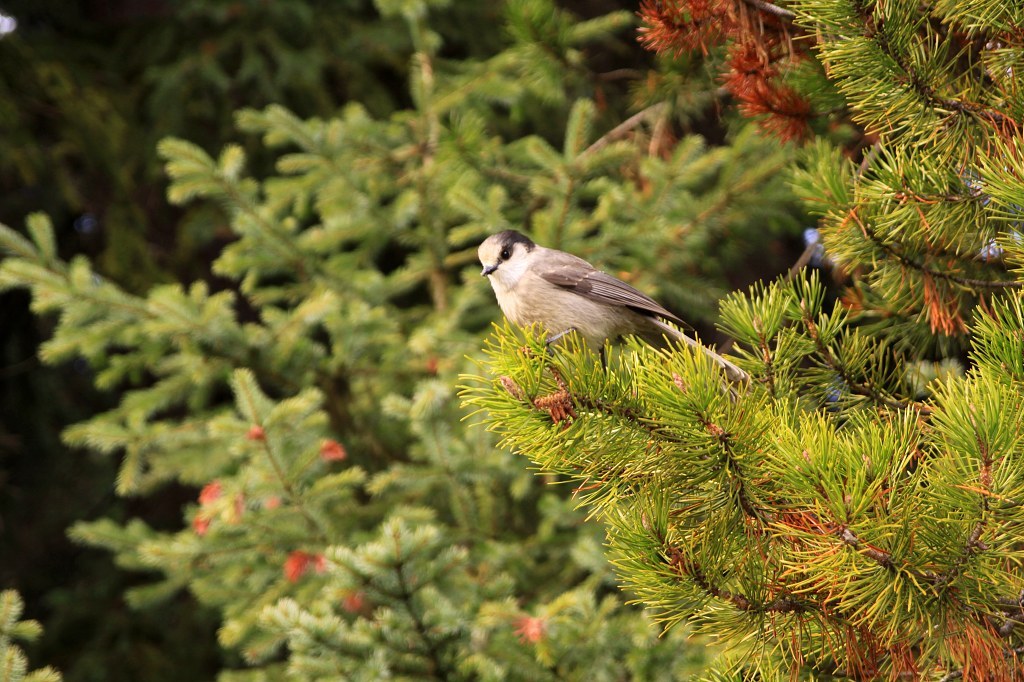
Key Field Marks
- Size & shape: Medium-sized jay, about 11-13 inches long, with a small bill, rounded head, and notably soft, fluffy-looking plumage that gives it a puffball appearance, especially in cold weather.
- Plumage: Overall pale gray body with a whitish forehead, throat, and underparts, and a darker gray-black nape and hindcrown forming a partial hood - no crest is present.
- Wings and tail: Uniform gray wings and a long gray tail, often tipped whitish.
- Juveniles: Sooty dark gray overall, quite different from the pale adult, retained through the first summer before molting into adult-like plumage.
- Behavior: Famously tame and curious, often approaching campsites, picnic areas, and hikers closely; flies with slow, silent, gliding wingbeats between trees.
Separating from Similar Species
- Clark's Nutcracker: Overlaps in similar high-elevation/northern habitat but is larger, has a long, sharp bill, and shows bold black-and-white wings and tail, quite different from the plain gray Canada Jay.
- Northern Shrike: Superficially gray-and-white but has a hooked, hawk-like bill, a black mask through the eye, and black wings, unlike the soft, uniformly gray-headed look of a Canada Jay.
- Mockingbird (range overlap in some areas): Slimmer, longer-tailed, with bold white wing patches in flight, and lacks the fluffy, hooded look of Canada Jay.
- Overall: No other northern forest bird combines the fluffy gray body, whitish face, and dark cap/nape of the Canada Jay, making it fairly easy to identify once seen well.
Where & When to See It
- Habitat: Boreal and subalpine coniferous forest, particularly spruce-fir stands; found at higher elevations in the southern part of its range.
- Range: Resident across the boreal forest belt of Canada and Alaska, extending south into the northern Rockies, Cascades, Sierra Nevada, and northern New England/Great Lakes states.
- Season: Present year-round; non-migratory, and one of the few songbirds that breeds in late winter (often February-March) while snow still covers the ground, relying on cached food stores.
Voice & Song Cues
- Vocalizations are varied and include soft whistled notes, chuckles, and harsher scolding calls, generally quieter and less harsh than typical jays.
- Pairs and family groups often call softly to stay in contact while foraging through the forest, and birds may approach silently before vocalizing.
Frequently asked questions
What is the key field mark for a Canada Jay?
Look for a fluffy, crestless gray jay with a whitish face and throat and a darker gray-black cap and nape, typically seen in northern conifer forest and often remarkably tame around people.
Was the Canada Jay formerly called something else?
Yes, it was long known as the Gray Jay (and sometimes 'whiskey jack' or 'camp robber') before its official English name reverted to Canada Jay in 2018.
Why is the Canada Jay so tame?
It has a long history of foraging around human camps and cabins in the boreal forest, and its year-round caching strategy makes it bold about investigating any available food source, including from hikers and campers.
How do you tell a Canada Jay from Clark's Nutcracker?
Canada Jay is plain soft gray with no bold wing or tail markings, while Clark's Nutcracker is larger with a long sharp bill and bold black-and-white wings and tail.
When does the Canada Jay nest?
Unusually early - often in February or March while snow still covers the ground - relying on food it cached the previous summer and fall to feed its young.