
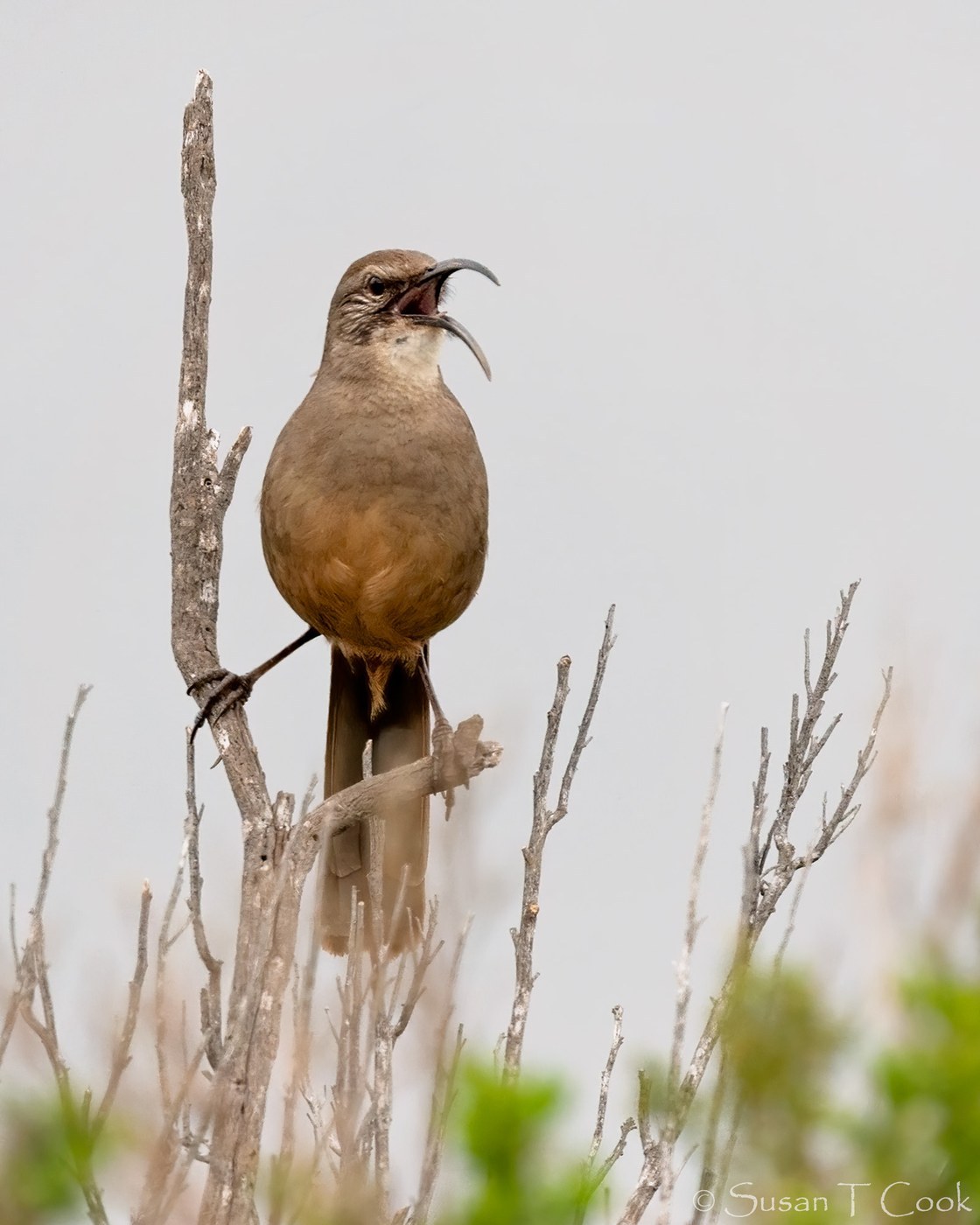
California Thrasher
Toxostoma redivivum
A large, dark, long-billed thrasher endemic to California chaparral, more often heard singing than seen in its dense scrub habitat.
- Size
- 28-33 cm (11-13 in) long
- Habitat
- dense chaparral and coastal scrub
- Type
- songbird
Spotted a bird like this?
Identify any bird from a photo, free.
Overview
The California Thrasher is a large, dark thrasher essentially endemic to the state for which it is named, closely tied to the dense chaparral that blankets many of California's hillsides. It has one of the longest, most strongly downcurved bills of any North American thrasher, an adaptation for probing deeply into soil and leaf litter beneath thick scrub.
Plumage is a fairly uniform dark grayish-brown above, with a pale buffy throat set off by a dark malar (mustache) stripe, and unstreaked warm buffy underparts. The bird is often secretive within the tangled chaparral but reveals itself with a loud, melodious song delivered from an open perch.
How to identify it
Key field marks
- Very long, strongly downcurved bill
- Dark grayish-brown upperparts
- Pale buffy throat contrasting with a dark malar stripe
- Long tail, often held cocked
- Unstreaked underparts
Similar species
Crissal Thrasher is similar in shape and unstreaked underparts but is paler overall and shows a chestnut undertail patch, with limited range overlap mainly in southeastern California deserts, whereas California Thrasher favors coastal and foothill chaparral. Le Conte's Thrasher is much paler and sandy-colored, found in more open desert habitat.
Habitat & range
Habitat
California Thrashers are closely associated with dense chaparral and coastal sage scrub, favoring thick, continuous stands of shrubs on foothills and coastal slopes.
Range
The species is essentially endemic to California, found through much of the coastal ranges, foothills, and interior valleys of the state, with a small extension into northern Baja California, Mexico.
Migration
California Thrashers are non-migratory, remaining on territory year-round within their chaparral habitat.
Behavior & voice
Behavior
California Thrashers forage on the ground, using their long bills to dig and sweep through leaf litter and soil for insects and other invertebrates, and also eat berries and other fruit; they typically stay low and hidden within dense chaparral.
Voice
The song is loud, melodious, and highly varied, often incorporating mimicry of other birds, delivered from an exposed perch atop the chaparral, particularly in the early breeding season.
Nesting
Nests are built low within dense shrubs, constructed as a bulky cup of twigs lined with finer material. Females lay 2-4 pale blue-green eggs, and pairs often remain together on the same territory year after year.
Frequently asked questions
Where is the California Thrasher found?
It is essentially endemic to California, occurring in dense chaparral and coastal scrub through much of the state's coastal ranges and foothills, with a small range extension into northern Baja California.
How do you identify a California Thrasher?
Look for a large, dark grayish-brown thrasher with a very long, strongly downcurved bill, a pale buffy throat, and a dark malar stripe.
Does the California Thrasher migrate?
No, it is a non-migratory resident that stays on its chaparral territory year-round.
What does a California Thrasher eat?
It eats insects and other invertebrates dug from soil and leaf litter, along with berries and other fruit.
California Thrasher guides
In-depth guides for identifying, finding, and understanding California Thrasher.
Other birds you may enjoy

Black Redstart
13-14.5 cm (5.1-5.7 in) long, 23-26 cm wingspan

Black-throated Sparrow
12-14 cm (4.7-5.5 in) long, about 19-20 cm (7.5-8 in) wingspan

Greater Bird-of-paradise
Body about 43 cm; males with additional flank plumes up to 50 cm and long tail wires

Blue Tit
11-12 cm (4.3-4.7 in) long, 17-20 cm wingspan

Red-billed Quelea
11.5–13 cm long, wingspan about 20–22 cm
White-plumed Antbird
13-14 cm (5-5.5 in) long

Pyrrhuloxia
19-22 cm (7.5-8.7 in) long, 30 cm wingspan

Blue-gray Tanager
16-18 cm (6-7 in) long

Blackburnian Warbler
11-13 cm (4.3-5.1 in) long, 20-22 cm wingspan

Bluethroat
13-14 cm (5.1-5.5 in) long, 20-22 cm wingspan

Eurasian Nuthatch
12-14.5 cm (4.7-5.7 in) long, 22.5-27 cm wingspan

Wood Thrush
19-21 cm (7.5-8.3 in) long, about 33 cm (13 in) wingspan