
California Thrasher Identification Guide
A large, dark, long-tailed thrasher with a dramatically curved bill, a chaparral specialist that is more often heard singing from cover than seen in the open.
Read the full California Thrasher encyclopedia entry →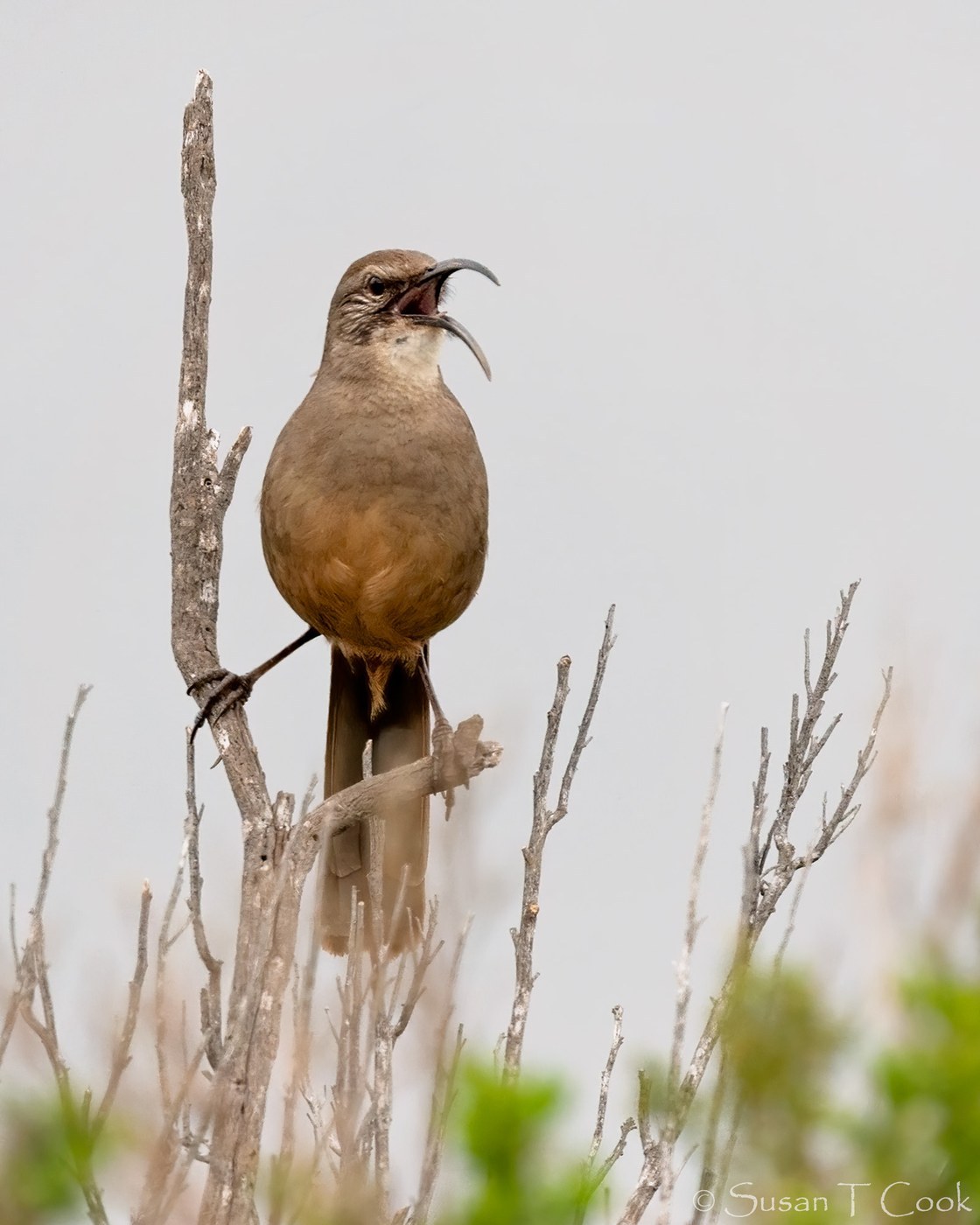
Key Field Marks
- Size & shape: Large thrasher, about 11-12.5 inches long, with a long tail, sturdy legs, and an unusually long, strongly downcurved bill - one of the most curved bills of any North American songbird.
- Plumage: Uniformly dark grayish-brown to olive-brown above and below, with a slightly paler, buffy throat and belly; overall plumage looks plain and unpatterned compared to spotted thrashers elsewhere in North America.
- Face: Pale eyebrow stripe and a dark eye-line give a subtly marked face, with a pale malar (mustache) stripe bordering the throat.
- Tail: Long and dark, often held cocked upward or trailed low as the bird moves through dense brush.
- Behavior: Skulking and secretive, spending most of its time on or near the ground under dense chaparral, using its long bill to dig and sweep through leaf litter for insects.
Separating from Similar Species
- Crissal Thrasher: Very similar overall shape and curved bill, but has a rustier (chestnut) undertail and a grayer body, and occurs in desert wash habitat rather than coastal chaparral, with minimal range overlap.
- LeConte's Thrasher: Paler, sandy-gray overall (not dark brown), found in open desert flats rather than dense chaparral.
- California Towhee: Smaller, shorter-tailed, with a short conical (finch-like) bill rather than a long curved bill, and lacks the thrasher's skulking, ground-sweeping foraging style.
- Overall: The combination of very dark, unstreaked plumage and an extremely long, curved bill is unique among West Coast chaparral birds.
Where & When to See It
- Habitat: Dense chaparral, coastal sage scrub, and brushy foothill canyons; strongly tied to unbroken shrub cover.
- Range: Resident (non-migratory) along the California coast and coastal ranges from northern California south into northern Baja California.
- Season: Present year-round; singing activity peaks in late winter through spring when males proclaim territory from an exposed shrub top, one of the few times the species is easily seen.
Voice & Song Cues
- Song is a long, varied series of musical phrases, often repeating individual notes once or twice before moving to the next phrase, similar in style to other mimid thrashers and mockingbirds but with richer, throatier notes.
- Calls include a sharp, whistled chuck or check note given from cover, often the only sign of a bird's presence deep in dense brush.
Frequently asked questions
What makes a California Thrasher easy to identify?
Its very long, strongly downcurved bill combined with plain, unstreaked dark brown plumage and a long tail are the key marks, especially in coastal chaparral habitat.
How do you tell a California Thrasher from a Crissal Thrasher?
California Thrasher is darker brown overall and lives in coastal chaparral, while Crissal Thrasher is grayer with a rusty undertail and lives in desert wash habitat; their ranges rarely overlap.
Is the California Thrasher easy to see?
Not usually - it is a skulking bird that stays low in dense brush; it is most visible when males sing from an exposed perch in late winter and spring.
What does a California Thrasher sound like?
It sings a long, varied, musical song with phrases often repeated once or twice, similar to a mockingbird but with richer, throatier notes.
Where do California Thrashers live?
They are year-round residents of dense chaparral and coastal sage scrub along the California coast and coastal ranges into northern Baja California.